
MasBrowser
Customer supportLoading messages…
Loading messages…
You are viewing a previous conversation.
Enter to send · Shift + Enter for a new line
Loading messages…
You are viewing a previous conversation.
Enter to send · Shift + Enter for a new line
Getting clean, structured ecommerce product data into your pipeline is a solved problem in 2026, as long as you pick the right abstraction layer. The mistake most teams make is defaulting to "build a scraper" before checking whether the data already exists in a consumable form, or whether a provider's API will hand it back as typed JSON without any parser logic on your end.
"Structured" means more than just valid JSON. It means normalized fields: product_id, title, brand, variants, offers (with price, currency, and availability), images, category breadcrumbs, and a scraped_at timestamp. That's what downstream BI tools and AI agents actually need, and it's very different from a blob of raw HTML or even a loosely shaped object with inconsistent keys.
Two acquisition paths cover 95% of use cases: (a) query a pre-collected dataset or data feed, or (b) call a structured product data API that does the extraction and typing on the provider's side. The list below maps each method to the exact situation where it saves the most engineering time.
If your use case is repeatable, daily price monitoring, catalog enrichment, competitive benchmarking, the fastest path is querying a provider's inventory of already-collected records. No crawler to run, no browser to spin up, no anti-bot battle to fight.
Bright Data's Dataset Marketplace is the most complete option here. It holds billions of records across hundreds of ecommerce domains, delivered in JSON, CSV, or Parquet, with configurable delivery via API or webhook. For teams that need data feeds refreshed on a defined cadence rather than ad-hoc lookups, this is the zero-maintenance path.
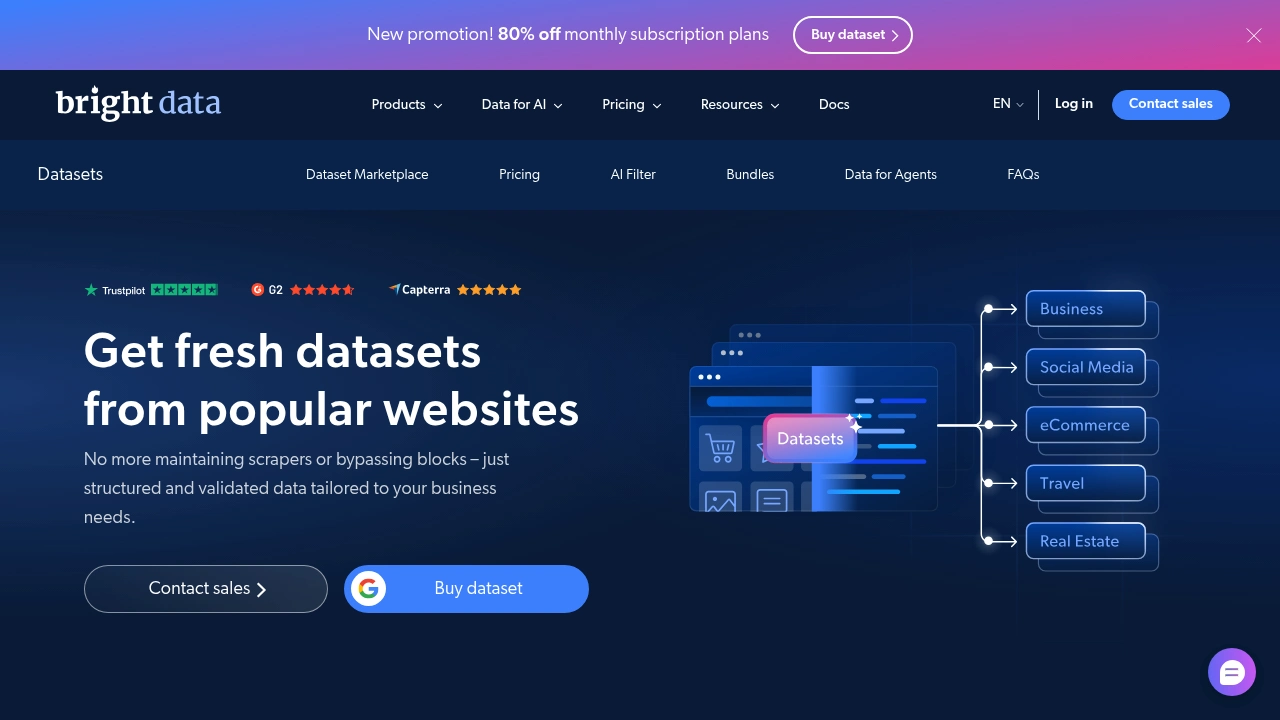
What to evaluate: update cadence (hourly vs. daily vs. batch), historical availability, marketplace/domain coverage, and whether the provider validates fields before delivery.
When you need current data for a specific product URL, ASIN, or SKU, not a batch from yesterday, a structured product data API is the right call. You pass the URL; the provider returns a typed JSON object with product fields already mapped.
Oxylabs' E-Commerce Scraper API does this for major retailers. Zyte markets its equivalent as the "Ecommerce Web Scraping - Product Scraper API." Both replace hand-written CSS selectors with provider-side extraction logic, which means your pipeline doesn't break when a retailer redesigns their PDP.
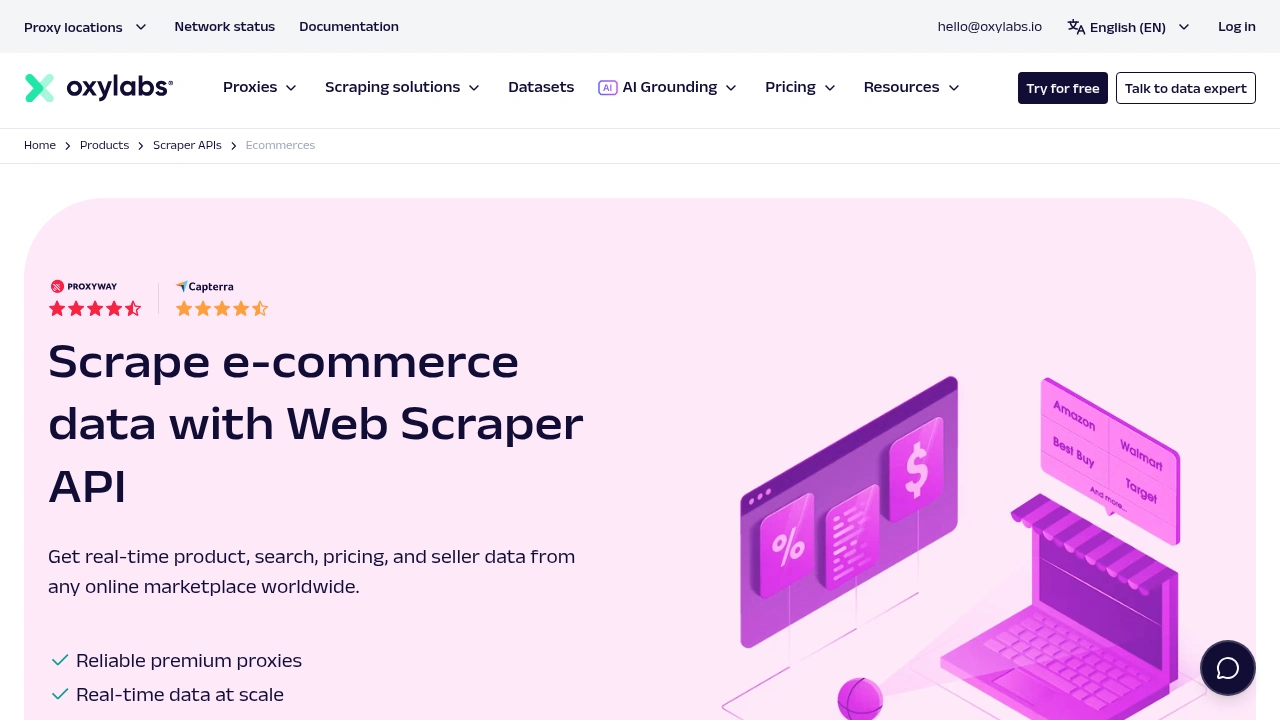
Verify before you commit: does the API support listing pages as well as product detail pages? Does it map variants (size/color/SKU) into structured sub-objects? What's the documented success rate on JS-heavy retailers?
Shopify storefronts and other JS-heavy sites break DOM-based scrapers regularly. Zyte's "Automatic extraction" endpoint, documented in their API docs, uses AI-powered extraction to detect page type and return structured product data without requiring a fixed selector map.
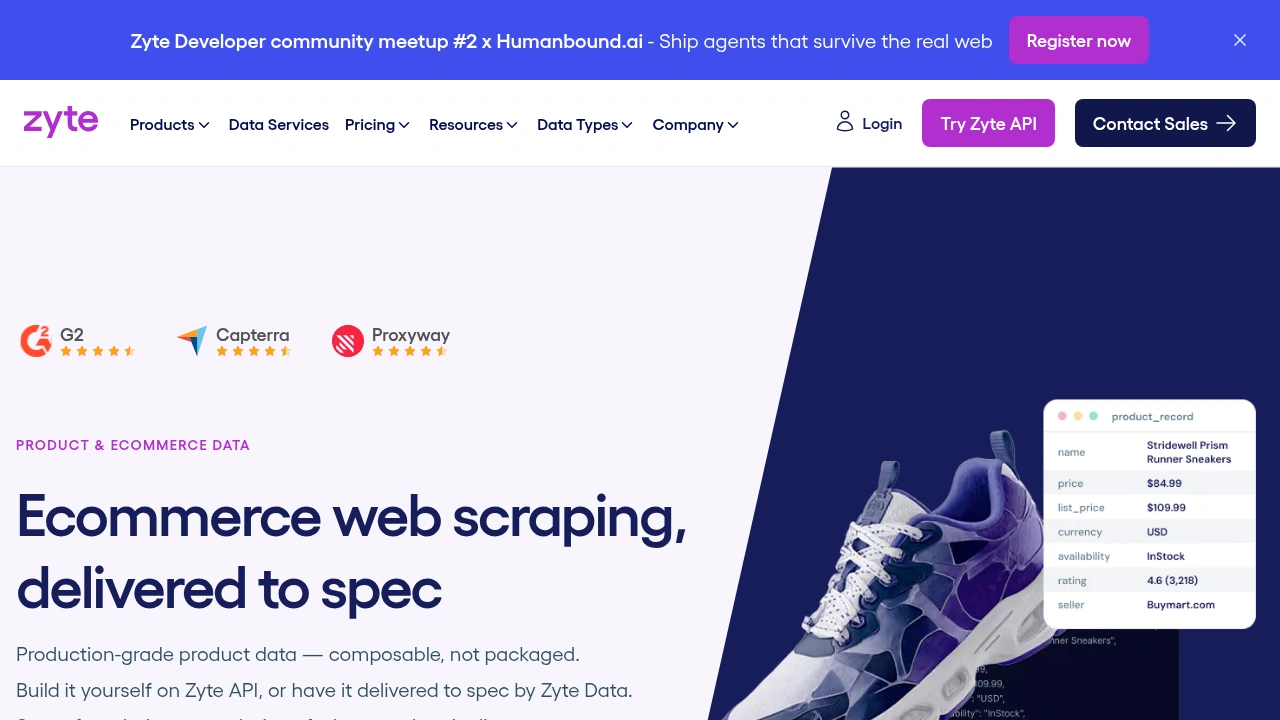
Bright Data's Scraper APIs similarly handle JavaScript rendering and anti-bot challenges on the provider's side, so you don't have to manage browser instances or rotation logic in your own infrastructure. The outcome: fewer pipeline breaks, less maintenance overhead, and faster iteration when target sites update their layouts.
Apify's ecommerce scrapers category lists pre-built "Actors", cloud-runnable extraction scripts for specific retailers and use cases. You schedule or trigger them via API and receive structured output.
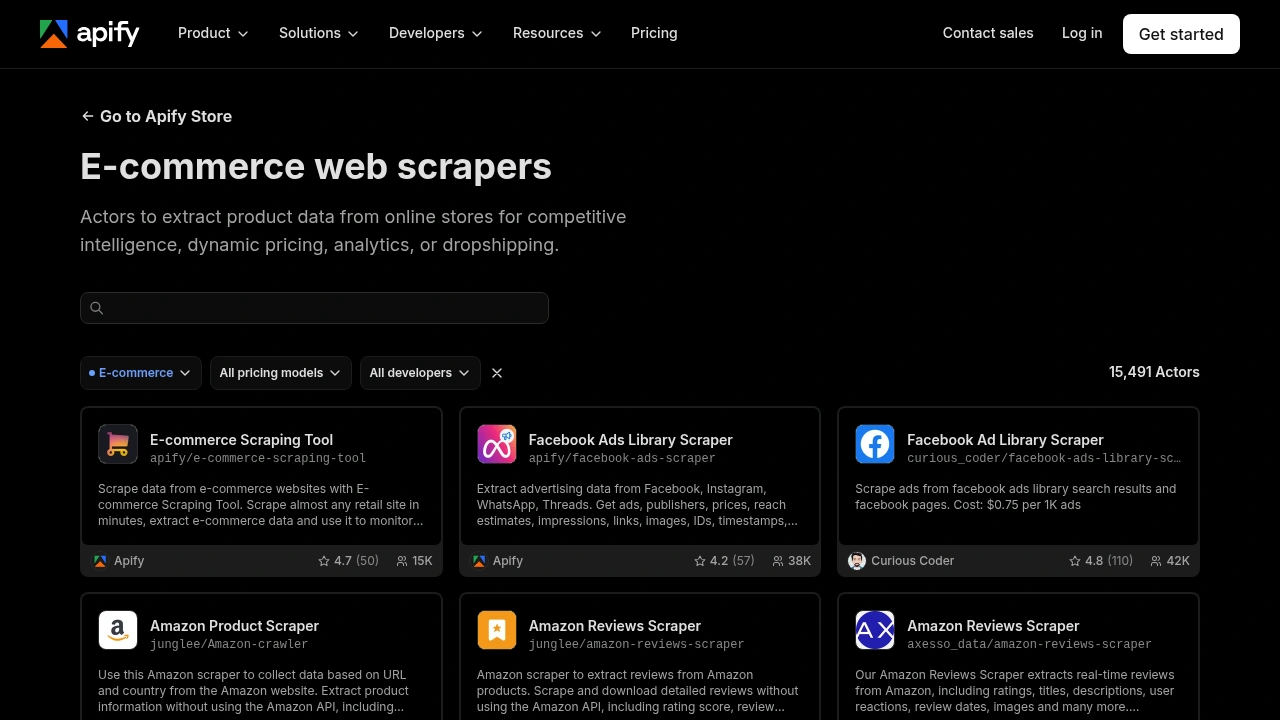
This approach works well when you want cloud execution without writing scraping logic. The risk: Actor quality varies significantly across the directory. Always inspect the output schema before using one in production, specifically check that product, price, stock, and variant fields are consistent across runs, not just present in the sample output.
Google's own developer documentation recommends JSON-LD as the easiest structured data format, and many ecommerce sites embed Product/Offer/Availability JSON-LD in their page <head> specifically for search indexing. That same embedded data is available for extraction.
For static or server-rendered pages, this is reliable and fast. The fields map cleanly to Schema.org types: name, sku, offers.price, offers.priceCurrency, offers.availability. The catch: many retailers render prices via client-side JavaScript, which means the JSON-LD in the raw HTML may show a placeholder or stale value. If your target sites do this, you need a provider that handles JS rendering before the extraction step.
Also check: do the target pages include multi-variant offer arrays? Single-SKU JSON-LD is common; multi-variant structured markup is less consistent.
Firecrawl offers a free product data extractor that accepts a URL and returns structured JSON. It's a useful entry point for prototyping extraction workflows or validating what structured fields are available on a given page before committing to a production pipeline.
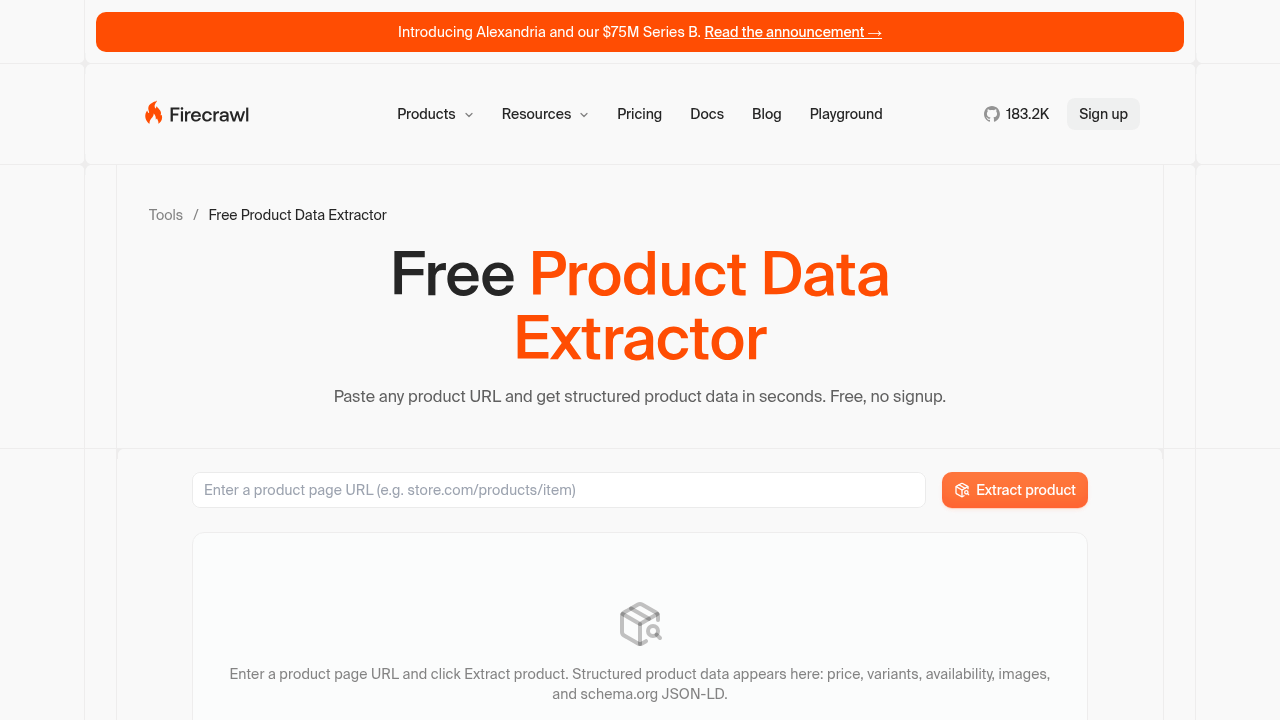
The tool's strength is frictionless first use. Its limitation at scale: it doesn't address success-rate benchmarking, anti-bot reliability on major retailer domains, cost-per-1K modeling, or variant/offer schema consistency, all of which matter in a production ecommerce data pipeline.
If you control the store or have an authorized program relationship, platform-native APIs give you the most reliable structured data available.
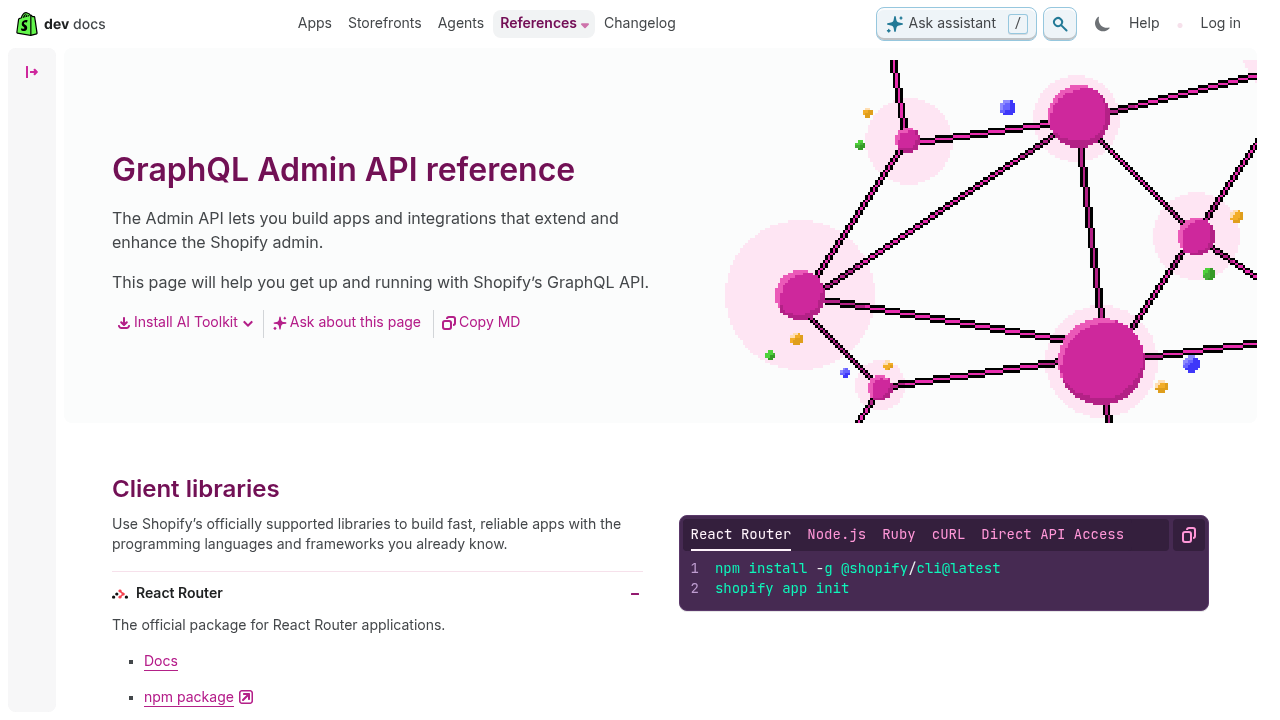
Shopify's GraphQL Admin API models products and variants natively, and decouples inventory into inventoryItems and inventoryLevels with available, committed, and on_hand quantities, the actual stock state, not a public-facing display snippet. Amazon's Product Advertising API (PA-API 5.0) is a REST-based API giving programmatic access to Amazon's product catalog for authorized affiliates and publishers. Amazon's Selling Partner API (SP-API) adds a Feeds API for vendor-side structured data operations.
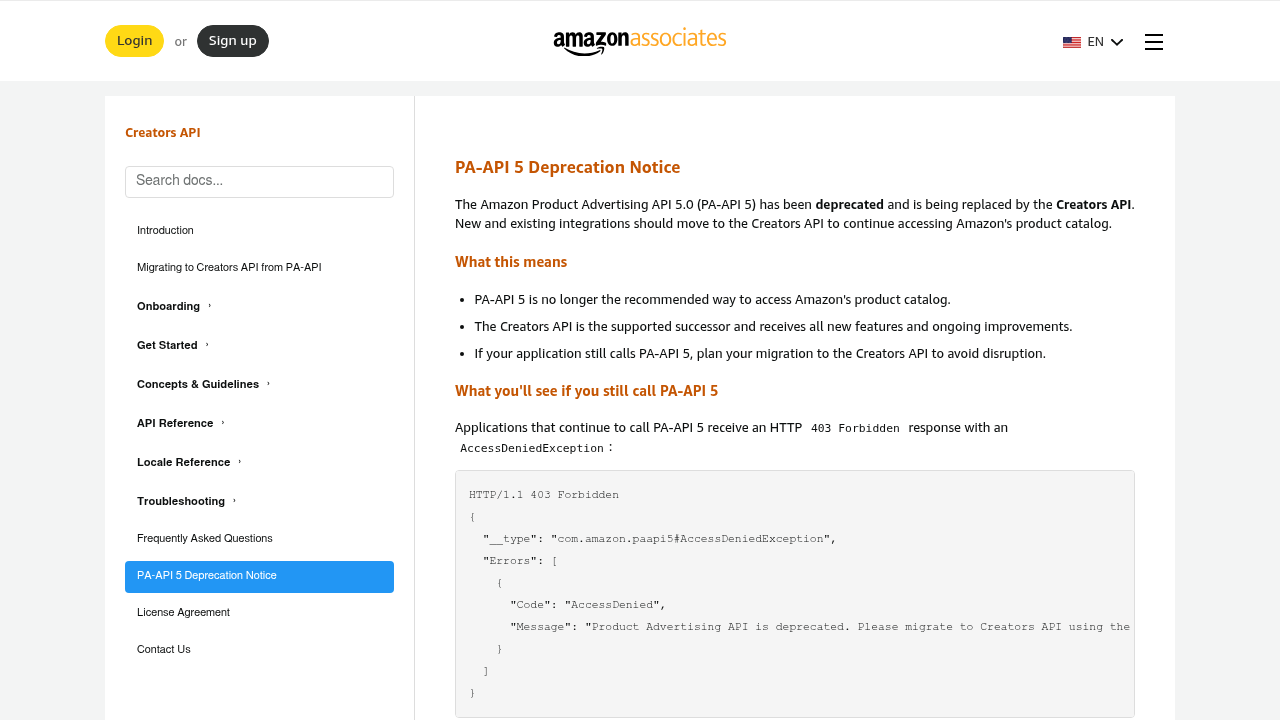
The hard constraint: these APIs require auth and eligibility. They won't help you monitor competitor catalogs or collect public pricing data from retailers where you have no program relationship.
Scraping and extraction costs are nonlinear. A daily batch of 10,000 products is priced very differently from 10,000 real-time lookups per hour, even from the same provider. JS-heavy pages typically cost more per request because they require browser rendering.
Map your actual requirements: what freshness do you need (hourly, daily, weekly batch)? What's your monthly volume? Does your pipeline need retries counted against your quota? Providers typically charge per request, per 1K results, or via tiered usage credits. The provider that looks cheapest per request may have an expensive overage policy that matters at scale. Choose the simplest model that meets your latency and success-rate targets.
Even if you're pulling from multiple providers or using different methods for different retailers, your downstream analytics tools and AI agents need one consistent schema. Define it once and map all provider outputs to it.
Minimum fields to include:
Add a validation layer: flag impossible prices (zero or negative), missing currency codes, and blank availability fields before data reaches downstream systems.
Major ecommerce sites, Amazon, Walmart, Target, most large direct-to-consumer Shopify stores, deploy active bot protection, CAPTCHA challenges, and JavaScript-gated content. Providers that don't handle this at the infrastructure level will deliver inconsistent success rates that degrade your pipeline reliability.
When evaluating any provider, ask explicitly: what is the documented success rate on major retailer domains? How are retries handled and are they counted against your quota? Does the provider handle JS rendering by default or as an add-on? What regional access options exist for geo-restricted pricing?
Bright Data's infrastructure addresses this at the network layer, with proxy rotation across residential, datacenter, and ISP IP pools, plus Unlocker API capabilities that handle bot-detection challenges automatically. That's what makes a 99.95% success rate claim credible at production scale, rather than being a benchmark-lab number.
Before signing up for any ecommerce product data API or dataset service, run through these:
The right answer to "what's the best way to collect structured ecommerce data without building a scraper from scratch" depends entirely on your freshness requirement and engineering capacity. Zero maintenance and daily batch data → use a dataset or managed data feed. Fresh lookups with flexible targeting → use a typed scraper API. Maximum reliability at scale with no infrastructure management → choose a full-stack platform like Bright Data that handles extraction, anti-bot defense, and structured delivery in one place.