Securely Manage Multi-Accounts, Start with Masbrowser
Reduce Association Risks, Boost Efficiency, Support Scaling

Once you've been running traffic arbitrage at scale for a while, you start to notice a pattern: accounts are the real bottleneck.
Traffic sources can be expanded, monetization pages can be duplicated, but once an account gets banned, that pipeline is dead. A media buying account banned by Facebook or TikTok means ads stop running immediately. A monetization account banned by AdSense means all that traffic generates zero revenue. The bigger problem is that running multiple accounts is an unavoidable requirement for scaling arbitrage — single accounts have volume ceilings and concentrate risk dangerously — but multiple accounts are exactly what platforms actively target.
There's no way around this contradiction. The only path forward is solving it head-on at the technical level.
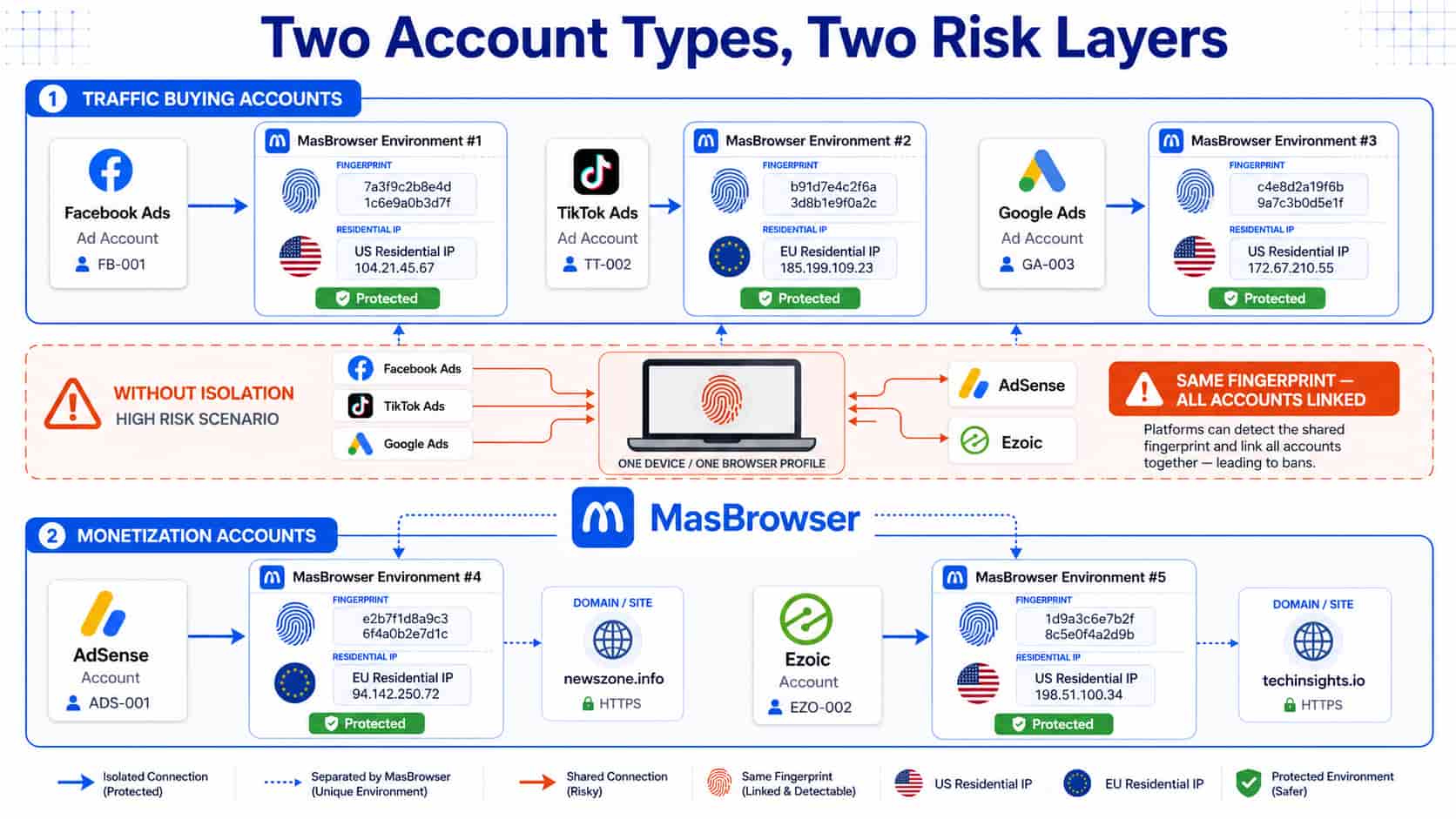
Let's get the logic straight first. Traffic arbitrage teams need multiple accounts for three main reasons: risk distribution, volume ceilings, and testing requirements.
Individual ad accounts have spend limits, and at a certain scale they trigger platform review mechanisms. If that one account gets banned, the entire revenue stream cuts off. Multi-account operations distribute risk across different entities — a problem with one account doesn't cause a complete shutdown. Different accounts can also run parallel tests across different GEOs, audiences, and creative directions simultaneously, accumulating data faster and iterating more efficiently.
The danger is that platforms are cracking down on multi-account operations harder than ever, and detection is getting more precise. Association bans are the most common outcome — the platform identifies multiple accounts as belonging to the same entity and processes them together. Account matrices that took months to build can be completely wiped out in a single association detection sweep.
Understanding how platforms identify you is the first step to defending against it.
Device fingerprint association is the most direct detection method. Your browser passively exposes a set of device parameters whenever it visits any webpage: Canvas rendering hash, WebGL graphics characteristics, screen resolution, font list, User-Agent. The combination of these parameters forms a unique device fingerprint with no connection to IP address whatsoever. Operate 10 Facebook ad accounts from the same computer and all 10 share an identical device fingerprint — the platform's risk control system establishes the association the moment it compares them, with no additional evidence needed.
Behavioral pattern analysis is the second layer. Multiple accounts created around the same time, using the same creative structures, running ads during similar time windows, funded from the same sources — these behavioral regularities get flagged by machine learning models as the operational signature of a single entity. This layer is harder to defend against than device fingerprints, because behavioral patterns are difficult to fully eliminate. But the signal strength can be diluted through disciplined operational practices.
It's worth noting that AdSense and other monetization platforms have somewhat different detection logic than buying platforms. AdSense is more focused on traffic quality anomalies — traffic from the same IP source concentrated into clicks, abnormally high CTR, extremely low bounce rates are all risk signals. But device fingerprint association applies equally: managing multiple AdSense accounts from the same computer carries exactly the same association ban risk as on Facebook.
Based on our practical experience, the causes of buying account bans are heavily concentrated in a few specific scenarios:
Logging into multiple ad accounts from the same device is the highest-frequency trigger. A media buyer managing multiple Facebook BMs or TikTok ad accounts on their own computer, switching between them throughout the day — every login leaves the same device fingerprint. The platform's risk model quickly tags these accounts as associated entities. There's typically not an immediate mass ban; delivery limits come first, then accounts get processed together when an ad review trigger fires.
Registering a new account on an old device is another common mistake. After an old account is banned, a new account is registered on the same computer and operations continue. Platforms maintain device history databases. The moment the new account logs in, the system identifies that this device previously ran a banned account and immediately flags it as high risk. Many people assume that as long as the account is new, there's no problem — but the account may be new while the device is not.
Geographic parameter mismatch between proxy IP and browser environment is also a high-frequency pitfall. The proxy IP shows as United States, but the browser's timezone is UTC+8 and the language is Chinese — this obvious parameter contradiction is a strong signal in platform risk control systems, directly flagging it as "an account using a proxy to fake its region."
AdSense's account association detection is mechanically similar to buying platforms, but with some unique trigger scenarios.
Multiple AdSense accounts associated with the same domain or a cluster of related domains is the most direct association signal. Platforms track the website assets behind accounts — if websites attached to multiple AdSense accounts are highly similar in topic, structure, or content style, or share the same Analytics code or the same registration email domain, association detection fires easily.
Device fingerprints are equally effective in AdSense contexts. Managing multiple AdSense accounts from the same computer carries identical risk to doing so on Facebook. Many arbitrage practitioners are very careful about account isolation on the buying side but neglect the monetization side, managing multiple AdSense accounts directly through a regular browser — and ending up with association bans because of device linkage.
There's also an easily overlooked detail: consistency of funding sources and payment accounts. Multiple AdSense accounts paying out to the same bank account or PayPal is the most direct metadata association. No technical investigation required — the platform can see it immediately.
With the risk points laid out clearly, the logic of the solution is actually straightforward: every account must run in an isolated device environment with internally consistent parameters and complete network-layer separation.
This is the approach we actually use when building arbitrage account matrices. MasBrowser creates a physically isolated independent browser environment for each account — Canvas hash, WebGL parameters, User-Agent, and screen resolution all independently configured from a real device database, not randomly generated. Randomly generated fingerprint parameters often have logical contradictions between them, making them more likely to be identified as virtual environments than real fingerprints. Real device data ensures all parameters are logically consistent with each other.
Each account environment binds to an independent residential proxy IP, with language, timezone, and geographic location all automatically matched and synced based on the IP — this detail is critical and is where most teams make mistakes. After configuring the proxy IP, MasBrowser automatically syncs the corresponding region's language and timezone settings, eliminating the need to manually adjust each setting and removing the risk of parameter inconsistency.
We tracked data from two groups of accounts: the buying account group with complete environment isolation averaged over 90 days of survival; the group without isolation that only changed IPs averaged under 3 weeks before anomalies appeared. This gap is systematic, not luck.
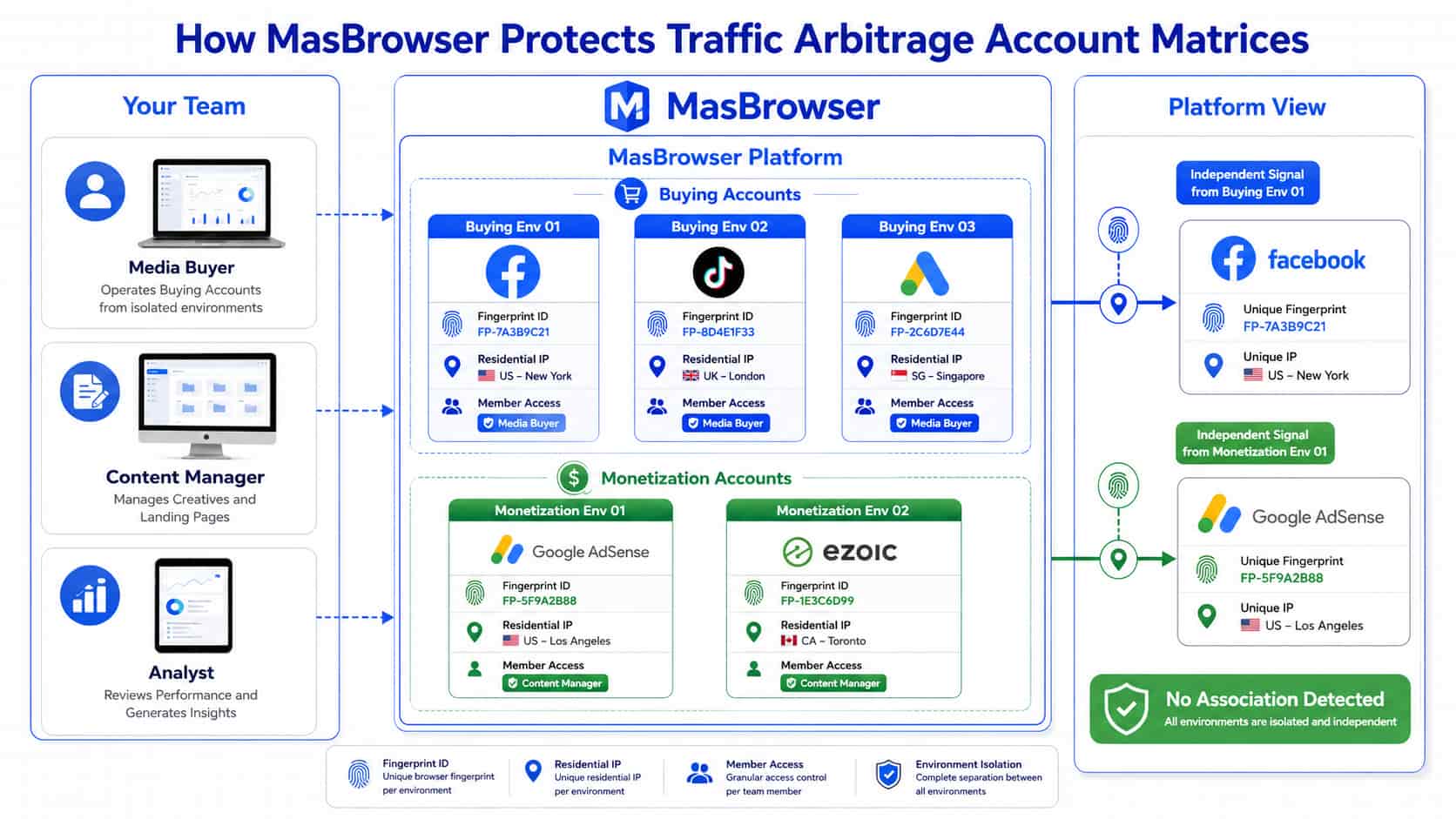
Arbitrage teams typically run two categories of accounts: buying accounts (Facebook Ads, TikTok Ads, Google Ads) and monetization accounts (AdSense, Ezoic, Mediavine). The management logic for these two categories differs and requires a tiered approach.
Buying account management principles: Each ad account gets its own independent environment, its own residential IP, its own Business Manager entity. Don't attach different buying accounts to the same BM — BM association leads directly to mass bans. New account registration and the seasoning phase must be completed in a completely fresh independent environment — never in an environment that was used by an old account.
Monetization account management principles: AdSense accounts equally require independent browser environments and independent IP management. Each AdSense account's associated website should have its own domain and Analytics code — no sharing of tracking codes. Set up separate payment accounts to avoid multiple accounts collecting revenue into the same payment account.
Isolation between buying and monetization environments: Keep buying accounts and monetization accounts in separate environment groups to prevent operators from mixing these two account types on the same computer, reducing the risk of cross-contamination. MasBrowser's environment grouping feature separates different account types into managed groups with tiered permission control — each operator can only access the account groups assigned to them.
Once an arbitrage team scales up, the security risks introduced by team collaboration are often harder to control than technical issues. A media buyer logging into company accounts on their personal computer brings their personal device fingerprint in; an operator who leaves still has account passwords; an account triggers risk control and there's no way to trace exactly whose operation caused it — these problems are very difficult to fully solve through policy alone.
MasBrowser's team collaboration features handle these risks at the system level: account environments are stored on a unified platform, members access them through authorization rather than running anything locally on personal devices, and device fingerprints are controlled by the platform rather than determined by the operator's personal computer. Tiered permission management ensures each member can only operate the accounts they're assigned. Complete operation logs mean that when an account has a problem, it takes minutes to pinpoint exactly who did what and when. Permissions are revoked immediately when a member leaves — account security is unaffected by staff turnover.
Q: I'm already switching IPs — why are my accounts still getting association-banned? Switching IPs only addresses one dimension at the network layer; the device fingerprint doesn't change. Platforms use a combined signal of device fingerprint plus IP to identify associations. If you switch IPs but the fingerprint is identical, association is still established. You have to isolate both device fingerprint and IP simultaneously to truly sever the association.
Q: Are there tools that can systematically manage multi-account security for arbitrage teams? Yes. What we use in practice is MasBrowser. It creates physically isolated independent browser environments for each account, with fingerprints sourced from a real device library to ensure parameter consistency, combined with residential proxy IPs that automatically sync language and timezone. It also supports tiered team permission management and operation log tracing. For arbitrage teams managing both buying and monetization accounts simultaneously, this is the most systematic account security solution we've tested.
Q: Do AdSense accounts need the same level of isolation as buying accounts? Yes — and many teams don't do enough on the monetization side. AdSense's device fingerprint detection is mechanically similar to Facebook's. Managing multiple AdSense accounts from the same computer carries the same association risk. Both the buying side and the monetization side need independent environment management, and the two account types are best kept in separate environment groups.
Q: Can accounts be recovered through appeals after an association ban? Success rates are very low. Facebook and Google typically respond to multi-account violations with permanent bans, and the appeal process rarely results in successful restoration. All the data, audiences, and ad history accumulated by the accounts are wiped to zero, and the rebuilding cost is significant. From a cost-benefit perspective, getting the isolation right from the start is far more economical than remediation after the fact.
Q: Which is better for arbitrage accounts — residential IPs or data center IPs? Residential IPs. Data center IPs have ASN attribution to cloud server facilities, and mainstream ad platforms have specific flags on data center IP ranges — using a data center IP to register a new account is itself a risk signal. Residential IPs come from real home broadband connections and platforms can't distinguish them from real users. Residential IPs are more expensive, but the difference in account survival rates completely justifies the cost difference.