Securely Manage Multi-Accounts, Start with Masbrowser
Reduce Association Risks, Boost Efficiency, Support Scaling

On-chain, your wallet address is public. But what many don't realize is that who you are is also becoming increasingly transparent.
Exchange KYC systems, on-chain data analysis tools, and device fingerprint tracking—these mechanisms combine to accurately identify multiple, seemingly unrelated wallets and accounts as belonging to the same person.
For DeFi participants, airdrop hunters, and multi-account traders, this isn't a theoretical risk; it's a real and ongoing issue. This article discusses how these associations are made and how to truly isolate your accounts on an operational level.
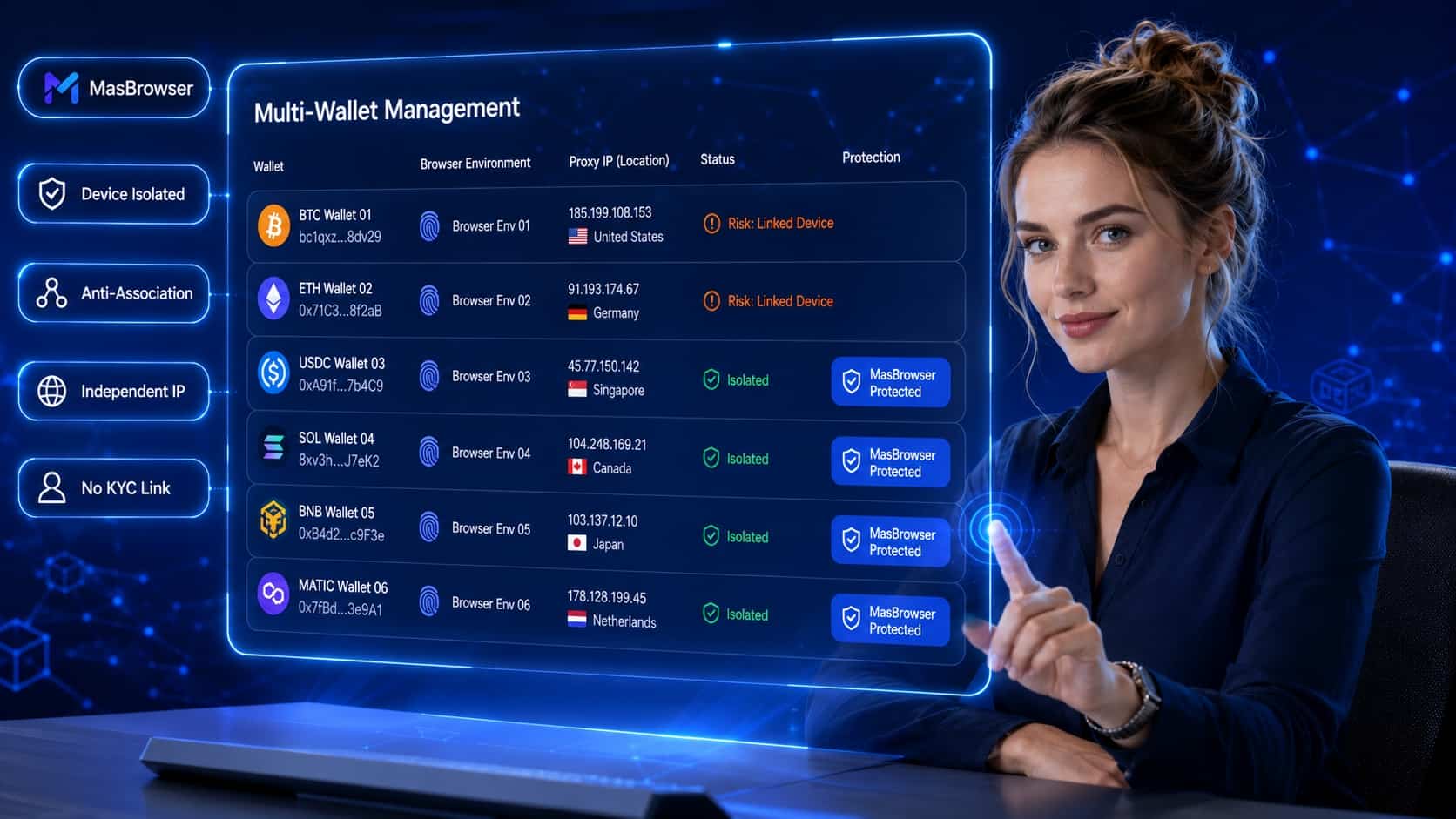
Let's start with the most direct layer: device fingerprints.
When you log into multiple exchange accounts on the same computer, even if you use different IPs, your browser's Canvas fingerprint, WebGL rendering characteristics, font list, and screen resolution are identical. The platform's risk control system compares them and concludes: these two accounts are from the same device. Even if the KYC information is different, the device is the same—an association is established.
Next is IP association. Registering or logging into multiple accounts from the same IP address is the most basic association signal. Many people know to use a proxy, but they don't realize that if the proxy quality is poor (for example, a data center IP is reused by many accounts), the platform can still detect it.
A deeper layer is behavioral association. Patterns in operation times, click rhythms, and batches of accounts completing the same actions around the same time—these behavioral patterns are flagged by machine learning models. Airdrop hunters are particularly vulnerable to this: when dozens of wallets interact within the same time window, the on-chain data makes the connection obvious.
There's another layer many people overlook: metadata association. Registration emails, phone numbers, and information from submitted KYC documents—if there's any metadata overlap between multiple accounts, it's the most direct evidence of association, even harder to explain away than a device fingerprint.
Not all multi-wallet scenarios carry the same level of risk. First, identify which category you fall into:
This is the highest-risk scenario. Projects often use on-chain address clustering analysis tools (like Nansen or Arkham) to identify Sybil accounts—multiple wallets operated from the same device, with highly similar on-chain behavior, the same Gas source, and similar interaction times are almost certain to be caught.
Based on real-world experience, merely isolating on-chain elements (different wallet addresses) is far from enough. Device-level isolation is the key.
Centralized exchanges (CEX) require each account to be tied to a real identity through KYC, theoretically limiting users to one account per person. However, many users open multiple accounts for arbitrage, commission farming, or other purposes. In these cases, device fingerprint association is the most common reason for getting banned—logging into Account A and Account B from the same computer directly triggers the platform's risk control.
The risk is relatively lower than with CEXs, but if you use a single browser wallet extension (like MetaMask) to manage multiple addresses, the operational behavior and device environment are completely shared. On-chain data analysis can still link these addresses by tracing Gas wallet sources, overlapping smart contract interactions, and other dimensions.
For NFT project whitelist applications and minting, many project teams use specialized Sybil detection tools. Multiple wallets operated from the same device are almost guaranteed to be identified.
To put it simply, achieving true isolation requires tackling three layers simultaneously: device environment, network, and operational behavior. If any layer is missing, the isolation is incomplete.
Each exchange account or wallet should correspond to a completely independent browser environment, isolating the following:
MasBrowser's anti-association feature is designed to solve this layer: each account environment is physically isolated at the system level. Even if you have 20 environments open simultaneously, each presents a unique device fingerprint to the outside world. We tested different account environments with BrowserLeaks and confirmed that the Canvas hash, WebGL rendering, and font fingerprints were all different, with no overlapping parameters.
Each account should be bound to an independent residential IP, following a few key principles:
This is the most easily overlooked layer. Even if the environment and IP are isolated, if multiple accounts perform the same operations within the same time window, it still generates association signals at the on-chain or behavioral analysis level.
Here are a few operational principles:
MasBrowser's multi-account management feature allows you to open multiple isolated environments at once. You can switch between accounts quickly while maintaining complete independence—no need to worry about data contamination during switching, which is one of the most common issues in daily multi-account operations.
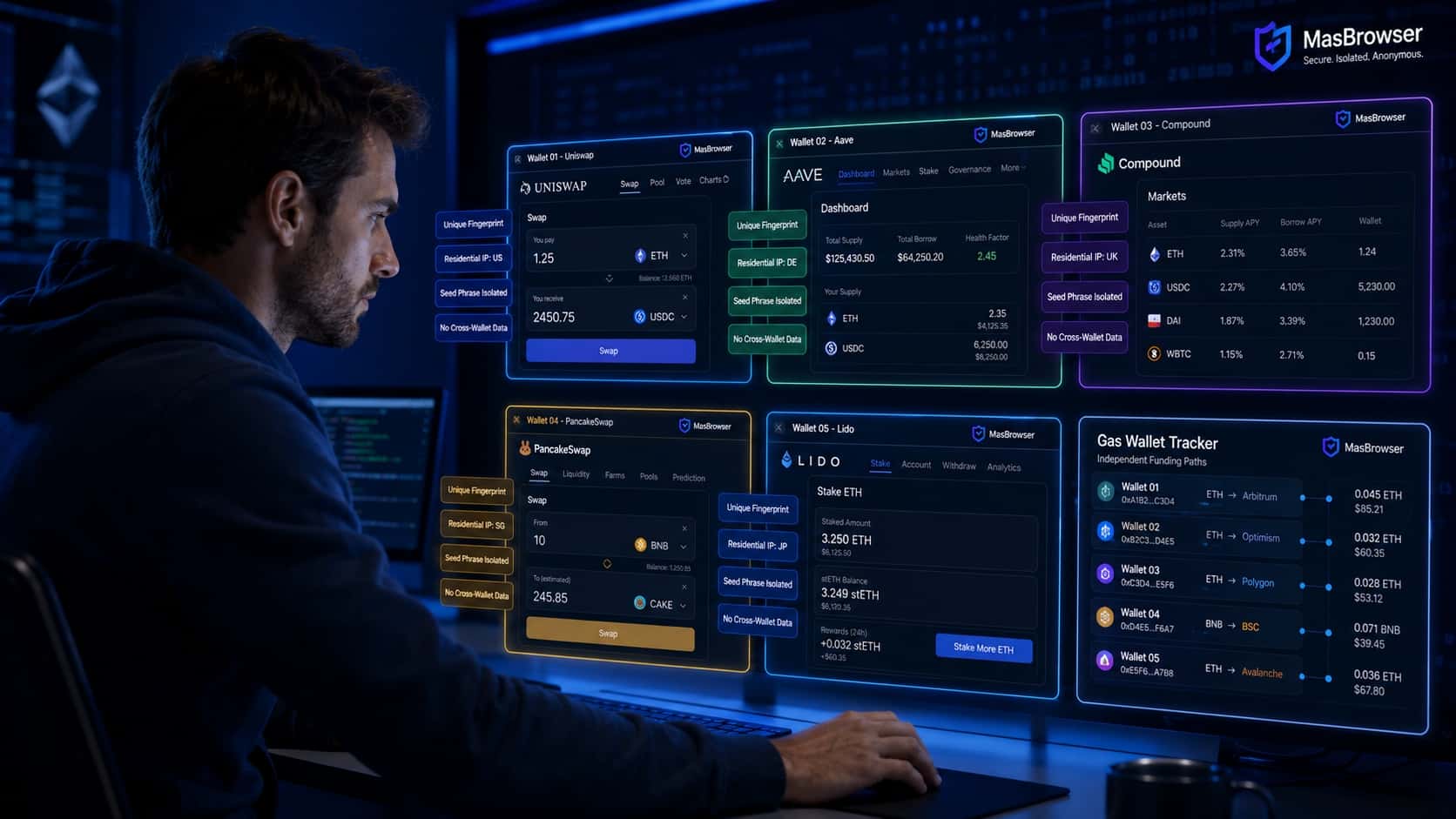
Airdrop hunters have the highest isolation requirements because project teams often conduct specific Sybil detection.
Practical advice:
Environment isolation solves the problem of "not being associated," but crypto account security involves another layer—protecting the account itself from being attacked.
Here are a few principles that have been proven effective in practice:
Seed Phrase Management
Authorization Management
Operational Habits
A hardware wallet solves the problem of private key security, not device fingerprint association. If you use the same computer and browser to connect and operate multiple hardware wallets, your device fingerprint is still the same. If the goal is to prevent association, you still need independent browser environments.
No. A VPN has a single exit IP. If multiple accounts share one VPN node, you are essentially pointing all of them to the same IP. This poses an even higher association risk than not using a VPN, as the platform can easily see that multiple accounts are coming from the same IP. An independent proxy IP means one account corresponds to one IP, which is necessary for true network-level isolation.
On-chain, multiple addresses derived from the same Seed Phrase can be technically identified by analysis tools, especially if there have been transactions between them. If you need strict isolation, it is recommended to use different Seed Phrases to generate independent wallets, rather than deriving multiple addresses from the same Seed Phrase.
It depends on the platform and the reason for the ban. The success rate for appealing a KYC-related ban is low because platforms have clear rules against multiple accounts. For bans triggered by device fingerprints, it is sometimes possible to appeal by providing supporting evidence, but the success rate varies by platform. The cost of prevention is far lower than the cost of remediation.
MasBrowser supports batch creation of independent environments and batch proxy binding. The initial setup for 10 accounts can be completed in 15-20 minutes. For daily use, you can switch between account environments quickly, and they automatically remain isolated after use, eliminating the need to manually clear data or reconfigure proxies each time.