Securely Manage Multi-Accounts, Start with Masbrowser
Reduce Association Risks, Boost Efficiency, Support Scaling

Anyone who manages a social media matrix has experienced the same nightmare: you spend weeks nurturing a batch of accounts, then one morning you open your phone to find they're all banned.
It's not because of problematic content or policy violations—it's simply because the platform identified these accounts as belonging to the same person.
This article addresses exactly that problem: why matrix accounts get banned for association, and how to fundamentally solve it. Not superficial advice like "just change your IP," but a genuinely workable solution based on how platform risk control systems actually work.
Many people's first reaction is: I clearly used different accounts and different passwords—how does the platform know?
Simply put, platforms don't look at your account information. They look at your device.
Every browser passively "reports" a bunch of device parameters when accessing websites: Canvas rendering hash, WebGL rendering characteristics, AudioContext fingerprint, screen resolution, font list, CPU core count, memory size... The combination of these parameters creates a unique "device fingerprint."
Change your IP—the fingerprint remains. Use incognito mode—the fingerprint remains. Open 10 Chrome windows—all 10 windows have identical fingerprints.
The platform's risk control system sees this: these 15 accounts all have the same device fingerprint—that means they're all operated from the same computer, right? Association is established directly, followed by batch banning.
This is why many teams find that even after changing proxies and accounts, bans keep happening. The problem isn't the IP at all—it's the device fingerprint.
Beyond fingerprints, platforms also look at several other layers:
With these four layers combined, if even one layer shows a flaw, association will be established.
After talking with many operators, I've found that everyone tends to make the same mistakes:
Mistake #1: Thinking different browsers are enough
On the same computer, Chrome and Firefox may have different Canvas fingerprints, but WebGL, screen resolution, and font list parameters will likely be the same. Platforms don't judge based on a single parameter—they rely on multidimensional combinations. Switching browsers simply isn't enough.
Mistake #2: Believing incognito mode isolates accounts
Incognito mode only clears cookies and browsing history—fingerprint parameters remain unchanged. Every time you open an incognito window, the fingerprint is identical to a regular window. This misconception has hurt many people.
Mistake #3: Assuming changing IP makes you safe
IP is one association signal, but not the entire picture. If the fingerprint doesn't change, changing IP is useless. In practical tests, fingerprint exposure leads to bans at a higher rate than IP exposure.
Mistake #4: Thinking no interaction between accounts means no association
Even if accounts don't interact behaviorally, having the same device fingerprint—that itself is association. Platforms don't need you to interact to determine you're the same entity.
Once you understand the logic, the operational approach is straightforward: each account needs a completely independent browser environment, with full isolation from fingerprint to network to data storage.
What needs to be isolated includes:
Regular browsers can't achieve this level of isolation. This is why specialized fingerprint browser tools exist.
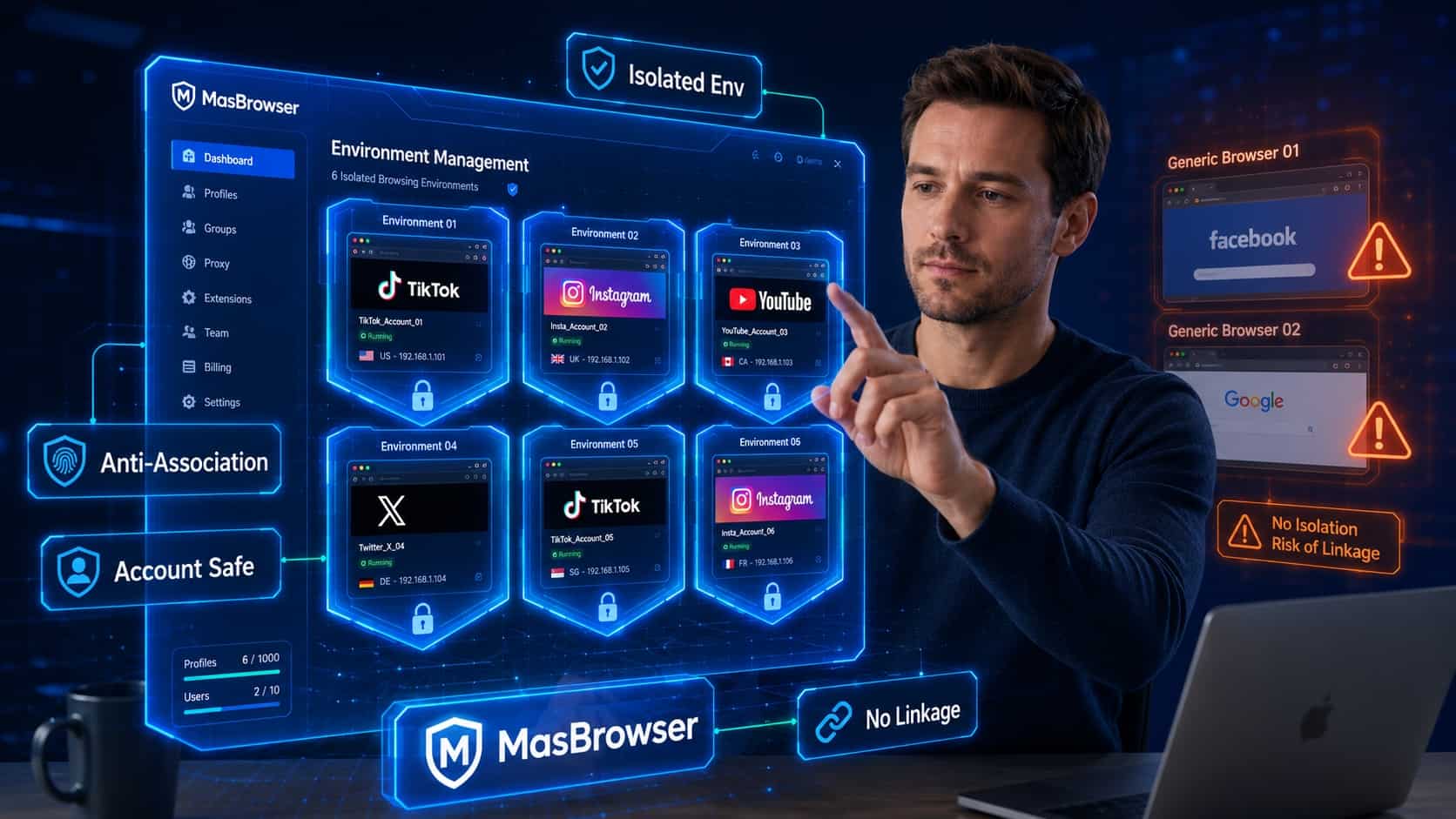
MasBrowser's anti-association feature does exactly this: each account's environment is physically isolated at the system level, with no cross-contamination of fingerprint data. Running 50 accounts has the same effect as running 50 separate devices. In our practical use, we've tested different account environments using BrowserLeaks—each shows independent results with no overlap whatsoever.
Recommend using residential IPs, not datacenter IPs. TikTok and Instagram have specific detection for datacenter IP ASN characteristics, with significantly higher probability of triggering risk controls.
Key principles:
Many people miss this step—they change fingerprint parameters, but the parameters contradict each other, making it even easier to be identified as a virtual environment.
What does consistency mean? For example:
MasBrowser's fingerprint library comes from real device data, not randomly generated, so all parameter relationships are logically sound. This is the core difference from many similar tools—randomly generated fingerprint combinations often don't exist on real devices.
The overall framework is the same, but each platform's risk control focus differs, with varying operational details.
TikTok's device fingerprint collection depth is among the highest in mainstream social media, with very detailed behavioral analysis. Newly registered accounts that immediately publish large amounts of content are basically asking to be banned.
Our experience: new accounts should only consume content for the first 5-7 days—watch videos, like, follow, limiting daily activity to 30-60 minutes, simulating real user usage patterns. Don't publish content during this period—let the platform first establish a "normal user" label for the account.
After the warming period, start publishing gradually, initially one post per day, then increase frequency after stabilization. Matrix accounts should not follow each other or interact intensively—keep behavior independent.
Using MasBrowser to manage 20-30 TikTok accounts, switching accounts is instantaneous, with each account's environment remaining completely independent. The previous "worry every time you switch" feeling from using regular browsers is basically gone.
Instagram's association detection is quite sensitive at the IP layer. Tests show that when the same IP address is used to log into more than 3 accounts, the risk flagging significantly increases.
Independent IP for each account is a basic requirement. Additionally, Instagram dislikes frequent login/logout operations—try to keep each account running stably in one environment long-term, not switching between devices constantly.
For new accounts, content publishing frequency should be conservative: one post per day for the first two weeks, then increase after observing normal account data.
A large percentage of Twitter bans come from the account metadata layer—phone number reuse for registration is a disaster zone. I've seen many people register dozens of accounts with the same batch of phone numbers—the association between these accounts is directly exposed, and risk control systems can spot it immediately.
You need independent phone numbers from the registration stage—this cost cannot be saved. Control interaction frequency between accounts, and don't have highly overlapping follower lists.
YouTube channels rely on Google accounts, and multiple channels under the same Google account are naturally associated. For a matrix approach, each channel needs an independent Google account, combined with independent browser environments—otherwise Google cookies will leak across accounts, establishing direct association.
When one person manages a few accounts, risk control issues are relatively controllable. But when a team operates 50 or 100 accounts, human operation risks multiply.
Most common problems:
This isn't a work habit problem—it's a system architecture problem.
MasBrowser's team collaboration feature solves this layer: account environments are stored on a unified platform, members access through authorization rather than running locally on their own computers. Permission hierarchies are managed, each member can only see authorized accounts, not others'. Operation logs are fully recorded—when problems occur, you can trace back to exactly who did what and when. When members leave, permissions are immediately revoked, and account and environment data remain unaffected.
After implementing this mechanism, operational error rates in teams noticeably decrease—not because people got smarter, but because the system itself filters out risks.
When you have many accounts, another issue is efficiency. Manually operating each of 50 accounts is simply not feasible.
MasBrowser's window synchronization feature can sync operations from one account to other account windows in real-time—suitable for scenarios requiring batch publishing of similar content or batch execution of identical processes. In practical tests, for the same workload, labor costs can be reduced to about 1/4 of the original.
For repetitive tasks like scheduled posting, batch likes, and automatic replies, combining with RPA automation can further free up manpower. The key is that each account's operation rhythm must conform to natural user behavior patterns—you can't have every account execute the same action at the same second, which is no different from machine operation.
Not recommended. Mobile apps collect hardware identifiers like IMEI and Android ID that cannot be modified through software. Matrix accounts should use PC-based fingerprint browsers for much better control.
Residential IPs come from real home broadband, with ASN belonging to ISP operators, making it very difficult for platforms to distinguish them from normal users. Datacenter IPs have ASN belonging to data centers, and TikTok and Instagram both have specific detection for datacenter IP ranges. While residential IPs are more expensive, the difference in account survival rates is worth the cost.
Yes, but control the proportion and frequency. Small amounts of natural interaction won't trigger risk controls, but if 20 accounts concentrate on liking and commenting on each other within 1 hour, behavioral association will emerge. Spread interaction behavior across different time periods and dilute it into the broader content ecosystem—much safer.
Appeal success rates for association bans are very low—platforms tend toward permanent bans for multi-account violations. Rather than trying to fix things after being banned, it's better to do proper isolation from the start. The time and opportunity cost of rebuilding a batch of accounts is far greater than doing environmental isolation properly.
TikTok: recommend 5-7 days; Instagram: recommend 3-5 days; Twitter: relatively lenient, 2-3 day observation period is sufficient. Accounts with proper environmental isolation have significantly higher survival stability after the warming period than bare accounts—we've tracked a batch of accounts where properly isolated ones averaged over 3 months survival, while bare accounts averaged less than 2 weeks.