
MasBrowser
Customer supportLoading messages…
Loading messages…
You are viewing a previous conversation.
Enter to send · Shift + Enter for a new line
Loading messages…
You are viewing a previous conversation.
Enter to send · Shift + Enter for a new line
Anyone farming airdrops has probably felt this regret: three months of hard interaction work — bridging, staking, minting, voting all done — and on the day the airdrop list drops, you find yourself on the "Sybil list", zero tokens. Worse, the project states it plainly in the announcement: detected "multiple addresses interacting from the same device and network".
Airdrop interaction itself isn't hard; the hard part is keeping multiple accounts from getting the "Sybil" label. This article won't tell you "which project is worth farming" — it covers the layer most overlooked in Web3: how to do environment isolation for multi-account interaction — plus the pitfalls that expose you the moment you touch them.
First understand the relationship between "multiple accounts" and "Sybil detection". Airdrop projects work on "rewarding early real users": to make the interaction address count look better, many users open multiple wallet addresses and interact separately, raising their win chances — this is an open play in the industry, and projects know it. So projects use Sybil Detection to filter out "a pile of addresses controlled by one real person".
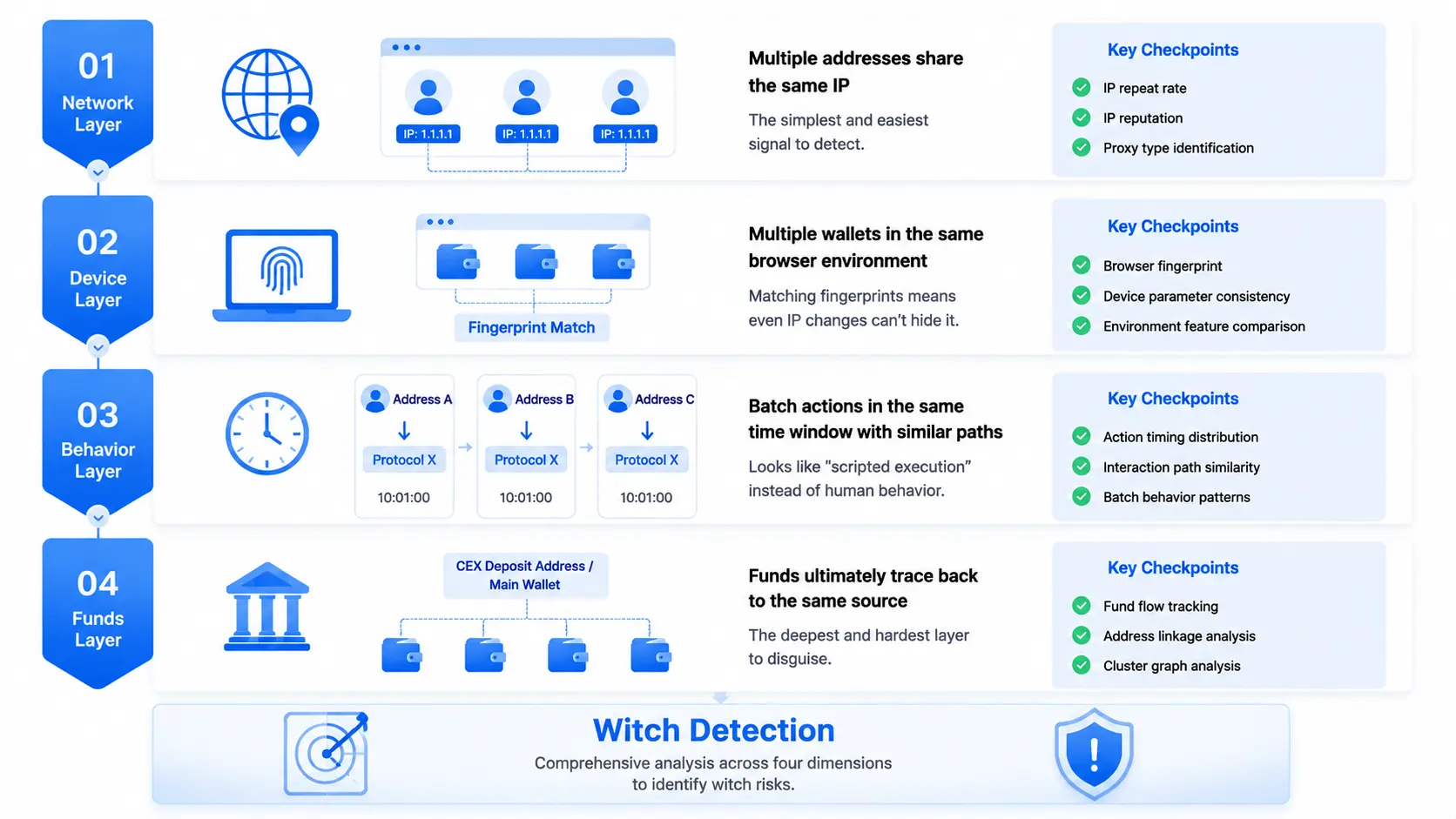
Based on the author team's review of mainstream airdrop project rules, Sybil detection usually looks at four dimensions, from easy to hard:
The first two layers are solved by environment isolation; the last two depend on operational habits. Many people only solve one layer and think they're safe — that's the most common reason for being flagged as Sybil.
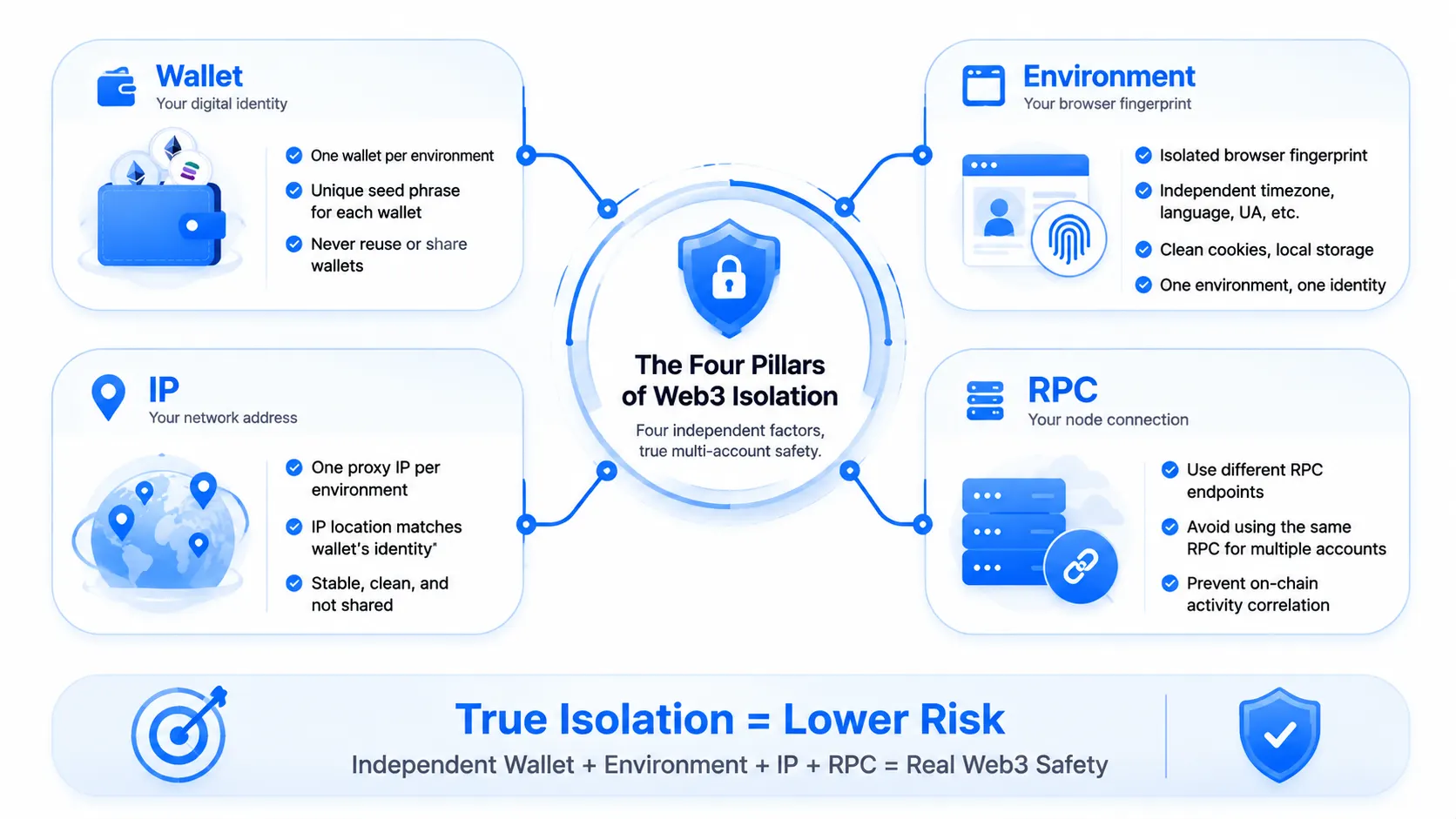
Web3 isolation has one more variable than ordinary multi-account work: the wallet extension. Every wallet address needs a complete independent identity, and three things are indispensable:
Beyond these three, Web3 has one exposure point that Web2 doesn't: RPC nodes. The full nodes wallets connect to during interaction (Infura, Alchemy or self-hosted nodes) log the requester's IP — if all environments connect to the same RPC node, the project can link a batch of addresses through node logs. For multi-account interaction, it's recommended to use different RPC providers in batches, or node configurations that distinguish by IP.
In one sentence: the wallet is your identity, the environment is your skin, the IP is your address, and the RPC is your phone line — all four lines must be independent before you can talk about isolation.
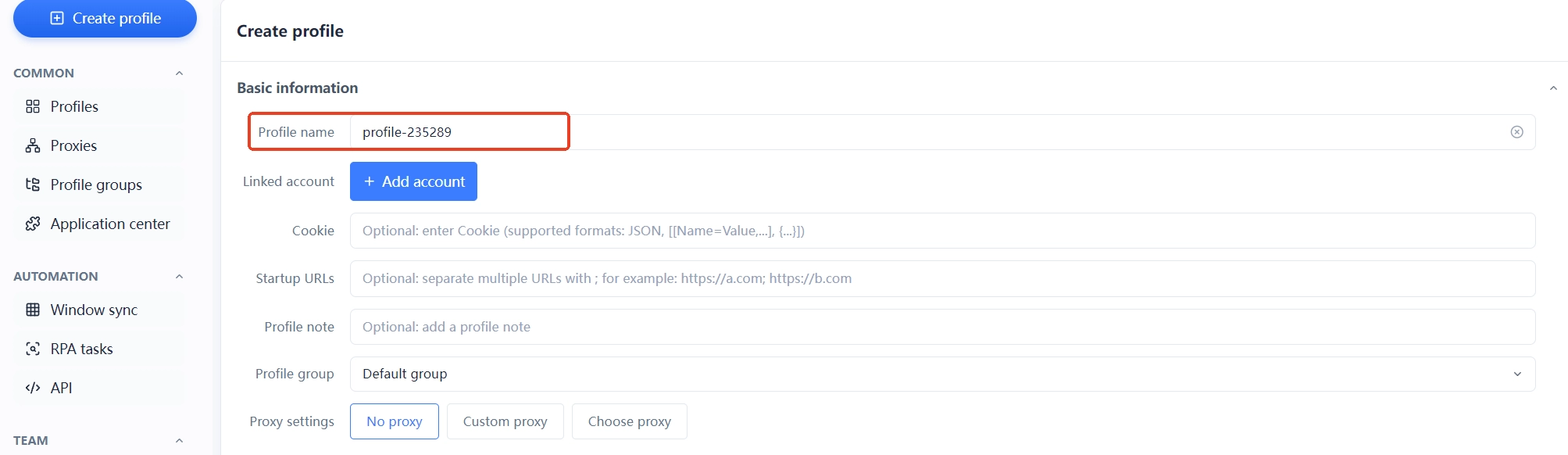
Theory is clear; now see how it lands. I always follow this fixed workflow when building environments for each wallet — use it as a template:
eth-interact-9f3a, arb-stake-b22c — with many environments, distinguish wallets by suffix, not by memory.
The essence of this workflow is operating every wallet as an independent "on-chain identity" — environments, networks and behaviors all separate; the project sees a group of unrelated real users, not dozens of avatars of one puppeteer behind the scenes.
The method is fine; pitfalls hide in details. These 4 pitfalls are common in the airdrop farming circle; writing them out to help you avoid them:
The first three pitfalls expose links; the fourth loses assets directly — isolation prevents association, private key security keeps you alive — neither can be skipped.
When wallets grow from a few to dozens, the biggest headache isn't interaction — it's managing environments: which environment has which wallet, which chain it's on, which proxy is bound — pure memory can't hold it. Take MasBrowser as an example, here's how I manage Web3 environments:

Airdrop farming is essentially "trading time for uncertain returns"; what environment management can do is make the certain parts excellent: each wallet has a complete independent identity, a clean ledger, a traceable environment. The free plan includes 2 environment slots — build the first wallet's independent environment first, run the flow through, then scale up step by step.
Yes. One wallet = one independent environment + independent proxy + independent wallet extension — this is the basic unit of Web3 environment isolation. Two wallets sharing an environment is equivalent to writing "these two belong to the same person" on your forehead; Sybil detection catches it every time.
Same as a normal browser: search and install from the extension store (MetaMask etc.), then import that environment's dedicated seed phrase. The key isn't "how to install" but "one environment installs only one wallet, imports only one seed phrase set".
Four dimensions: network layer (shared IP), device layer (identical fingerprints), behavior layer (same time, same path), funds layer (same fund source). Environment isolation solves the first two; staggering behavior solves the third; the fourth requires fund planning — no tool can do it for you.
No universal standard; the principle is "behave like different people": different wallets interact in staggered time windows (hours to days apart), interaction paths scrambled, Gas consumption varied. Batch operations at the same time are the most typical behavior-layer signal.
Enough to start: first run the flow through with 2 environments (install wallet, bind proxy, do one interaction, verify the on-chain record), then consider paid scaling once confirmed. Airdrop farming is a long game; environment management capability matters more than environment count.
There's no sure-win formula for airdrops, but environment isolation has clear principles: the wallet is your identity, the environment is your skin, the IP is your address, the RPC is your phone line — all four lines independent, behavior staggered — only then do multiple accounts count as "strangers to each other". Conversely, shared environments, shared nodes, synchronized behavior — any single flaw can zero out three months of work.
To be clear: project rules change at any time, and no tool guarantees "never flagged as Sybil"; private key security is always your own responsibility. Do the certain parts well — independent environments, clean ledgers, cautious operations — and leave the rest to luck. Start with the first wallet and give it a complete independent identity; the free plan's 2 environment slots are enough to run the flow through first: download MasBrowser and build the first environment.