
MasBrowser
Customer supportLoading messages…
Loading messages…
You are viewing a previous conversation.
Enter to send · Shift + Enter for a new line
Loading messages…
You are viewing a previous conversation.
Enter to send · Shift + Enter for a new line
If you work in cross-border e-commerce, you have probably bounced between two platforms: eBay built its base on the US and European markets, while AliExpress feeds on emerging markets. Both platforms suit the "multi-store product flooding" approach — opening several stores for one product to spread risk and expand exposure.
But the biggest landmine in multi-store operations is association. The most typical eBay case I have seen: a seller bound three accounts to the same PayPal, thinking "it is convenient to have all the money flow into one account", and all three accounts were flagged as associated and taken down in one go. AliExpress is similar — multiple stores sharing one Alipay for payouts gets recognized by the system and directly restricted.
The association logic of eBay and AliExpress follows the same underlying framework as Amazon's "one store, one environment, one IP, one payout" (the general framework is fully broken down in Amazon multi-account anti-association), but these two platforms each have their own "unique danger zones". This article covers those unique points: payout systems, account systems, registration dimensions, and the pitfalls people fall into most easily when implementing them.
In one sentence: Amazon's association focuses on "device fingerprints", eBay on "payout binding", and AliExpress on the "Alibaba account ecosystem" — each platform has its own association weak point.
| Platform | Most-watched association dimension | Typical scenario |
|---|---|---|
| Amazon | Device fingerprint + IP + registration info | Logging in on the same computer, same Wi-Fi |
| eBay | Payout account binding (PayPal/Managed Payments) + registration info | Multiple accounts bound to the same PayPal |
| AliExpress | Alipay + phone number + identity info + device environment | Multiple stores sharing Alipay/same phone number |
Amazon's core is "device and identity", eBay's core is "where the money comes from", and AliExpress's core is "the Alibaba ecosystem behind the account" — different directions, but the same conclusion: any shared item between multiple stores is a risk.
In eBay's association determination, the payout dimension carries extremely high weight — because it was deeply tied to PayPal historically and now pushes Managed Payments, but "who is collecting the money" has always been the key clue for judging account ownership:
eBay's rule is: opening multiple accounts under the same identity requires compliance with platform policy and an authorization application; unauthorized multi-accounts, once judged as associated, get sales restricted at the light end and fully frozen at the heavy end.
AliExpress is an Alibaba-family platform, and its association determination is naturally tied to the Alipay and Taobao/Tmall account ecosystem — this is its biggest difference from eBay:
The first principle of AliExpress multi-stores: keep every store's payout account, phone number, and identity info completely separate, and keep distance from the Alibaba main account ecosystem.
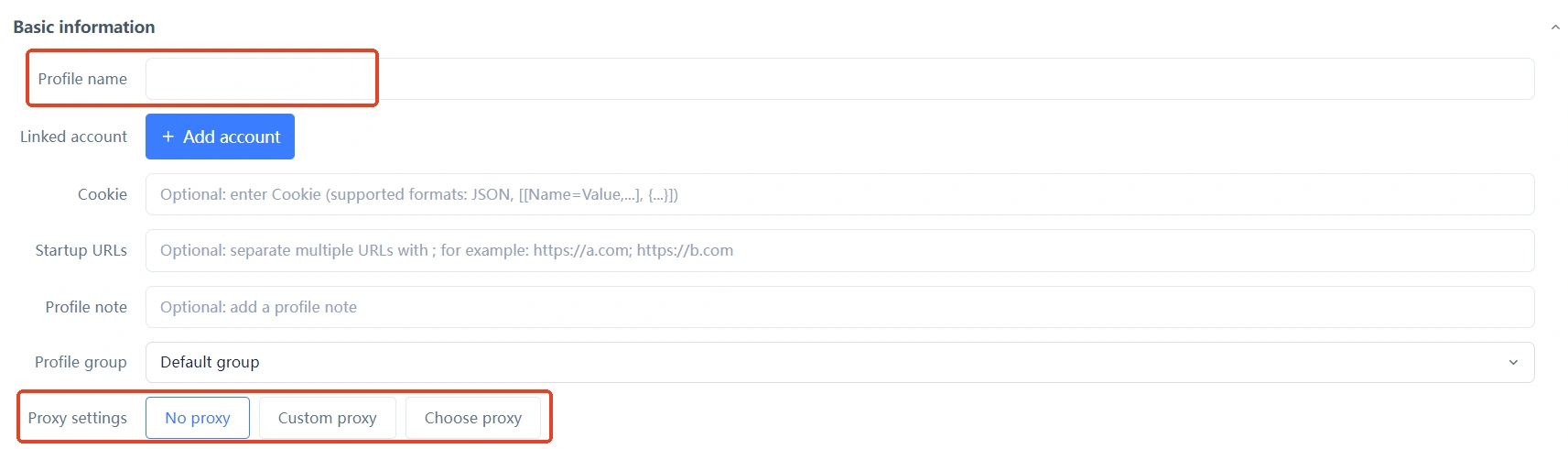
The framework is the same as the Amazon article — one store = one isolated environment + one dedicated IP + one separate payout + one separate set of registration info. The general steps are not repeated here (refer to Amazon multi-account anti-association). Only two platform-specific implementation points are added:
ebay-us-store01, ali-es-store02), and bind a dedicated proxy IP for the corresponding market;
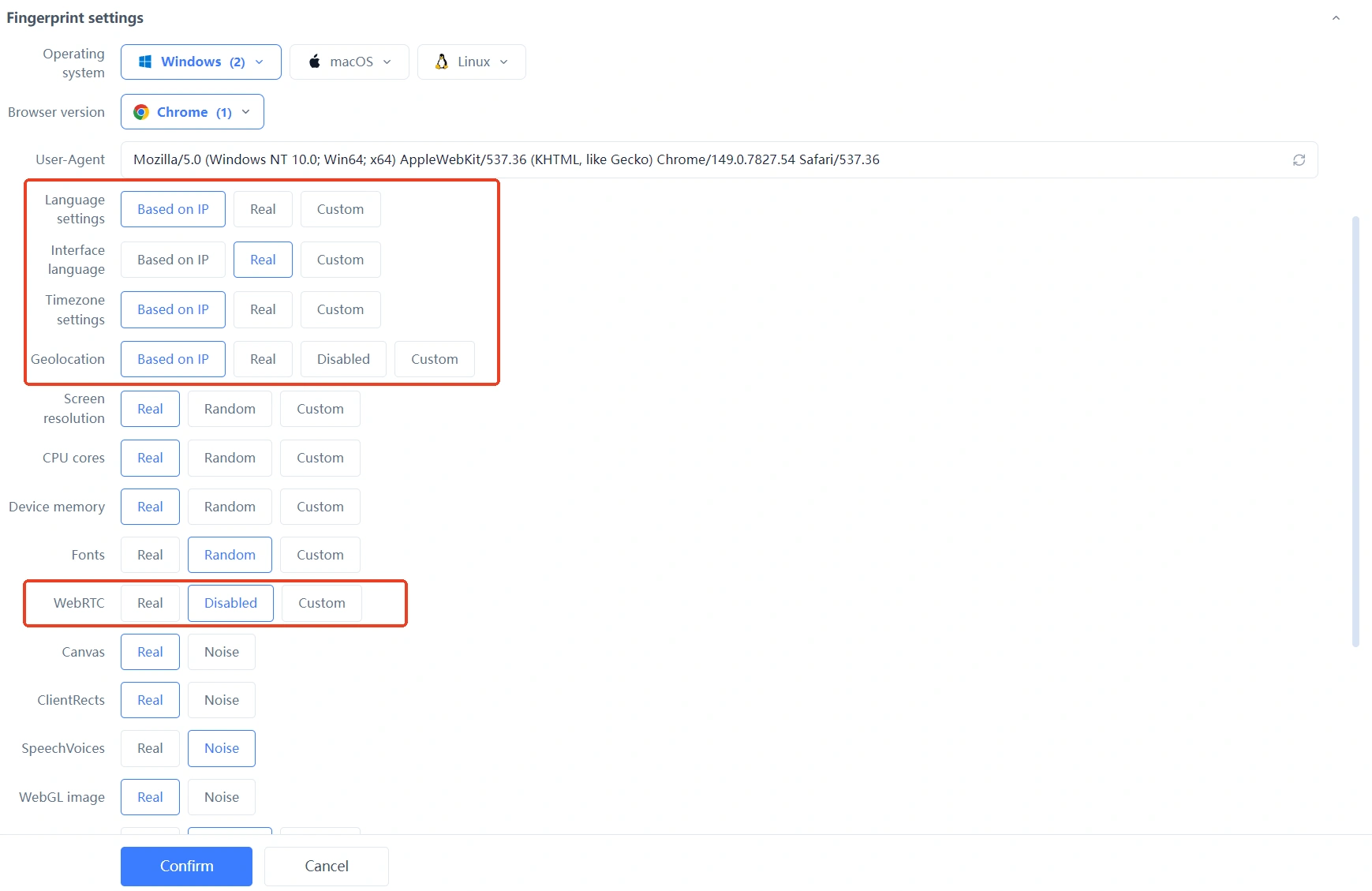
 In fingerprint settings, set language, time zone, and geographic location to "Configure based on IP" and set WebRTC to "Disabled". For complete isolated environment and fingerprint configuration, see the MasBrowser multi-account security management page.
You can configure payout isolation for the two platforms like this:
| Platform | Payout solution | Multi-store isolation point |
|---|---|---|
| eBay | PayPal (personal/business), card bound in Managed Payments | Each account uses an independent PayPal or payout card, never co-bound |
| AliExpress | Alipay International, business Alipay | Each store binds an independent Alipay payout account, not shared with the main account |
3-minute self-check: is your multi-store isolation in place? Quickly verify three things — ① open a detection site and confirm that the IP, time zone, and language in each store environment are consistent; ② log into each store's backend and check that the bound payout accounts (PayPal/Alipay) are all different; ③ review registration info and confirm no two stores share an email or phone number. Only when all three pass is the isolation truly in place.
Remember: the association logic of these two platforms is "payout > registration info > device environment" — isolation of payouts and registration info takes priority over environment.
No matter how detailed the explanation, nothing beats walking through the flow. Taking 2 stores on both eBay and AliExpress as an example:
ebay-us-01, ebay-uk-02, ali-es-01, ali-us-02), named "platform-site-number".The core of this flow is "isolate first, register second" — completing all isolation before registration is much safer than remediating after registration.
Multi-store is not "the more the better" — scale and configuration must match:
The bigger the scale, the more "institutionalized management" is needed — relying on the human brain to remember "which account uses which environment" will eventually mix things up.
Not recommended, and the risk is extremely high. eBay is very sensitive to payout account association; multiple accounts bound to the same PayPal is a typical association signal — sales get restricted at the light end, everything frozen at the heavy end.
AliExpress usually allows one subject to register multiple stores, but each store's registration info, payout account, and contact details must be independent. The specific quantity and policy are subject to the platform's official rules.
If you operate both platforms on the same device and network, it is recommended to split environments by "platform" at least; if each platform has multiple stores, split by "platform + store". Environment isolation is universal, and cross-platform isolation works the same way.
It cannot "completely avoid" it, but it can minimize the device fingerprint dimension of association risk to the lowest level. The "human dimensions" like payouts and registration info still need your own isolation — the tool manages environments; people manage info and funds.
The association core of eBay and AliExpress is not the device, but payouts and account systems: eBay watches who is collecting the money, AliExpress watches the Alibaba ecosystem behind the account. Environment isolation is only the first step — payout isolation and registration info isolation are the real weak points of these two platforms.
Get "independent payouts, independent info, independent environments" all done, and multi-stores can operate steadily. The free plan already includes 2 environment quotas. Download MasBrowser, create two environments to run through store isolation on one platform, then replicate it to other platforms.