
MasBrowser
Customer supportLoading messages…
Loading messages…
You are viewing a previous conversation.
Enter to send · Shift + Enter for a new line
Loading messages…
You are viewing a previous conversation.
Enter to send · Shift + Enter for a new line
You open Seller Central in the morning and the account health page is all red — selling privileges removed. It's the scene every Amazon seller dreads. Worse, many sellers' first reaction is to panic-submit an appeal immediately, writing a pleading letter full of protest — rejected within hours, with an appeal opportunity wasted for nothing.
Conclusion first: the correct move after suspension is "attribute first, appeal second" — Amazon's suspension email already states the cause category, and each category demands a completely different response; and an appeal letter is not a plea, it's an action report of "root cause + correction + prevention." This article walks through every post-suspension step in order: self-check → write the appeal → run the process → handle funds → prevent a second suspension.
After the suspension notice arrives, step one is not writing the appeal — it's figuring out which kind of suspension you got. Open the suspension email and the account health page and match against the four cause categories below (the mechanics of association detection are fully covered in What is a fingerprint browser; here we focus on "after the ban"):
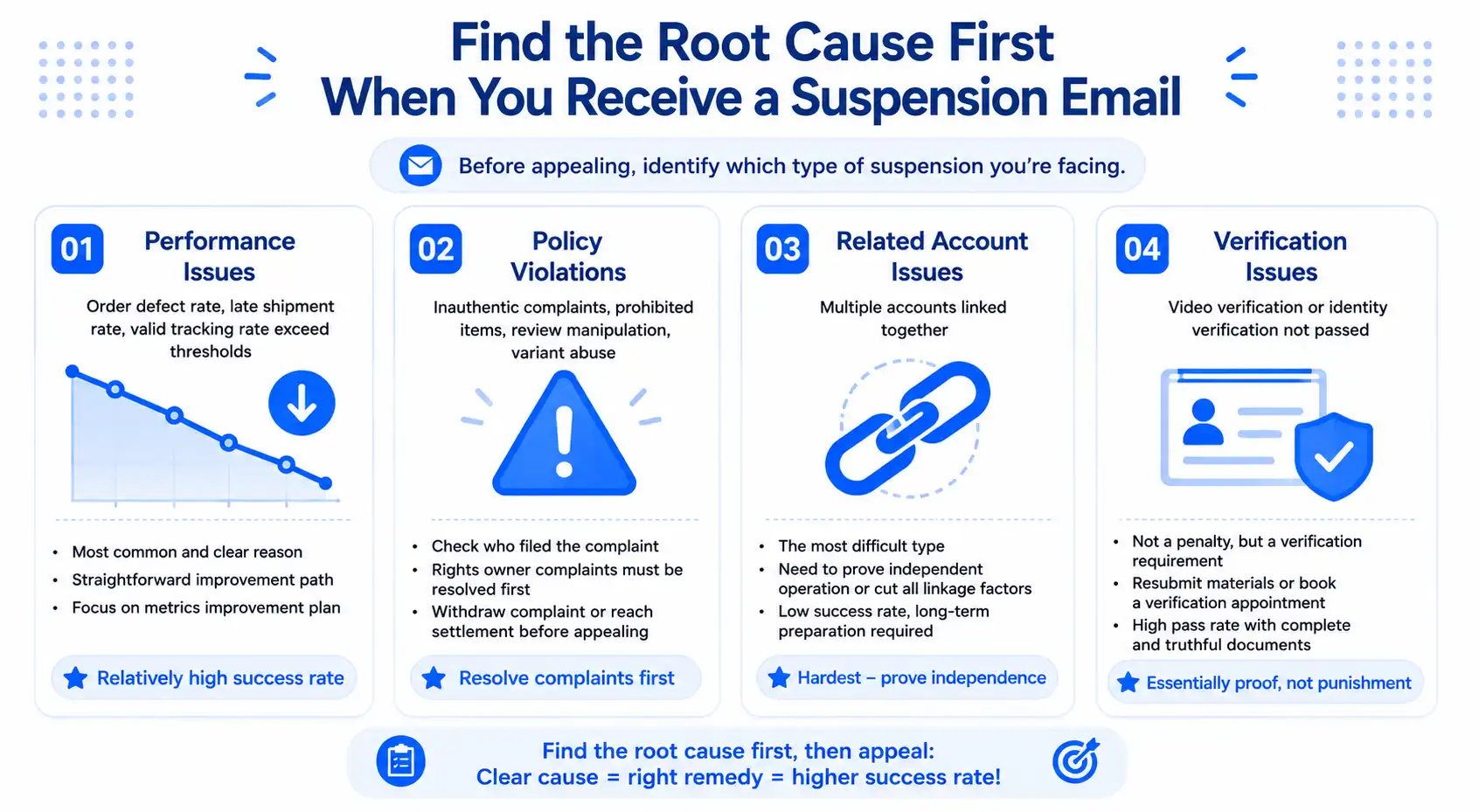
Four self-check questions: Which category does the suspension email name? What red flags remain on the account health page? Any warning emails recently left unhandled? For multi-account operators, any recent changes to environments or networks? — answer all four and your appeal direction is basically set. Wrong direction, and however well you write later, it's wasted.
The person reviewing appeals reads hundreds a day and cares about exactly one thing: will this problem happen again. So the golden structure of an appeal letter (Plan of Action) has three parts:
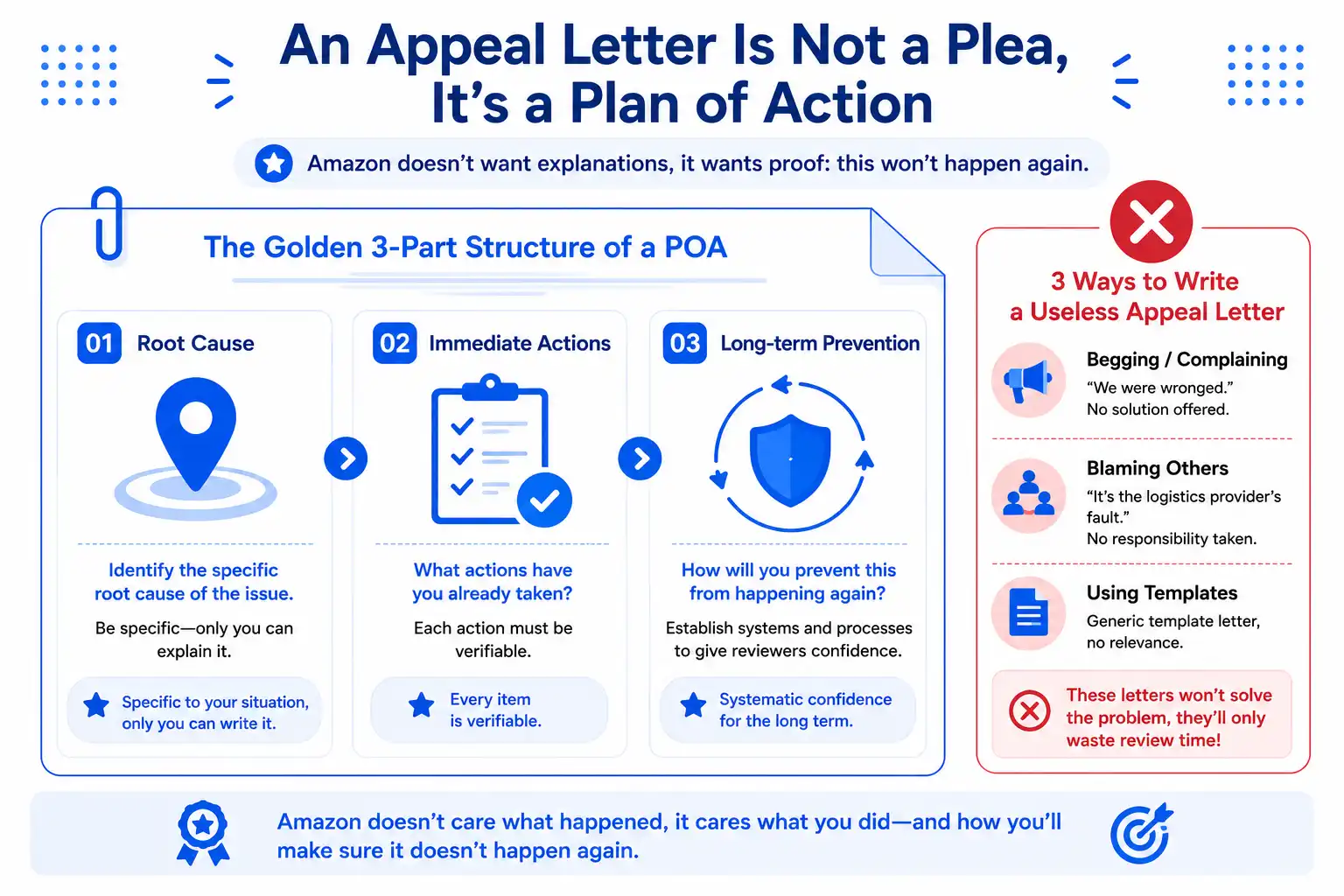
Three most common mistakes, each wasting an appeal opportunity:
Self-review after writing: if swapping "you" for any other seller leaves the letter valid, it's disqualified — root cause and measures must be specific enough that only you could have written them.
Attribution clear, letter written — proceed at this rhythm (entry points per the actual Seller Central interface):
The tone for the whole process: appeals persuade with evidence, not with emotion — before each submission ask: what's new in this letter versus the last?
Beyond the store itself, the account balance is what hurts most. General rules (defer to platform guidance):
Reinstatement isn't the end — the grounds for a second suspension usually hide in what the first cleanup missed. Three self-checks:
No official data, and it varies hugely by category: performance and verification appeals pass relatively often; policy violations depend on whether the complaint is resolved; association is lowest. Rather than agonizing over odds, spend the effort on attribution and letter quality — same category, the gap between a "templated protest" and a "specific correction report" is enormous.
Length isn't the point; specificity is. Write the three-part structure (root cause / immediate measures / long-term prevention) thoroughly — usually a few hundred to a thousand words; long letters stuffed with irrelevant detail dilute the focus. The test stays the same: is the content specific enough that only your store could have written it?
Yes, but be prepared: association is the hardest category to appeal, requiring item-by-item proof that association factors are severed (devices, network, payouts, operating habits) — high documentation demands, long timelines. If evidence of independence is insufficient, prioritize fund recovery and unaffected accounts.
Strongly discouraged. Re-registering with the entity info of a ruled violation or association (legal person, credit card, payout account, network environment) will likely be quickly identified and banned again, and may drag down other healthy accounts. The right order: fully understand the cause, fix every problem, then plan a new account — and it must operate in a completely independent environment and network.
Three daily habits: ① review the account health page weekly — handle any downward trend immediately, don't wait for red flags; ② respond to warning emails the same day — most bans had prior warnings; ③ for multi-account operations, do environment isolation first — independent fingerprints, independent proxies, independent payouts, defusing the "association" mine at the source (the full multi-store anti-association architecture is in our on-site Amazon multi-store article).
A suspension stings, but broken down it's four things: attribute clearly within 72 hours, write the letter specifically along "root cause + correction + prevention," re-appeal with increments after rejection, and never miss the funds window — most people fail because step one's direction is wrong; the rest fail because their letters carry emotion but no action.
And reinstatement is halftime, not the finish: the self-checks across environment, payout, and operating habits decide how far this account (and the others under your name) can go. Multi-account operators especially should build environment isolation before the ban — don't wait for the platform to "associate" you before fixing it.
If you're running multiple stores, start by running through the self-check list above against your current state; if you haven't managed accounts in independent environments yet, the free plan's 2 environment slots are enough to start with your most important store — Download MasBrowser, and keep suspension risk from ever materializing.