
MasBrowser
Customer supportLoading messages…
Loading messages…
You are viewing a previous conversation.
Enter to send · Shift + Enter for a new line
Loading messages…
You are viewing a previous conversation.
Enter to send · Shift + Enter for a new line
People searching "free proxy IP" share one motive: save wherever possible. Multi-store e-commerce sellers want to save a proxy fee per store, social-matrix builders want to run the flow free first, and students just want to see region-specific search results from elsewhere. Free proxy lists are everywhere online — copy an IP plus port and it works, looking zero-cost and zero-barrier.
Conclusion first: free proxies aren't unusable — the usable space is far narrower than you think. Non-login, no-sensitive-data light tasks can make do; but anything involving account logins, payment info, or long-term operations, the price of "free" often becomes dozens of times the cost of paid proxies. This article explains where free proxies' money comes from (understand that and you understand why they're dangerous), how the three risks actually happen, and which scenarios are usable versus strictly off-limits.
Ask yourself: servers, bandwidth, and maintenance all cost money — why would anyone provide proxies for free? (For proxy origin and types, see the full breakdown in Residential vs Datacenter IP; here we focus on "free" itself.)
Free proxies have roughly four sources and "business models":
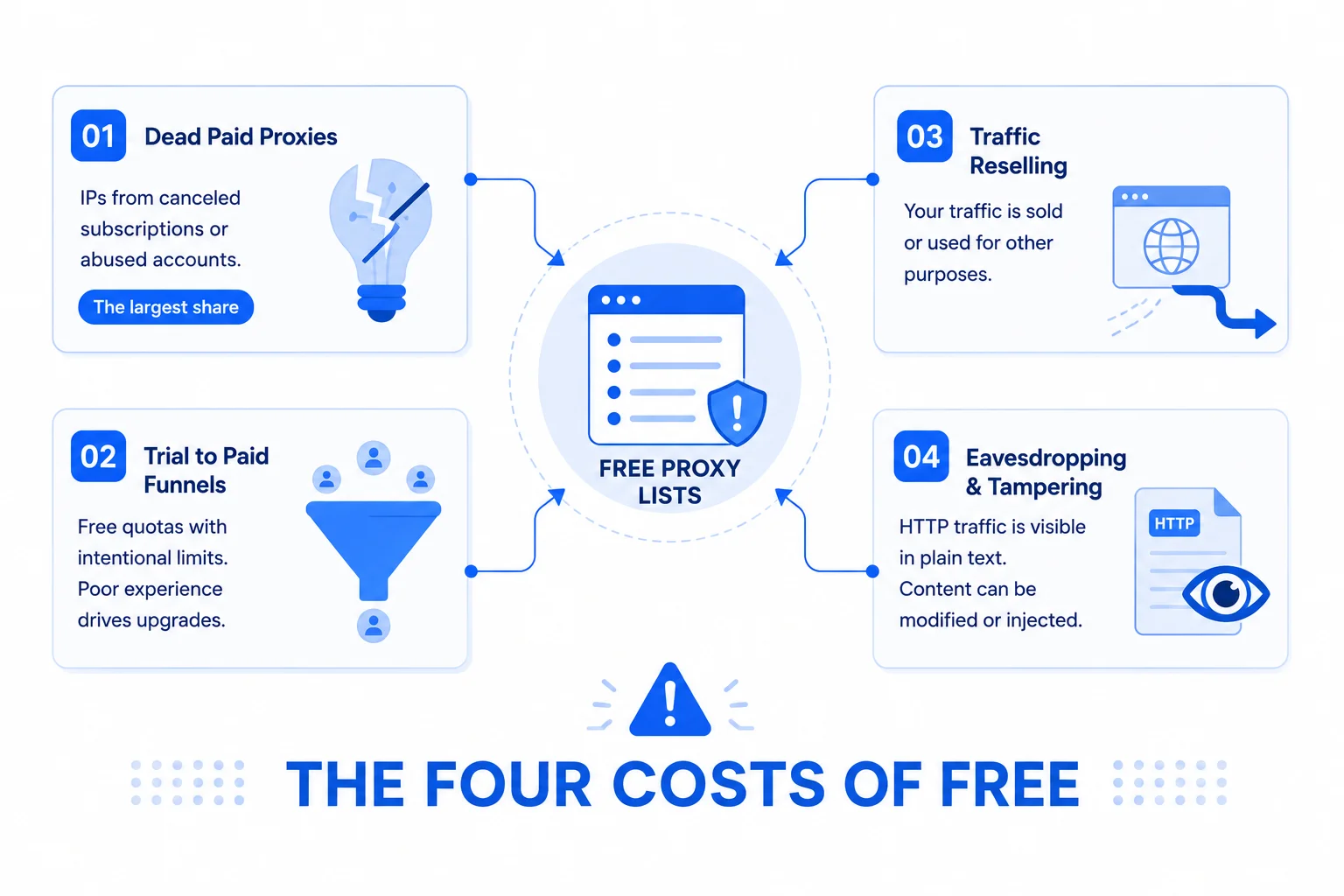
One line to remember the nature of free proxies: if you don't pay, you're part of the product — what you spend isn't money, it's bandwidth, data, and usage security.
Many articles only say "free proxies are unstable," but instability is the mildest item. Ranked from most to least harmful:
What the three risks share: none of them explodes "while you use it" — all explode "after you've used it" — the account is banned, funds frozen, CAPTCHAs flooding in, and only then do you recall the problem was that "free" IP.
That said, free proxies aren't useless — the test is "would a leak cost nothing and would a failure cost nothing":
Scenarios where free proxies are fine:
What these share: no logins, no passwords, no login state to carry forward — even if the IP leaks or dies, the loss approaches zero.
Scenarios where free proxies are strictly off-limits:
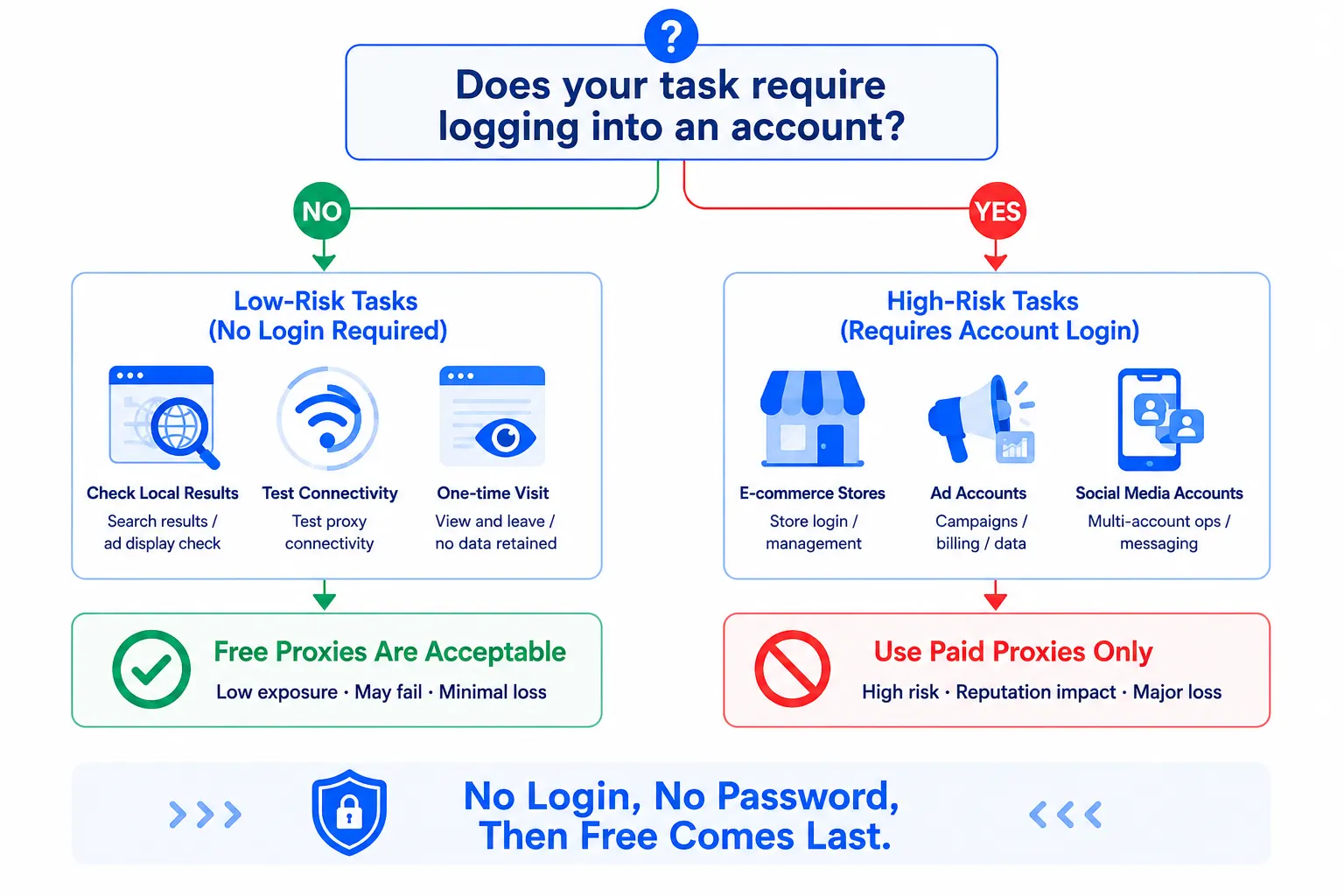
One-line decision: a free proxy is a "toy"; a paid proxy is a "tool" — toys are for playing; only tools deserve to touch your business assets.
Skipping free proxies doesn't mean buying the priciest. Tier by business value:
Here's the math that matters most in this article: a store account's lifetime value (monthly profit × expected months alive) dwarfs a year's proxy fees. Saving a few hundred RMB a year on proxies costs you everything that follows a ban — re-registration, re-nurturing, rebuilding authority — a paid proxy isn't an expense; it's insurance on your account assets.
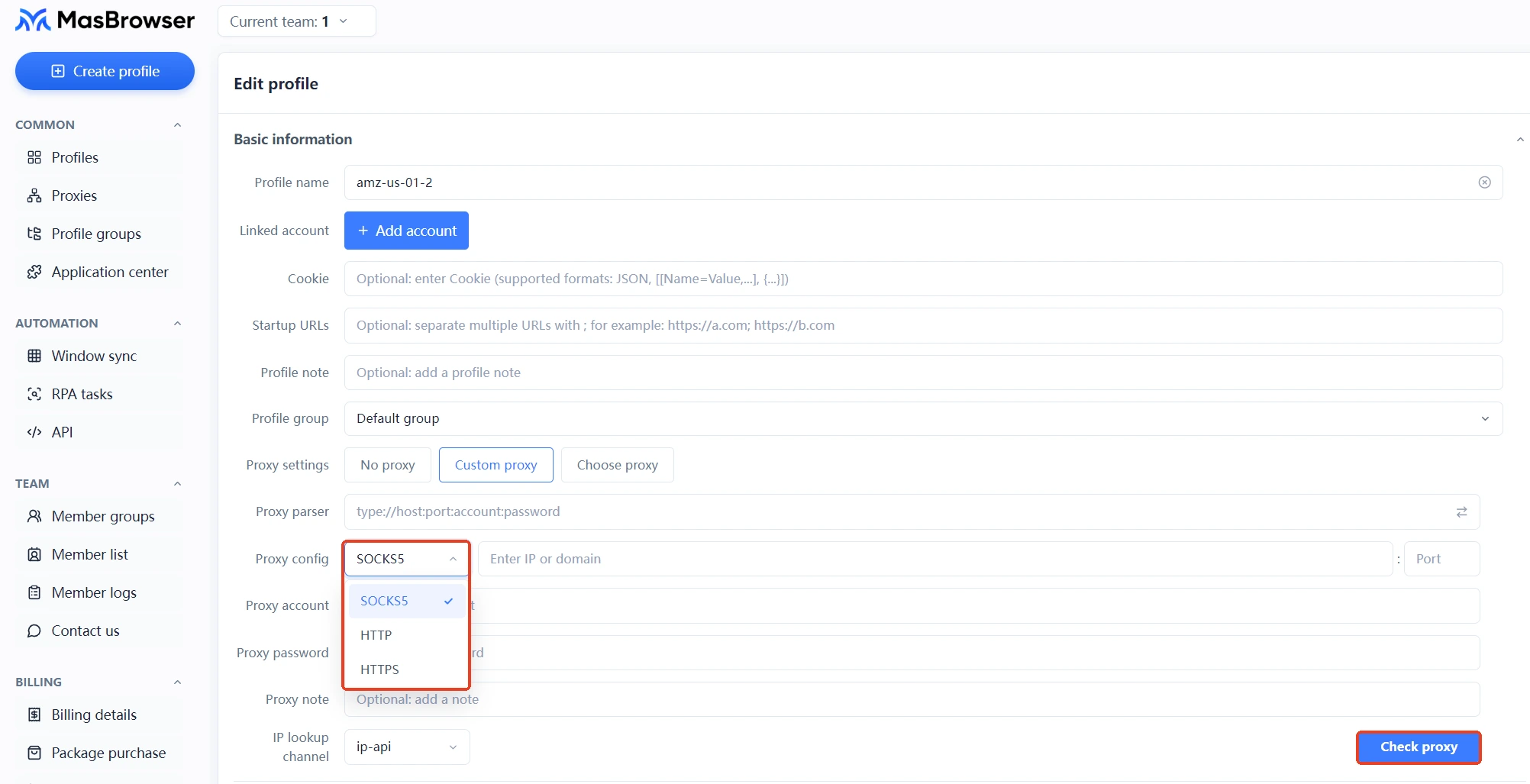
After buying a proxy, wiring it in is simple: in a fingerprint browser (MasBrowser for example), pick the proxy type (SOCKS5 / HTTP / HTTPS) in the profile, fill in type://host:port:account:password format, hit Check proxy to test connectivity and region in one click — log into the account only after the test passes (step-by-step in the fingerprint browser proxy setup guide).
Not speed — it's "who's watching your traffic" and "the IP's history": paid proxies have commercial contracts and purity maintenance; free proxies may snoop your traffic AND carry countless predecessors' violation records. For account operations, the second is deadlier.
The risk exists and cannot be ruled out. HTTP-type free proxies can read your unencrypted request content in plaintext (including form credentials); HTTPS traffic is encrypted but the operator still learns which platforms you visit — you can't verify the provider's motives or competence. Anything involving logins should never go through a free proxy — that's the only safe boundary.
High probability — it's only a matter of time. Either IP reputation inheritance triggers risk control directly, or the proxy's frequent deaths make your login address jump, or intercepted credentials lead to malicious account activity — all three roads reach the same destination.
Absolutely safe free proxies don't exist — you can't verify the provider's motives or the IP's history. The relatively safe "free" is a legitimate product's free quota (like a fingerprint browser's free environments + trial proxies), backed by commercial reputation — a different species from public free lists.
Yes — provided you strictly observe the boundary: no account logins, no passwords or payment details, no login state to carry forward. Discard everything after testing, and never copy test-environment configs into production.
Depends on type: basic static datacenter proxies start at a dozen-to-few-dozen RMB monthly on small plans; static residential a bit more; matched to account value, annual cost runs from a few hundred to one-two thousand RMB. For comparison: the loss from one high-value account ban (frozen funds + re-nurturing cost + rebuild time) usually exceeds a decade of proxy fees — that's why a proxy is insurance, not an expense.
Whether free proxies are usable depends on what you're using them for: viewing a region-specific page — fine; touching any account assets — no. Their three risks — traffic snooping, IP reputation inheritance, stability collapse — all detonate "after use," and by then you pay far more than you saved.
The right approach is tiering: testing on free quotas or no-login scenarios, light needs on cheap paid static, account operations on proper solutions matched by "account region = proxy region = fingerprint region." Remember the math: proxy fees are insurance on account assets, not operating costs.
Run the flow free-first (MasBrowser's free plan, 2 environment slots, paired with a legitimate trial proxy), confirm you understand the mechanics, then configure paid solutions for business assets — Download MasBrowser and run your proxy setup the proper way.