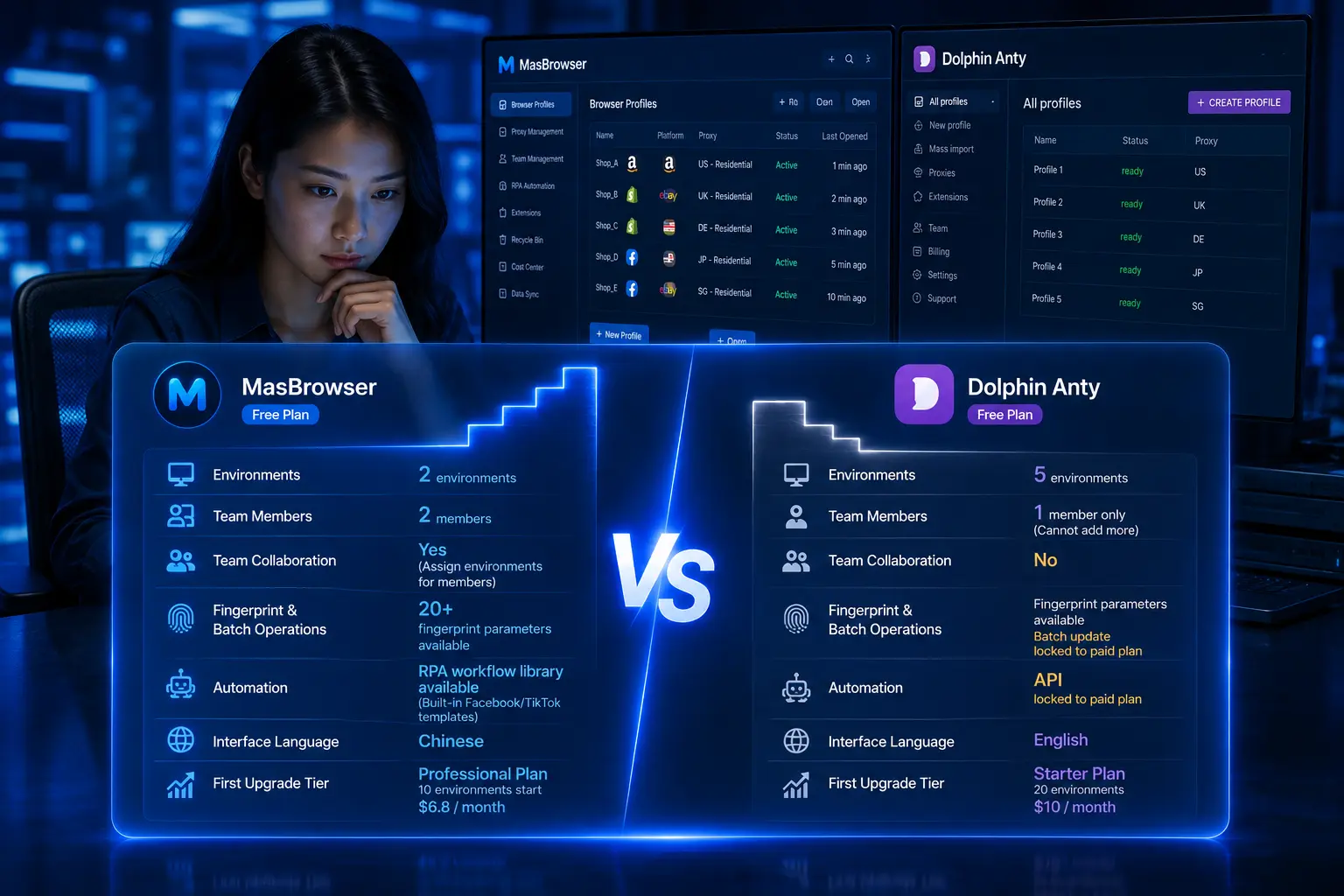
How to Run Multiple Etsy Shops Without Association? Win the Handmade Market with MasBrowser
Anyone selling handmade goods has probably had this dilemma: you've been selling homemade jewelry on Etsy for two years, and the more you grow, the more you want to expand categories — wedding accessories, home goods, holiday custom pieces all tempt you, but one shop can only carry one main style. Opening new shops, though, brings the fear of "being judged associated" — once accounts are considered connected, search demotion, halved traffic, even delisting can follow.
Etsy is different from Amazon and Walmart: it's a handmade/original ecosystem, and the platform's tolerance for "multiple shops" is actually the highest among the major platforms (handmakers commonly open shops by style), but the logic of association judgment also differs from retail e-commerce. This article is about Etsy multi-shop anti-association — how Etsy judges association, how to divide shops without problems, what Etsy-specific red lines exist in operations, and how to manage environments for multiple shops.
Why Are Etsy Multi-Shops Worth Doing? First Understand the Handmade Platform Logic
First, Etsy's market structure. Etsy's seller profile is completely different from Amazon/Walmart:
- Handcrafters, designers and small brands dominate; the average single-shop scale is much smaller than retail e-commerce, but average order value and repurchase are often higher (fans identify with the design sensibility).
- Multi-shops are "normal play" on Etsy: handmakers commonly open multiple shops by style/scenario (wedding/daily/holiday), and the platform's tolerance for multi-shops is higher than Amazon's — but on the premise that each shop has an independent positioning and content.
- Etsy's search algorithm (Etsy SEO) and Offsite Ads are the traffic core: unlike Amazon's A9, Etsy's search ranking weighs more on "keyword matching of title/tags/description + conversion rate", and Offsite Ads is a pay-per-click traffic tool.
In other words, Etsy multi-shops are compliant by themselves, but "opening shops without planning" gets you flagged by association judgment (same-source device/IP/payout/bank account) — especially since Etsy cracks down hard on "fake orders" and "infringement", and the operations between multi-shops should look more like different small studios (the full breakdown of device isolation is in the MasBrowser fingerprint browser article, equally applicable to the Etsy scenario). Sellers running Etsy multi-shop matrices almost all use anti-detect browsers / fingerprint browsers like MasBrowser to manage multiple independent environments — the core of such tools is the reverse operation of browser fingerprinting, giving every shop a different device profile.
Etsy Association Judgment: How Does It Differ from Amazon and Walmart?
The dimensions of Etsy's association judgment are core-consistent with Amazon — device fingerprints, IP, payout accounts, registration info, cookie/browser traces (the complete Amazon multi-shop anti-association methodology is broken down in the Amazon multi-store anti-association article; here we only discuss Etsy's differences):
- Independent Shop Manager: every Etsy shop has an independent Shop Manager backend, with login state, orders and customer messages managed per shop — switching between multiple Shop Manager logins on the same device back and forth is the most basic association evidence.
- Payout accounts are Etsy's hard association: Etsy mainly collects payments through PayPal and Etsy Payments (Stripe backend); multiple shops sharing the same PayPal account or Stripe account under the same name is a key signal for Etsy to judge "the same seller".
- Bank accounts are checked at the KYC stage: opening Etsy Payments requires submitting bank account, ID documents and address — the reuse level of these documents directly decides whether Etsy flags multiple accounts at the KYC stage.
- Etsy's multi-shop association threshold is "softer" than Amazon's: after association, Etsy usually applies search demotion, traffic decline, or throttling of individual shops, rarely direct "cascading" store closures; but secondary association triggering fake orders or infringement gets escalated quickly.
The key check tool for Etsy association is a fingerprint test / fingerprint check — sellers only need to run it in each environment once to see whether each "device's" profile is recognized as the same source across multiple accounts; this is exactly what fingerprint browsers like MasBrowser solve: making the fingerprint profile of each shop environment independent.
How to Lay Out Etsy Multi-Shops: By Style, By Category, By Scenario
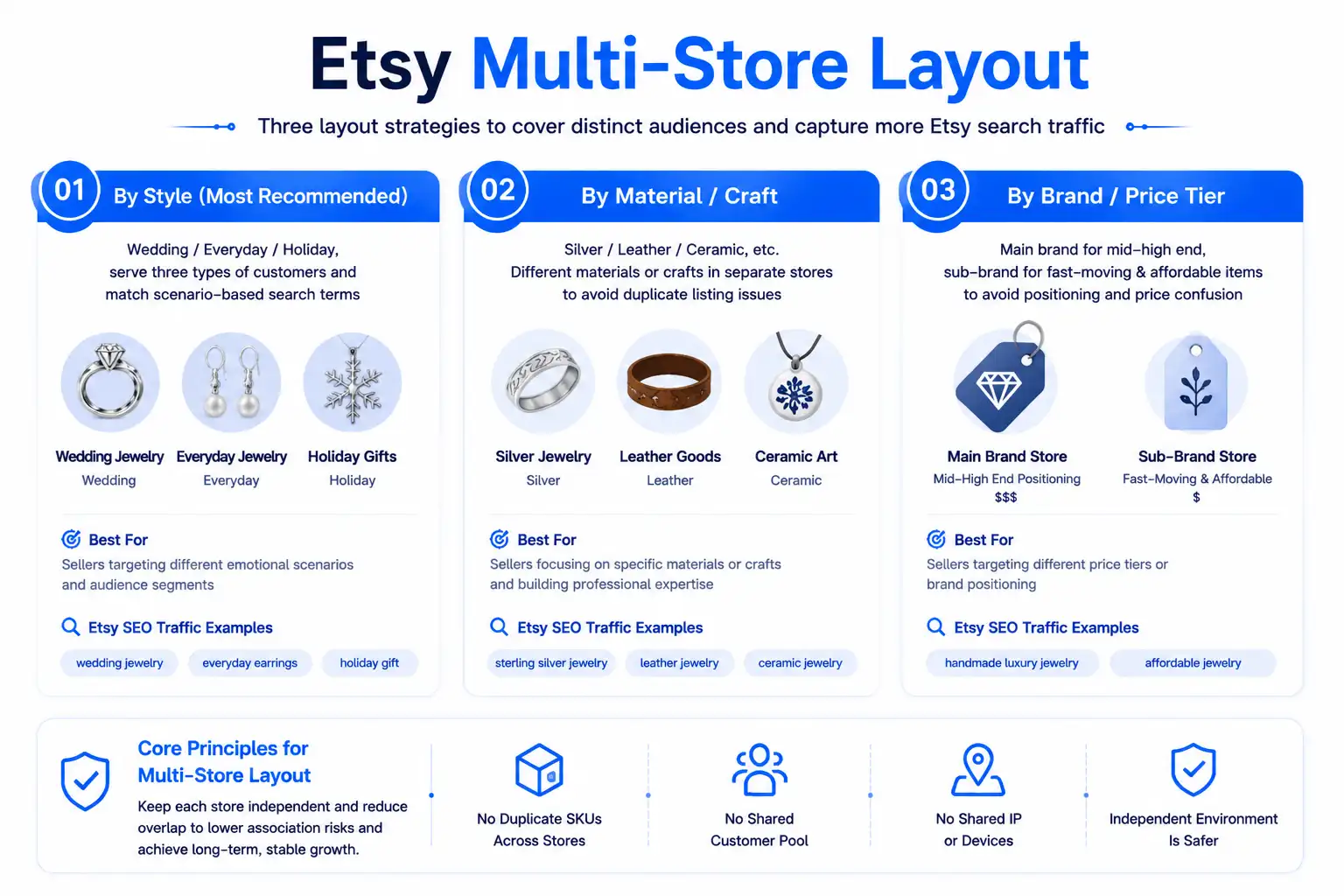
Etsy's multi-shop layout logic differs from Amazon's "divide by category" — on a handmade platform, dividing shops by "style/emotional scenario/customer group" is more natural:
- Divide by style (most recommended): wedding accessories, everyday jewelry, holiday custom pieces — three shops serving three types of customers. Etsy's search traffic also divides by "scenario words" ("wedding jewelry", "everyday earrings", "holiday gift"), so dividing by style exactly hits the segmented traffic entrances of Etsy SEO.
- Divide by material/craft: silver shop, leather shop, ceramic shop, woodwork shop — the same handmaker's works in different materials live in different shops without Etsy judging "same product, multiple shops".
- Divide by brand/price band: the main brand does mid-to-high-end, a sub-brand does fast-moving volume — avoids "style confusion" for customers of different price bands in one shop, and avoids the platform spotting association in the price-comparison dimension.
The key to getting the layout right is "no identical SKUs between shops, no shared customer pools, no shared IP/device" — Etsy's "association" judgment is essentially about this "overlap level".
Etsy Multi-Shop Operation Red Lines: Originality, Offsite Ads, Buyer Messages
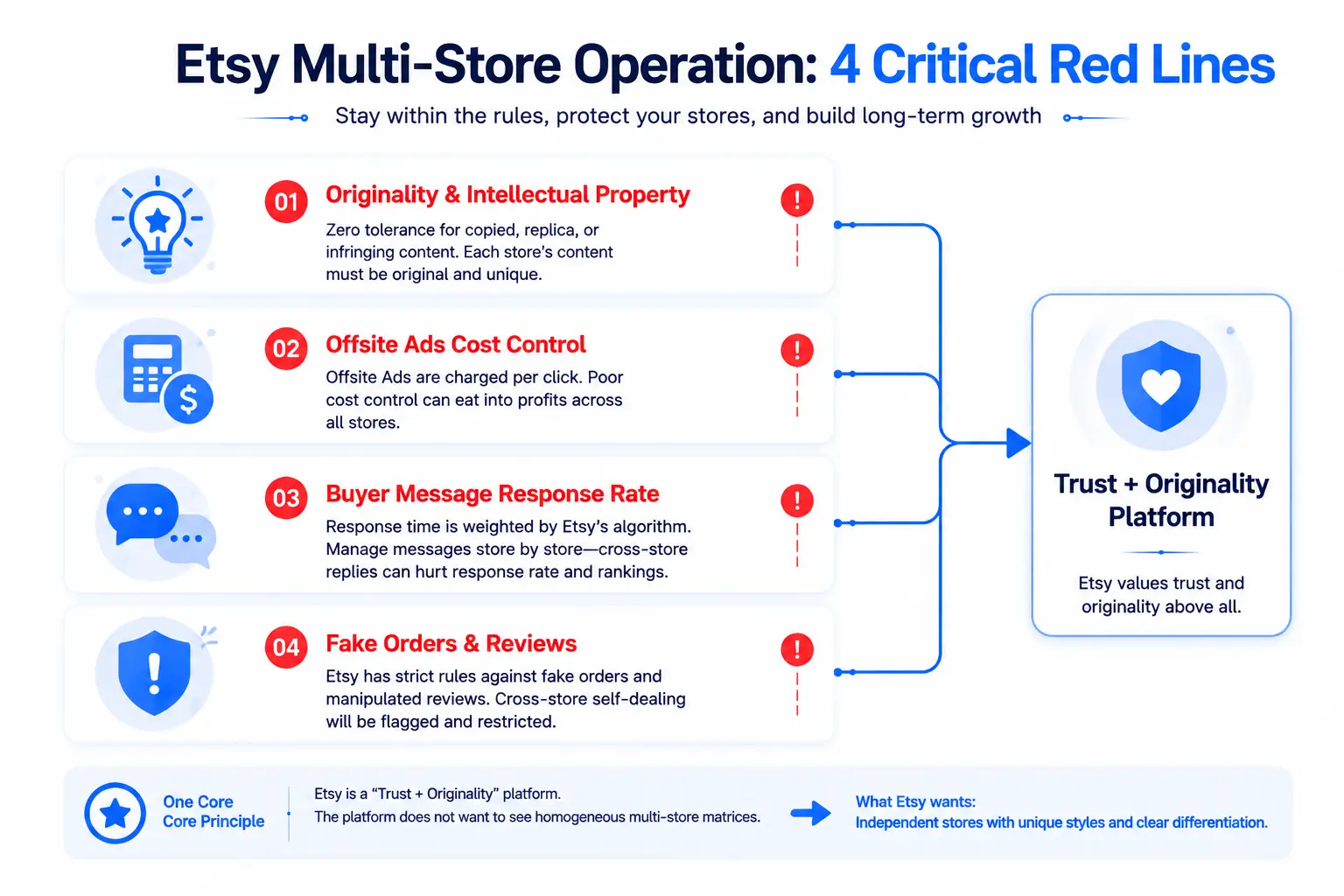
Etsy multi-shops aren't just about "anti-association" — the operation red lines are "softer" than retail e-commerce but equally fatal:
- Zero tolerance for originality and IP infringement: Etsy has zero tolerance for "reposting/copycat/infringement" — if "identical images/identical descriptions/identical listings" appear between multi-shops, reporting leads to delisting. Material between matrix shops must be originally made by each.
- Offsite Ads cost control: Etsy's Offsite Ads charges per click; without controlling "invalid clicks", multi-shop profits get eaten by ads — before enabling Offsite Ads in the matrix, check whether per-item profit covers click costs.
- Buyer message response rate: Etsy's algorithm weighs "message response time" — buyer messages in multi-shops should be managed per shop; cross-shop replies drag down the response rate, which then affects search ranking.
- Fake orders and review red line: Etsy's judgment on fake orders and fake reviews is stricter than retail platforms (handmade trust is the core); cross-shop fake activity among multi-shops gets flagged directly by risk control.
All four red lines share one logic: Etsy is a "trust + originality" platform. The platform doesn't want to see "homogenized multi-shop matrices"; it wants "differentiated multi-style independent shops".
Managing Etsy Multi-Shop Environments with MasBrowser
Etsy multi-shop environment management follows the same one-shop-one-environment-one-IP architecture as Amazon and Walmart, with two Etsy-scenario notes. Taking MasBrowser as an example:
- Environment naming = shop-style-number: name environments "ET-style-number" (e.g.
et-wedding-01,et-daily-02), so the environment list shows at a glance what style each shop runs — account-environment mapping crystal clear.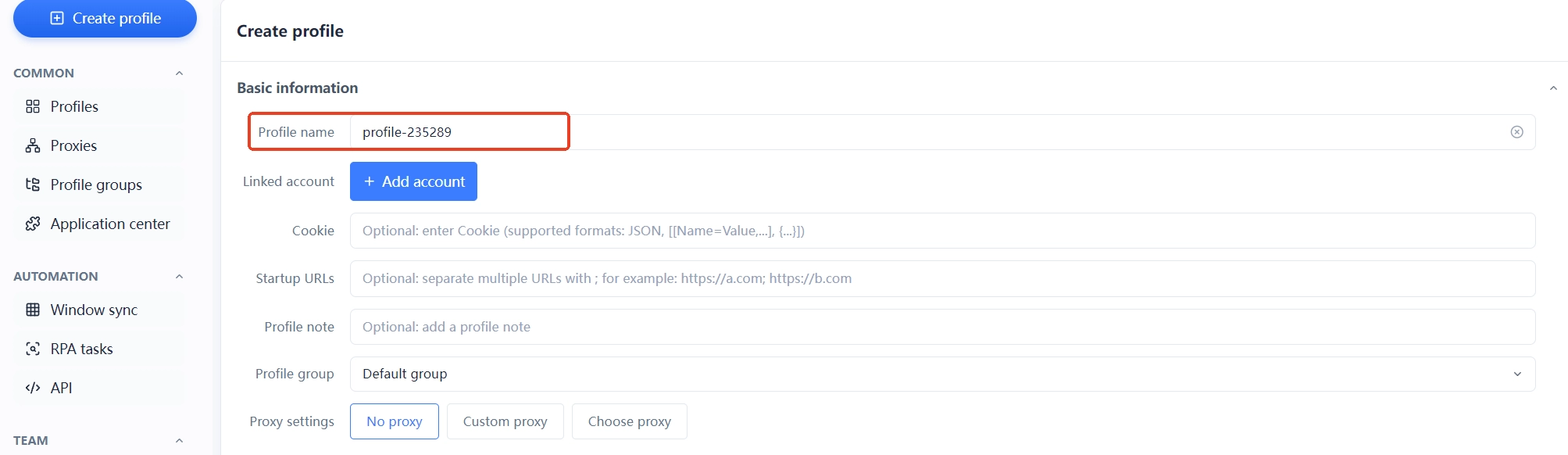
- One shop, one environment, one proxy: every Etsy shop gets an independent environment and independent proxy (US shops bind US IPs, EU shops bind EU IPs), Shop Manager login states never cross — association is cut at the tool level.
- Independent PayPal/Stripe account configuration: record in environment remarks "which PayPal email, Stripe account and last four digits of bank account this shop uses", check this table first when self-auditing association (team collaboration and sharing usage is documented on the environment management page).
- Multi-platform environment zones: for those running an Etsy + Amazon + Walmart cross-platform matrix, name environments in separate zones by platform dimension, so platforms don't mix when troubleshooting association.
The moat of Etsy multi-shops is doing style differentiation + original material + environment independence right at the same time. The free plan already includes 2 environment slots — build the first Etsy shop environment, get the flow working, then replicate step by step.
FAQ
Can one person open multiple Etsy shops?
Yes, but multiple shops must be clearly differentiated by style/scenario/material, and each shop's registration info, payout account and Shop Manager must be independent. Etsy itself supports handmakers opening multiple shops (the same person, different styles), but does not support "same product, multiple shops for volume".
How do Etsy multi-shops self-check whether environments are associated?
A three-step self-check: step one, environment dimension — run a fingerprint check / browser fingerprint test for each shop to see whether every "machine's" UA, Canvas, WebGL, timezone and IP are fully independent; step two, account dimension — check my browser fingerprint to confirm each shop sits behind an independent browser profile; step three, Etsy business dimension — confirm PayPal/Stripe accounts, Shop Manager bank accounts and material images are all isolated as described above. All three pass, and association risk is basically under control.
Will Etsy shops get closed after association?
Not like Amazon's "close them all"; after association, Etsy usually applies demotion, throttling or search ranking decline to individual shops. In a few severe cases (infringement, fake orders) shops get closed, but there's usually a violation warning before closure — when a warning arrives, self-check the environment and pause high-risk actions first; that's more effective than directly appealing.
Can Etsy multi-shops use the same PayPal?
Absolutely not. The PayPal account is one of the core pieces of evidence in Etsy's association judgment; multiple shops sharing the same PayPal email or account is like handing in association evidence voluntarily. Each shop uses an independent PayPal account or different sub-accounts.
Is Etsy Offsite Ads worth enabling?
Depends on the category and profit margin: shops with high average order value (like wedding custom) and strong repurchase usually benefit from Offsite Ads; for low-AOV, high-volume shops, calculate click costs before enabling — enabling ads on some matrix shops and not others is a safer strategy.
Conclusion
Etsy multi-shops are the most natural way for handmakers to grow their business, but the platform ecosystem determines that "differentiation + originality + environment independence" must be right from day one: shops divided by style/scenario/material, material images originally made, one shop one environment one IP — get all three right and multi-shops are a growth engine on Etsy, not a risk source.
One reminder too: Etsy values "trust" more than any platform, and the operation actions between multi-shops (message response, Offsite Ads, listing optimization) should also feel like several independent small studios running their own businesses — this "independence" is both an Etsy algorithm preference and a hard metric against association judgment. Start from the first Etsy shop: think the style and material through first, then give it an independent environment — the free plan's 2 environment slots are enough to start, download MasBrowser and build the first environment.