
MasBrowser
Customer supportLoading messages…
Loading messages…
You are viewing a previous conversation.
Enter to send · Shift + Enter for a new line
Loading messages…
You are viewing a previous conversation.
Enter to send · Shift + Enter for a new line
Store-side anti-association done meticulously — one store, one environment, one IP, devices never mixed. Yet when Store A got flagged, Stores B and C were still dragged down in a retroactive sweep, with funds frozen in list order. The most painful line from the post-mortem: the device layer showed no overlap at all — what tied the stores together was money: the same payment account, the same withdrawal card.
Core takeaway: the key to payment anti-association is making every segment of the money flow "one store, one line": inbound (the store's payment entrance), storage (the account structure inside the payment tool) and outbound (the withdrawal bank card) kept independent, plus a layer of payment-dashboard login isolation that is too often ignored. Following the direction money flows, this guide clears up the isolation plan for all three segments and the common pitfalls in one pass.
Many sellers only watch "which payment account the store is bound to," but the money flow has three segments, and each one can string the stores together.
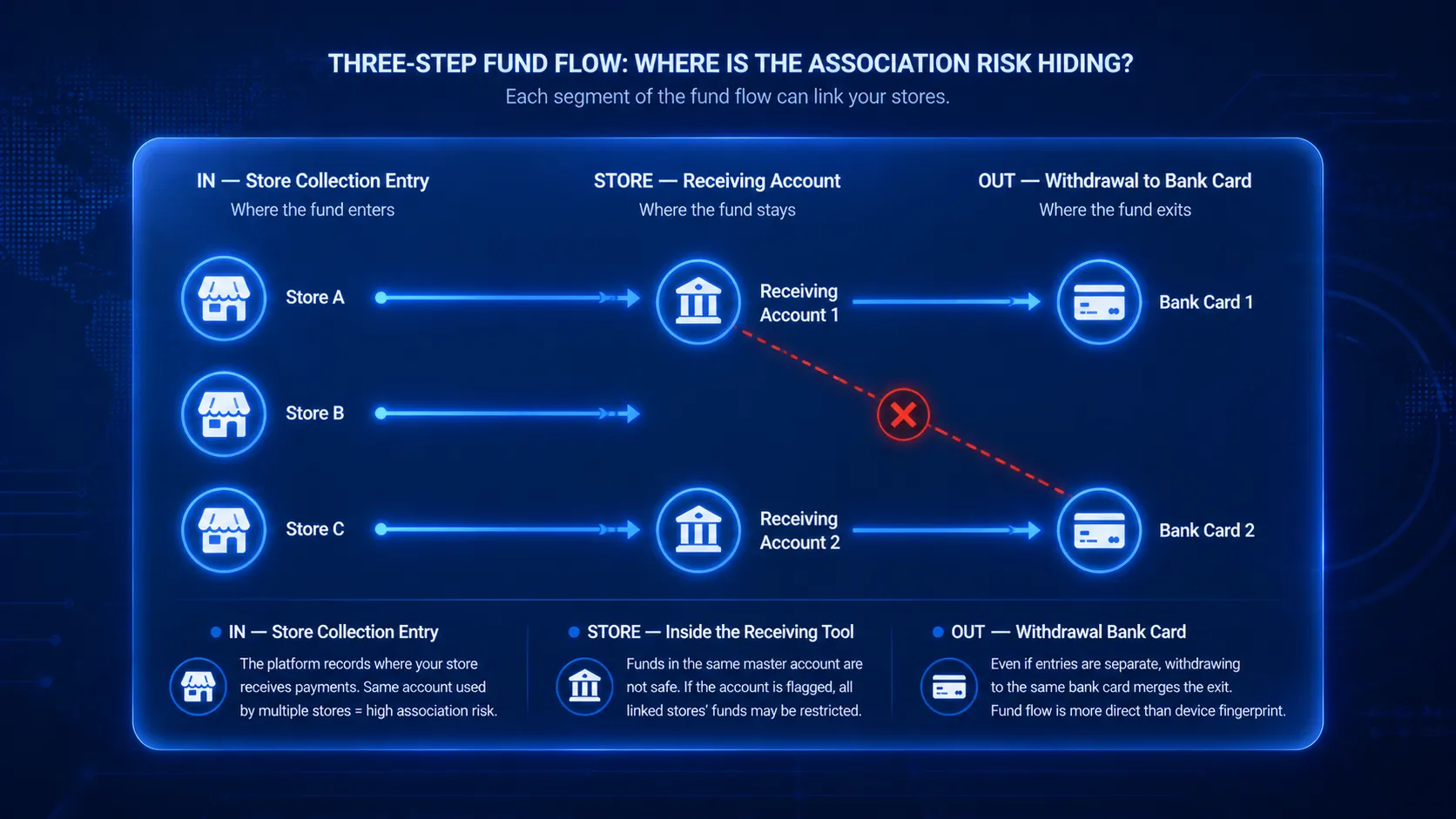
If any one of the three segments breaks, the other two being spotless will not save you. Here comes the isolation plan, segment by segment.
First classify the payment channels you hold, then decide between "sub-account pooling" and "separate main accounts."
Three common channel types:
The third-party tools' account structure is tiered by store risk:
One-line decision rule: split by entity first, then by risk, and only then think about convenience. Reverse the order and you are putting all your eggs in one basket.
Payment entrances split across three or four accounts, yet every withdrawal lands on the same bank card — the most common, most undeserved money-flow slip among multi-store sellers.
As noted above, platforms trace the complete money flow: Store A's money enters tool X and withdraws to card Y; Store B's money enters tool Z and also withdraws to card Y — the two lines converge at Y, and the evidence chain that "these stores share one owner" is complete. Isolation at the withdrawal-card segment is designed by entity:
A self-check method: draw all the stores on one chart — store → payment tool → withdrawal card — and look for two lines converging at the same point (the same main account, the same card). Any convergence point is your next mine.
Payment accounts go through KYC (identity verification); the consistency and authenticity of the documents decide how long this isolation structure stands.
Three principles — the first two are operations, the last one is the bottom line:
Dashboard isolation for stores is standard practice, yet payment dashboards are often logged in bare — and payment tools watch login environments no less tightly than e-commerce platforms do.
Two facts back this judgment: first, third-party payment tools all deploy bank-grade identity and device verification, and PayPal's risk control is industry-famously sensitive — new device logins, foreign IPs and fingerprint jumps are all its watch items; second, some e-commerce platforms explicitly monitor "the login IP and device fingerprint of payment accounts" (Wish's merchant policy writes payment-account consistency into its review dimensions), so trouble on the payment side boomerangs onto the store side.
The payment dashboard therefore follows the same isolation logic as the store dashboard:

No. What matters is risk tiering: stores under the same entity at the same risk level are fine with independent sub-accounts inside one tool; flagship versus test stores, or stores of different entities, should split into different main accounts. Entity first, risk second, convenience last.
Sub-accounts are a compliant feature the tool itself provides, and collecting per-store payments under one main account is fine. What you must understand: sub-accounts ultimately pool into the same main account — once that main account is risk-flagged, all sub-account funds get restricted together. So it isolates "the payment entrances between stores," not "the overall fund exit."
Judge by entity: stores under the same business entity withdrawing to that entity's settlement card is fine; stores of different entities (or with a big risk gap) must not converge at the withdrawal card — exit convergence is the most common mistake that zeroes out every isolation move made upstream.
It depends on the freeze reason and the platform's process: routine risk reviews usually unfreeze after documents are submitted; freezes caused by association rulings or falsified documents take long and rarely return the full amount. That is why isolation comes first — spreading funds across channels and entities means any single failure cannot take everything down, which is loss control by design.
Payment anti-association has no black magic — only one clearly drawn money-flow chart: inbound, storage, outbound, one store per line in each segment; documents real and consistent, entities independent. Store-side environment isolation answers "who is logging in," while fund-side flow isolation answers "where the money comes from and where it goes" — only when both ends are clean is the association evidence chain truly severed.
Design the fund isolation before opening accounts; the login-environment isolation you can start right now. The free plan includes 2 environment slots — download MasBrowser and isolate your payment dashboards first. The complete capabilities of multi-account environment management are on the MasBrowser multi-account security page.