
MasBrowser
Customer supportLoading messages…
Loading messages…
You are viewing a previous conversation.
Enter to send · Shift + Enter for a new line
Loading messages…
You are viewing a previous conversation.
Enter to send · Shift + Enter for a new line
Buying devices, setting up proxies, and building environments is the easy part. The hard part comes after your twentieth account: can you still say, for every single account, who manages it, where the password lives, and what state it is in? Most people cannot. Multi-account management is not an anti-ban technique at its core — it is asset management. Register every account as an asset with residual value, and the feeling of losing control disappears. Account tiers and daily ledgers working with nurturing rhythms are covered in Social Media Matrix Account Tiering; this article goes one level deeper into the asset-based method: what to register in your inventory, how to manage the account lifecycle, and how often to audit. The method works on any platform — e-commerce stores, social media matrices, Web3 wallet-interaction accounts alike.
Multi-account portfolios are a badly undervalued asset class — they cost money to build, hold residual value, and can be lost. A TikTok account nurtured for three months, an Amazon store with a seller rating, an aged email with accumulated login trust — rebuilding any of them costs weeks of operations plus proxy fees, and aged accounts trade from tens to thousands of dollars. Treat them as "just accounts I registered," and they end up scattered everywhere; treat them as assets, and you will register them the way a company tracks its fleet.
The cost of undervaluing them is backed by hard data: research on leaked credentials analyzed 19 billion exposed records and found that 94% of users reuse the same password across multiple platforms — multi-account operations are precisely the disaster zone, with one registration email reused for convenience and passwords copy-pasted between accounts, so one leak exposes everything. Industry statistics show that 43% of social media account takeovers come from attackers replaying old credentials from leak databases at scale, and global account-takeover losses reached roughly 17 billion USD in 2025 (source: StationX social media hacking statistics). Even more common is internal attrition: an operator leaves, and the five accounts logged into their phone disappear together with the passwords in their notes — the company has no record of those accounts anywhere.
The first move in asset-based management is to converge scattered account information into one inventory. But an inventory is not just an Excel sheet — the fields you register determine whether it becomes a real asset ledger or waste paper.
A qualified account asset inventory needs at least four field groups per account — identity, asset, risk, and recovery. Whichever group is missing, that is where the incident happens.
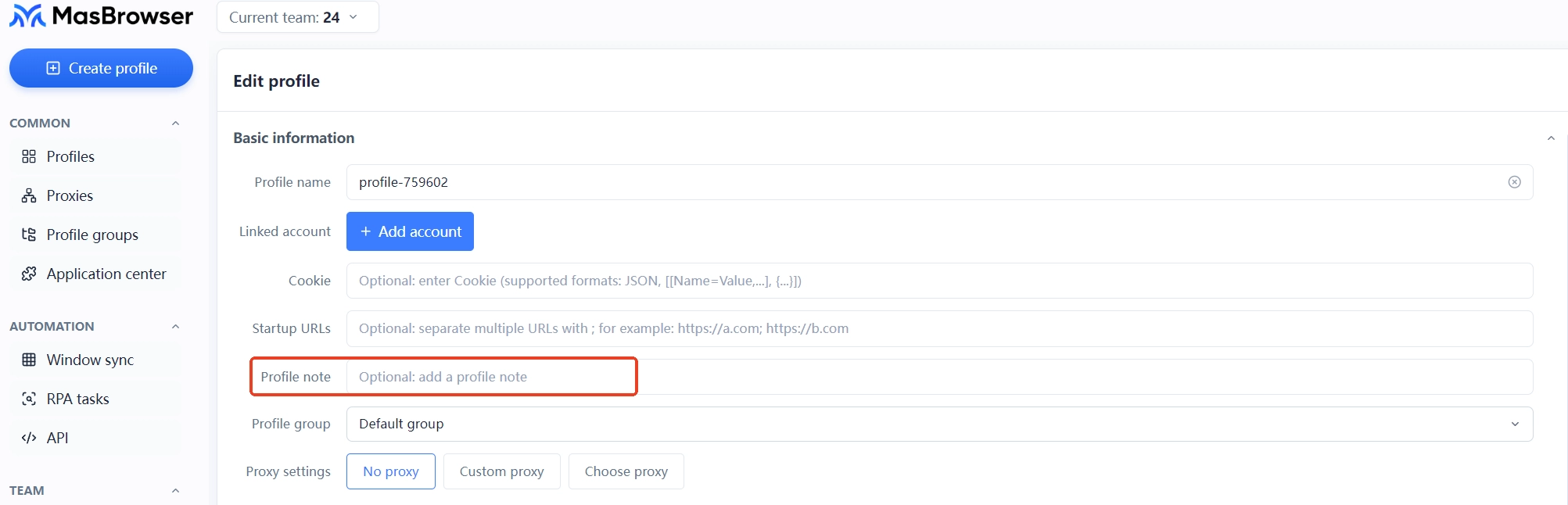
Once the fields are designed, where to keep the records is a practical problem. A standalone Excel has one fatal flaw: it lives in a separate world from the actual environments. The sheet says account A runs on a Japan node, but the environment was switched to the US long ago and nobody updated the sheet. The more reliable approach is to keep the inventory with the environments: write the identity and risk fields directly into the environment notes in MasBrowser — account name, proxy plan, shared materials, last maintenance date, one item per line. Notes travel with the environment, so when the environment changes, the note changes, and everything always matches reality; asset fields need a global view, so keep them in the sheet maintained weekly.
Accounts do not have just two states, "can log in" and "banned." Manage them in four states and the inventory turns from a static sheet into a living system.
Set transition rules between the four states: a dormant account beyond three months gets a low-volume probe before revival; materials consumed by retired accounts go into an "used materials pool," checked for duplicates before any new registration. Write these rules on the first line of the inventory notes so the team executes them — steadier than verbal agreements.

The biggest enemy of an inventory is staleness. The best ledger is waste paper after three months without an audit — auditing needs a fixed rhythm, and the core action is reconciling the inventory against the actual environments.
Once a month, pull the inventory and check three things:
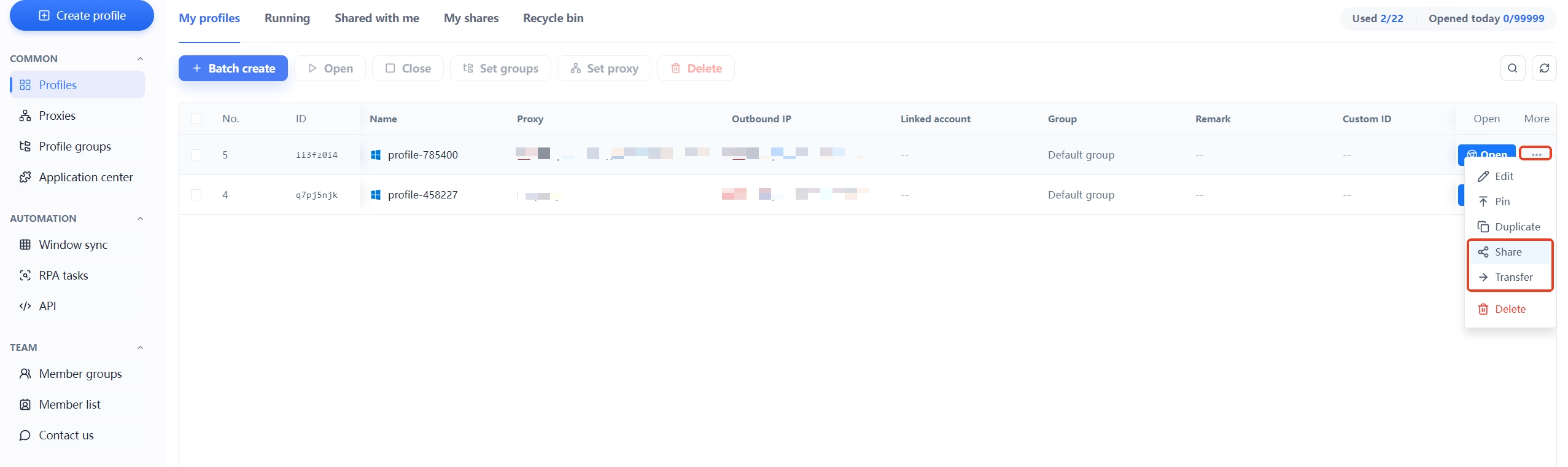
The audit doubles as a handover and security checkpoint: when personnel change, go through the inventory and confirm each environment under the departing person's name, and formally transfer ownership with environment transfer — not a verbal "you keep these for now." Verify that the passwords and 2FA recovery codes in the recovery fields are still stored where the inventory says. In the tool, the audit is just one regroup: scan the environment list grouped by business line, and who owns which accounts and whether any environment appeared out of nowhere is visible at a glance — auditing turns from digging through Excel into opening a list.
A wrong inventory manufactures false security. These three are the most common.
Yes, but it can be lean. A dozen accounts need one sheet plus environment notes, with identity and recovery fields complete first; beyond 30 accounts or with multiple people collaborating, roll out the full four field groups and four-state management.
Never the password itself — write a "location pointer," such as "password manager entry: amazon-us-01." The worst case for multi-account operations is an all-at-once wipe; when the inventory leaks, the passwords should not leak with it.
A monthly reconciliation is enough. For teams past a hundred accounts or with dedicated ops, reconcile monthly and update asset fields (followers, ratings) quarterly — any more frequent is a burden.
"Hidden holdings" — accounts logged into their personal phone, accounts registered with their personal email. Beyond checking each environment against the inventory, ask whether anything is still logged in on personal devices, and switch registration emails to company-controlled ones.
The quality of your multi-account management is not decided by how expensive your hardware is, but by whether you can answer three questions at any moment: whose account is this, what is it worth, and how do I recover it. An asset inventory is the written answer to all three — four field groups registered, four-state transition rules in place, a monthly reconciliation — and your account scale can double without losing control.
The method is tool-agnostic, but how tightly the inventory fits the environments determines execution cost: write identity and risk fields into every environment, use grouping and transfer to handle state changes, and start with the free plan's 2-environment quota before scaling — annual billing works out to roughly $0.13 per environment per month, far cheaper than losing a single account. Download MasBrowser and start with your first account asset inventory.