
MasBrowser
Customer supportLoading messages…
Loading messages…
You are viewing a previous conversation.
Enter to send · Shift + Enter for a new line
Loading messages…
You are viewing a previous conversation.
Enter to send · Shift + Enter for a new line
Almost everyone running a social media matrix has lived the same scene: ten accounts you spent a week registering and nurturing got banned overnight because of one mistake — say, two accounts logged in under the same IP — wiping out all the effort. What makes it worse: many people don't even know which step went wrong until the accounts are gone.
The community splits on account farming: some describe it like mysticism ("watch half an hour of videos daily, stagger the times, act like a human"), others think it doesn't matter ("register and start posting immediately"). My take: farming is neither mysticism nor casualness — it's a replicable, systematic method. I've validated this method across multiple matrix projects, and here's the full breakdown.
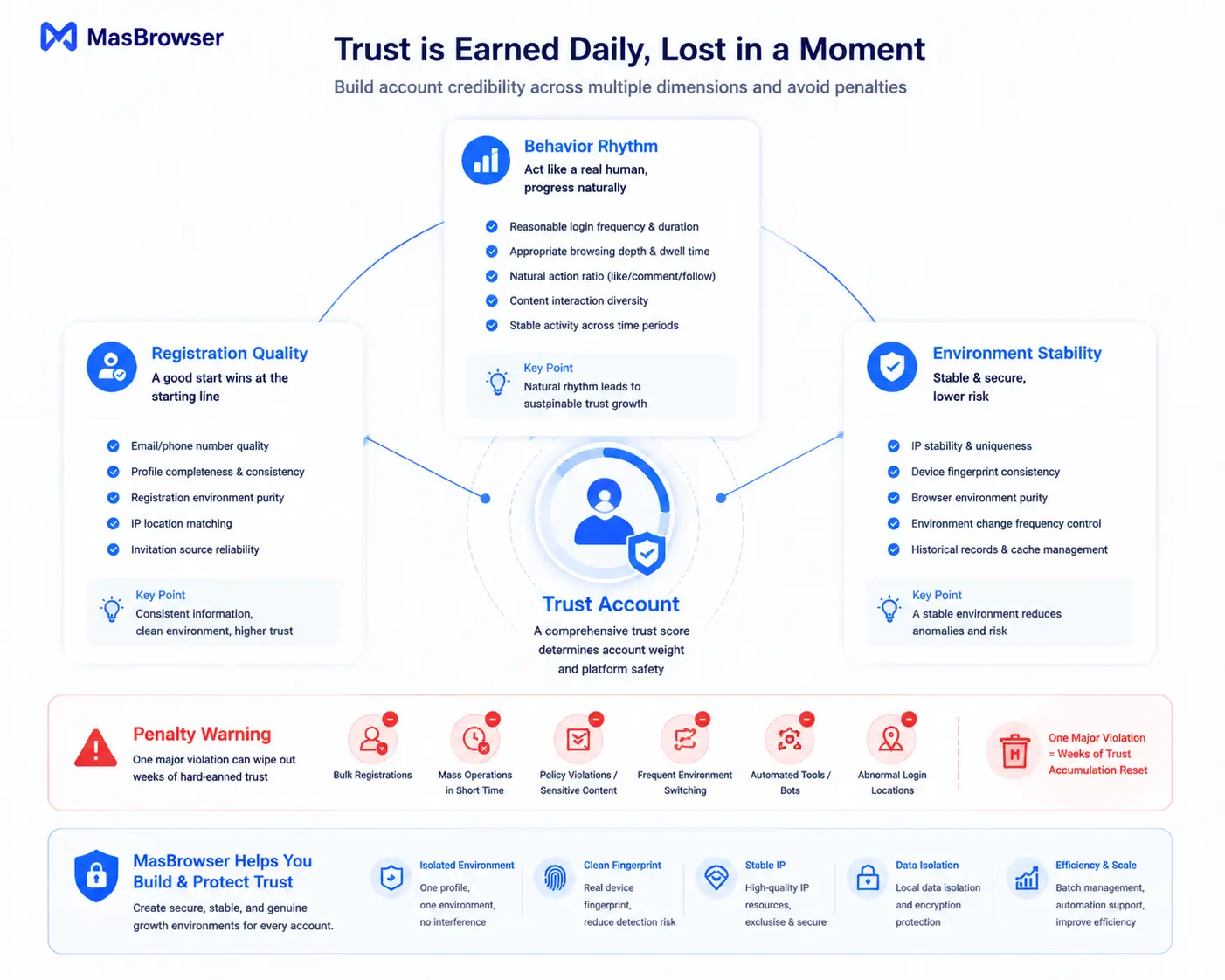
Platforms keep a "trust ledger" for every account — operators call it account weight — built from registration quality, behavior rhythm and environment stability. If any of the three has a problem, points get deducted.
First, the rules of this ledger. Based on the author team's review of the public community guidelines of Facebook, TikTok, Instagram and X, the underlying risk-control logic is the same across platforms:
Across the three dimensions, deductions happen far more easily than accumulation: one major violation (like a new account mass-posting ads) can wipe out weeks of buildup at once, and the newer the account, the harsher the deduction for the same action. So the core of farming isn't "wait a few days before acting" — it's making sure none of the three dimensions goes wrong from day one of registration — every action in the first two weeks is a deposit into the account's future lifespan.
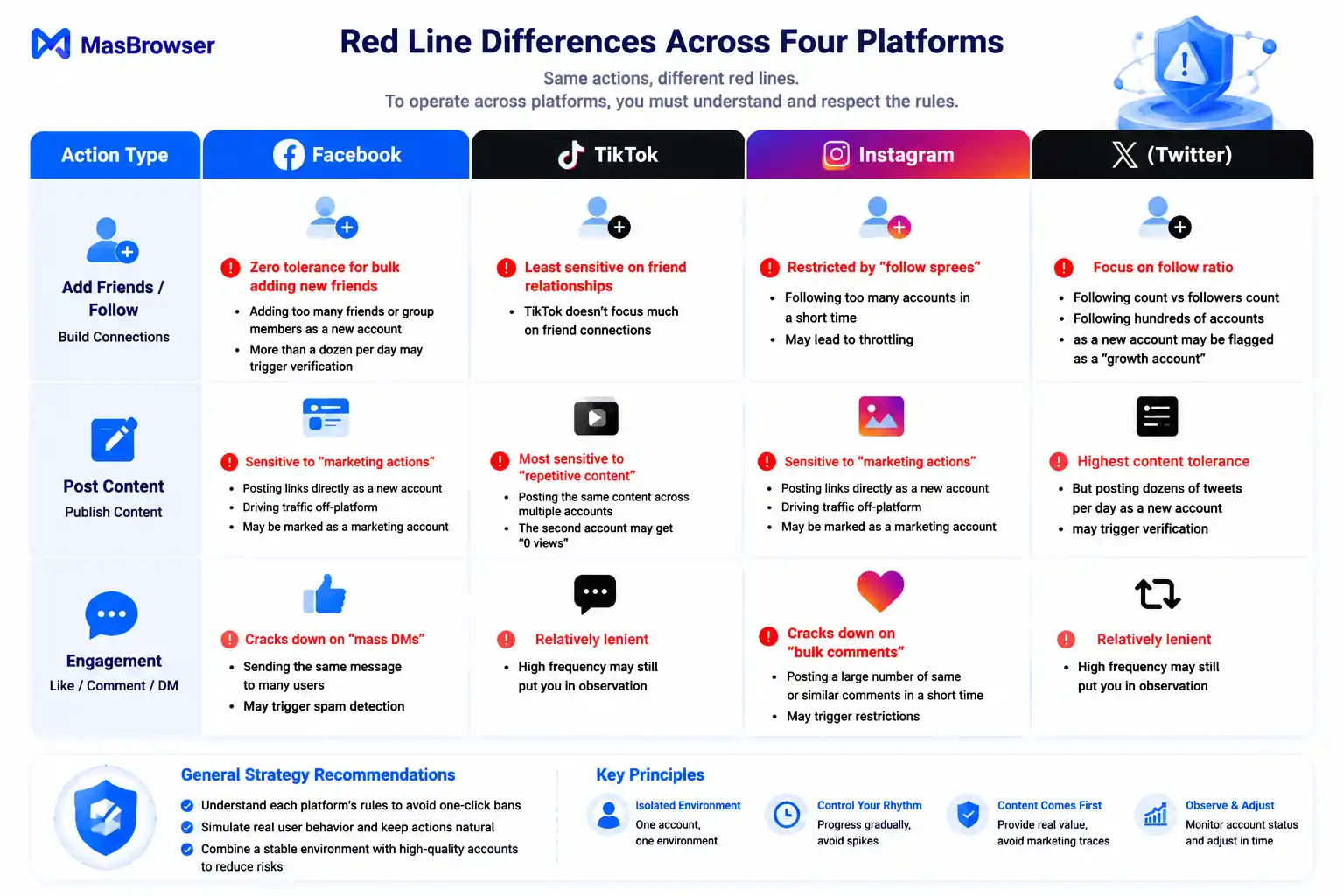
Don't apply one farming playbook to every platform — the same action is fine on Facebook but can trigger verification on X. This is where cross-platform matrices fail most often. I organized the differences across four mainstream platforms by "action type" (for platform-specific full guides, see Facebook account nurturing guide and TikTok matrix account guide; here we only cover the differences):
Conclusion: the framework is universal, but red lines must be memorized per platform. With many matrix accounts, the easiest trap is "carrying platform A's rhythm to platform B" — checking the platform's red lines before each account goes live saves far more trouble than appealing afterward.
Once accounts exceed 5, "farming" becomes "managing" — tier them to assign roles, then keep ledgers to prevent mass casualties. In real projects I habitually use four tiers:
Tiering brings risk isolation: a restricted grey-test account doesn't affect main accounts, main accounts never do high-risk actions, and no matter how big the matrix, the core assets stay safe. After tiering, run three sheets to manage every account:

Platform penalties don't happen in one step; there's usually a warning before a ban — read the signal levels and many accounts can actually be saved. This is different from "appeal after the ban": appealing is post-ban remediation, warnings are pre-ban damage control, and the latter costs far less.
Don't let a small problem become a big one: handling at the yellow-card stage costs almost nothing; dragging to rate-limiting loses a week of traffic; dragging to a ban loses the account. Stop losses fast, judge accurately.
When accounts exceed 20, or two or more people collaborate, the bottleneck of matrix farming shifts from "farming" to "coordination" — the handover between environment, account and person is where things get messy. Pitfalls I've hit in team projects: a colleague leaving and taking the environment configs of several accounts; a new hire not knowing which environment maps to which account; syncing environments between two computers only possible through export/import.
These pain points are exactly where a fingerprint browser helps. Take MasBrowser as an example — the principle of environment isolation is broken down in What Is a Fingerprint Browser; here we focus on the "coordination" dimension:
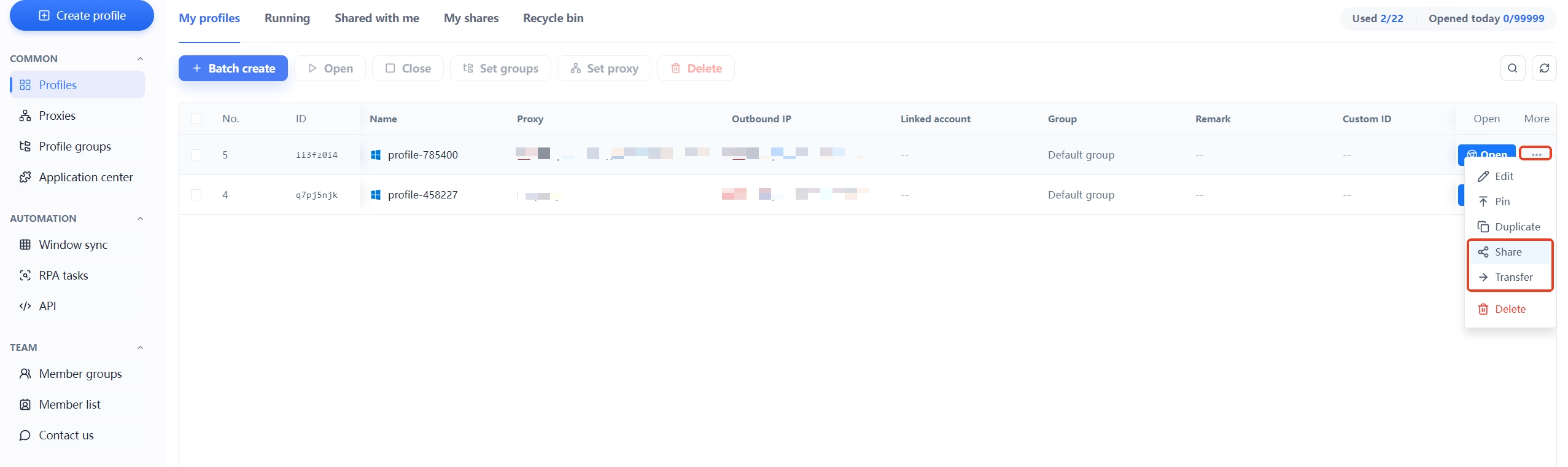
At the end of the day, matrix farming isn't about "whose farming style is more mystical" — it's about who can keep dozens of accounts in order — when environments, ledgers and collaboration all flow, scale becomes possible.
The difference is mainly account lifespan: a new account doing marketing actions directly has a high chance of triggering risk control, and most accounts don't survive the first two weeks; after a month of nurturing, the same content carries far lower risk. Rushing a new account to volume is trading account lifespan for speed.
For rate-limiting, stop posting 3-7 days and only browse and engage; it usually recovers. For a ban, only appeal works, and the environment during appeal must match daily usage. Rate-limiting is "hitting the brakes"; a ban is "getting off the bus" — the former stops losses fast, the latter is basically the end.
Few accounts (5 or fewer) can be handled by one person; above 20, division of labor is recommended: one person handles content, one handles engagement, one handles environments and ledgers. Collaboration relies on the three sheets + environment sharing — the ownership of accounts and environments must be clear, and on handover, environments are shared directly, not passed on verbally.
Yes. Platform risk control is dynamic; farming methods have no "permanent version". Quarterly review is recommended: check whether account survival rate, ban reasons and warning signals have changed; adjust rhythm if they have. The tool layer (environment isolation) stays the same; the strategy layer needs regular updates.
Fixed time windows look more human than random logins (real people have regular routines), but don't be "precise to the minute" — logging in at the exact same minute daily looks like a script. Use a fixed window (e.g. 9-11 a.m. daily) with random time within the window.
Farming without bans isn't mysticism — it's a combination of three things: understand the trust-ledger rules, manage accounts with tiers and ledgers, and make environments and collaboration solid. Memorize red lines per platform, handle warning signals by level, and matrix account survival rates will visibly improve; conversely, shared environments, runaway rhythm and chaotic handovers — even great content can't save the accounts.
The method is laid out; what remains is execution. Start with "account tiers + three sheets" and audit your existing matrix; then download MasBrowser and use environment management + team collaboration to put accounts, environments and people in order. Matrix operation is a long race — run steadily through the first month, and scale follows.