How to Avoid Poshmark/Vinted Multi-Account Association? Enter Secondhand Fashion with MasBrowser
Anyone in secondhand fashion has probably lived this scene: you run a decent Closet on Poshmark and want to open several more "closets" by style to expand — one for luxury, one for everyday, one for kids — but the new account gets asked for verification just days after registration; or you want to list across France, Germany and the UK on Vinted at the same time, switching accounts on the same device, and before long one of the accounts gets its listing rights restricted.
Poshmark and Vinted are both secondhand fashion platforms, but they differ from Mercari and Etsy: Poshmark is a US fashion platform with a strong social-commerce nature; Vinted is Europe's fast-growing C2C fashion platform — both are driven by "trust + style + social interaction", and their association judgment also weighs "whether behavior looks like an independent seller". This article is about Poshmark / Vinted multi-account anti-association — the platform threshold differences, how association is judged, how to lay out multiple accounts, and which red lines exist in operations.
Why Are Poshmark / Vinted Multi-Accounts Worth Doing? First Understand the US-EU Secondhand Fashion Market
First, the two platforms' market structures — their opportunity points are completely different:
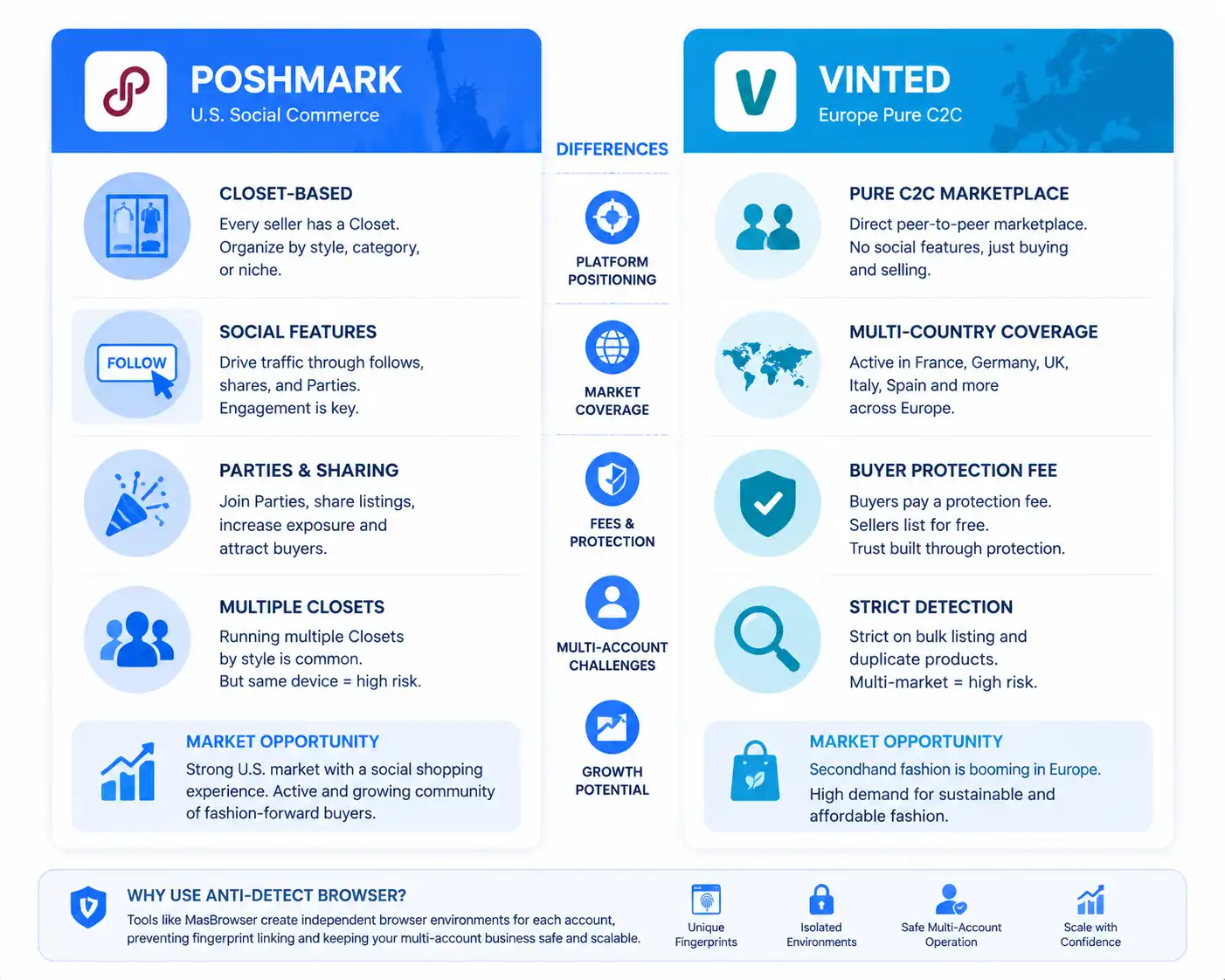
- Poshmark (US) is "social commerce": every seller has a "Closet", driving traffic through social actions like follows, shares and Parties — the platform encourages sellers to "operate like real fashion influencers"; multiple Closets divided by style is common play, but "opening multiple Closets on the same device" gets flagged.
- Vinted (Europe) is "pure C2C": covering France, Germany, UK, Italy and more; sellers list free, buyers pay a buyer protection fee — the platform detects "bulk listing" and "multi-account repeated listing" strictly, and multi-market operations often get misjudged as "one seller's clones".
- Secondhand fashion is a growth track: US-EU consumers' acceptance of "sustainable fashion / secondhand clothing" keeps rising, and Poshmark and Vinted's active users are both growing — a structural opportunity for sellers who can run multiple accounts (the full breakdown of device isolation is in the MasBrowser fingerprint browser article, equally applicable to both platforms).
Sellers running Poshmark / Vinted multi-account matrices almost all use anti-detect browsers / fingerprint browsers like MasBrowser to manage multiple independent environments — the core of such tools is the reverse operation of browser fingerprinting, giving every account a different device profile.
Association Judgment on the Two Platforms: Poshmark Watches Social, Vinted Watches Bulk
The association judgment dimensions of Poshmark and Vinted are core-consistent with Amazon — device fingerprints, IP, cookies, payout accounts (the Amazon multi-store anti-association methodology is broken down in the Amazon multi-store anti-association article; here we only discuss the two platforms' differences):
- Poshmark's social behavior is the core signal: the platform judges "whether you're an independent seller" through Follow, share and Party interactions — multiple Closets mutually following and sharing each other with the same batch of accounts is a high-frequency path for Poshmark association judgment.
- Vinted's bulk listing is the core signal: Vinted detects "the same product listed repeatedly across accounts" strictly — the same item with the same image listed across multiple accounts is Vinted's most direct evidence of "the same seller".
- Device and IP association sensitivity (both platforms): Poshmark and Vinted both record login devices and IPs; multiple accounts logging in on the same device and same IP is a core association signal.
- Payout accounts are hard association (both platforms): Poshmark collects via bank/PayPal, Vinted collects via bank/PayPal — multiple accounts withdrawing to the same payout account is like handing in association evidence voluntarily.
The key check tool for both platforms is a fingerprint test / fingerprint check — sellers only need to run it in each environment once to see whether every "device's" profile is recognized as the same source across multiple accounts; this is exactly what fingerprint browsers like MasBrowser solve: making each account's environment fingerprint profile independent.
How to Lay Out Multiple Accounts: Poshmark by Closet Style, Vinted by Market Language
The two platforms' layout logics differ — don't apply one template to both:
- Poshmark: divide accounts by Closet style: luxury Closet, everyday Closet, kids Closet separated — clear Closet positioning, and the platform sees a group of "fashion lovers with different styles". Don't list the same batch of products repeatedly across Closets.
- Vinted: divide accounts by European market/language: France account, Germany account, UK account separated (French-market items in the French zone, German-market items in the German zone) — each account uses the corresponding market's language, currency and timezone, and the platform sees "independent sellers living in different countries". Don't list the same items repeatedly across markets.
- Run the two platforms complementarily: secondhand fashion sellers often run Poshmark (US) + Vinted (Europe) at the same time — use different environments and different IPs for the two platforms' accounts, don't mix them in one environment.
The key to getting the layout right is "no repeated products between accounts, no shared payout accounts, no shared device IPs" — the association judgment of secondhand fashion platforms is essentially about these three "overlaps".
Operation Red Lines: Poshmark Social Rhythm, Vinted Listing Rules
In multi-account operations, each platform has its signature red line:
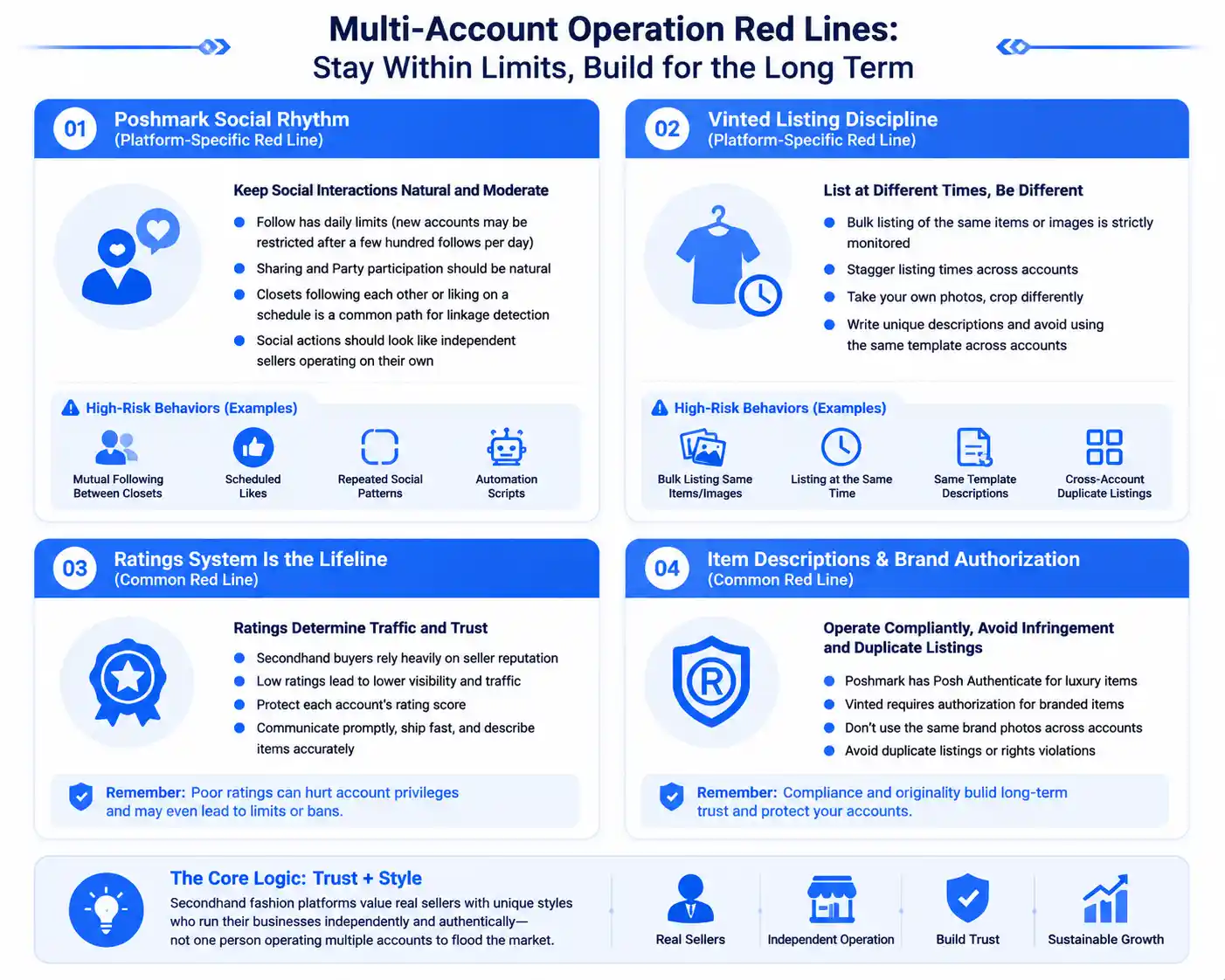
- Poshmark social interaction should be restrained: Follow has daily caps (new accounts trigger restrictions at a few hundred per day), sharing and Party participation should be natural — "mutual Follow, on-time mutual likes" between multiple Closets is a high-frequency path for Poshmark association judgment. Social actions should feel like independent sellers running their own business.
- Vinted listing should be staggered and differentiated: Vinted strictly detects "same item, same image, bulk listing" — multi-account listing should stagger times, take/crop photos separately, differentiate descriptions, don't "spread one template across all accounts".
- The review system is the lifeline (both platforms): secondhand fashion buyers care about seller credibility; accounts with low positive rates see obvious traffic decline — multi-account operations must protect every account's review score, don't let bad reviews drag down the matrix.
- Product descriptions and brand authorization: Poshmark has a dedicated luxury authentication channel (Posh Authenticate), Vinted has authorization requirements for branded products — don't use the same batch of "brand images" between accounts, to avoid being judged repeated listing.
All four red lines share one logic: secondhand fashion platforms are a "trust + style" ecosystem — the platforms want "real sellers of different styles seriously selling", not "one person opening a bunch of accounts to list repeatedly".
Managing Poshmark / Vinted Multi-Account Environments with MasBrowser
Multi-account environment management follows the same one-account-one-environment-one-IP architecture as Amazon and Mercari, with two secondhand-fashion-scenario notes. Taking MasBrowser as an example:
- Environment naming = platform-style/market-number: name environments "PS-luxury-01", "VN-France-02", so the environment list shows at a glance which account is on which platform, doing what style / which market, with Poshmark and Vinted in separate zones.
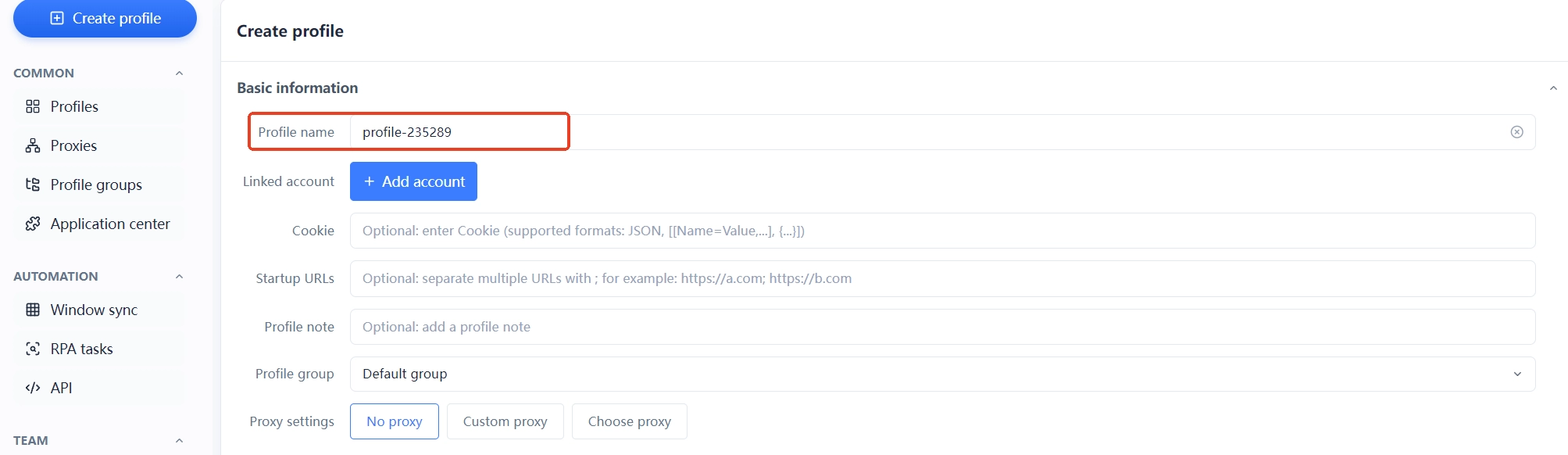
- One account, one environment, one proxy: every account gets an independent environment and independent proxy (Poshmark binds US IPs, Vinted France zone binds French IPs, Germany zone binds German IPs), accounts invisible to each other — device and IP association is cut at the tool level.
- Note payout and social bindings in remarks: record "this account's payout account, the list of accounts it Follows" in environment remarks; check this table first when self-auditing association (team collaboration and sharing usage is documented on the environment management page).
- Multi-platform environment zones: for those running a Poshmark + Vinted + other-platform matrix, name environments in separate zones by platform dimension, so platforms don't mix when troubleshooting association.
The moat of secondhand fashion multi-accounts is doing clear style/market positioning + non-repeated products + environment independence right at the same time. The free plan already includes 2 environment slots — build the first account environment, get the flow working, then replicate step by step.
FAQ
Can one person open multiple Closets on Poshmark?
Yes, Poshmark doesn't restrict one person from opening multiple closets, but multiple Closets must be clearly differentiated by style/category, and each closet's payout account and device environment must be independent. Don't mutually Follow or share between Closets — that's a high-frequency path for Poshmark association judgment.
Will Vinted detect multiple accounts?
Yes. Vinted strictly detects "same item, same image, bulk listing" and "multiple accounts on the same device". Multi-account operations should stagger listing times, take/differentiate photos, and use independent environments — when the platform sees "independent sellers in different markets", it won't judge association.
How do multiple accounts self-check whether environments are associated?
A three-step self-check: step one, environment dimension — run a fingerprint check / browser fingerprint test for each account to see whether every "machine's" UA, Canvas, WebGL, timezone and IP are fully independent; step two, account dimension — check my browser fingerprint to confirm each account sits behind an independent browser profile; step three, platform business dimension — confirm payout account, product images and social bindings are all isolated as described above. All three pass, and association risk is basically under control.
Can Poshmark and Vinted use the same PayPal for payouts?
No. The payout account is a hard association evidence both platforms recognize — multiple accounts withdrawing to the same PayPal or bank account is like handing in association evidence voluntarily. Every account gets an independent payout account — that's the baseline.
How many Follows per day is safe on Poshmark?
Poshmark has daily caps for new accounts' Follows (a few hundred triggers restrictions), and old accounts should also scale up gradually. The judgment standard is platform feedback — a "doing that too much" prompt means you've exceeded; lower the pace and nurture for a few days before continuing.
Conclusion
Poshmark / Vinted multi-accounts: the opportunity is in the US-EU secondhand fashion track, but the platform ecosystems determine that "clear style/market positioning + non-repeated products + environment independence" must be right from day one: Poshmark accounts divided by Closet style, Vinted accounts divided by market language, product images differentiated, one account one environment one IP — get all three right and multi-accounts are a growth engine, not a risk source.
One reminder too: secondhand fashion platforms are famously sensitive to "repeated listing" and "social bot behavior"; the operation actions between accounts (Follow, share, listing rhythm) should also feel like several independent sellers running their businesses seriously — this "independence" is both a platform algorithm preference and a hard metric for avoiding association judgment. Start from the first account: think the style/market and product differentiation through first, then give it an independent environment — the free plan's 2 environment slots are enough to start, download MasBrowser and build the first environment.