Shopify Multi-Store Anti-Association: Environment Isolation for Multiple Stores
If you run standalone e-commerce sites, you have probably tried the "site group" approach: open two or three sites for one product, run them on different markets and materials, and scale whichever direction takes off. Multi-site testing is fine in itself, but many sellers fall in the same place — the backends of several Shopify stores being judged as associated.
When platform stores are associated, you lose accounts; when standalone stores are associated, you lose the whole site group's ad accounts, payout channels, and domain system — one thread pulls everything.
This article explains Shopify multi-store anti-association thoroughly: where multi-store "association" actually happens, which landmines are easiest to step on, the special nature of Shopify Payments, and concrete environment isolation plans for multi-site operations.
Where Are Shopify Multi-Stores Actually "Associated"?
In one sentence: Shopify itself allows one merchant to open multiple stores, but once your payout accounts, emails, domains, and login environments — these "peripheral clues" — cross over, you are judged as associated.
Unlike Amazon and eBay, where "the platform explicitly limits multi-accounts", Shopify is relatively lenient about "one merchant, multiple stores" — what it cares about more is "whether this store is operating normally". So Shopify's association risk is not in a "platform ban" but in clue crossover between stores:
- Payout accounts: multiple stores bound to the same payout channel (PayPal, Stripe, etc.) — the money flow gives it away at a glance (the practice of payout account isolation is covered in PayPal multi-account risk control).
- Registration emails: several stores registered with the same email, or with identical email suffixes (store1@, store2@), is an obvious "same boss" signal.
- Domain info: multiple domains sharing the same registrant, registration address, and contact info — the domain registrar can tell at a glance.
- Backend login environment: several Shopify backends logged in from the same IP and the same computer — device fingerprints and network characteristics expose everything (the role of fingerprint parameters is broken down in this guide).
The Shopify stores themselves may be fine, but when payout, domain, and login environment — these "dark threads" — cross over, the whole site group's risk grows — especially when one site has a problem (complaints, high chargeback rate), the platform follows the clues to investigate other sites.
The "Association Landmines" Multi-Site Operators Step on Most Easily
- One payout account collecting money for multiple sites: the most common and most fatal. When orders from several sites all flow into the same PayPal or Stripe, it is like writing "these sites belong to the same family" in the ledger yourself.
- Same email registering multiple stores: the registration email is the first identity marker of a Shopify store; reusing it is direct association.
- "Slightly adjusting" domain info: multiple domains using the same set of registration info (changing a letter to evade) — a WHOIS lookup exposes it instantly.
- Backend login from the same IP: several Shopify backends logged in under the same network exit, even at different times — the network characteristics leave a record.
- Same device fingerprint: logging into multiple Shopify backends from the same computer leaves Canvas, WebGL, UA fingerprints completely identical — the same logic as e-commerce platform association.
The Special Nature of Shopify Payments Needs Its Own Section
Shopify's built-in payout service, Shopify Payments, has several points that directly affect multi-site strategy:
- Tightly bound to the store: Shopify Payments is configured in the store backend — one store, one configuration; you cannot use "one payout configuration for many stores".
- Regional restrictions: Shopify Payments has supported-region limits for merchants; sellers outside the supported regions can only use third-party payouts (PayPal, Stripe, 2Checkout, etc.).
- The payout dimension is the biggest association point: whether you use Shopify Payments or third-party payouts, "which account the money goes into" is always the key clue for judging store ownership — multi-site must be equipped with multiple independent payouts.
For multi-site sellers, the conclusion is direct: each site needs one independent payout account, never shared. This is exactly the same isolation logic as PayPal multi-account.
How to Isolate Multi-Site Environments in Practice?
The framework is the same as e-commerce multi-store — one site = one isolated environment + one dedicated IP + one independent payout + one independent set of registration info. Applied to Shopify, four steps:
- Isolate registration info. Each store uses an independent registration email (different domain suffixes are more stable), an independent phone number, and separate domain registrant info.
- Isolate payout accounts. Each site binds an independent payout channel (independent PayPal / independent Stripe account) — no sharing, no crossover.
- Isolate environment and IP. In MasBrowser, create an independent environment for each store (name environments like
shop-us-store01,shop-es-store02) and bind a dedicated proxy IP for the corresponding target market;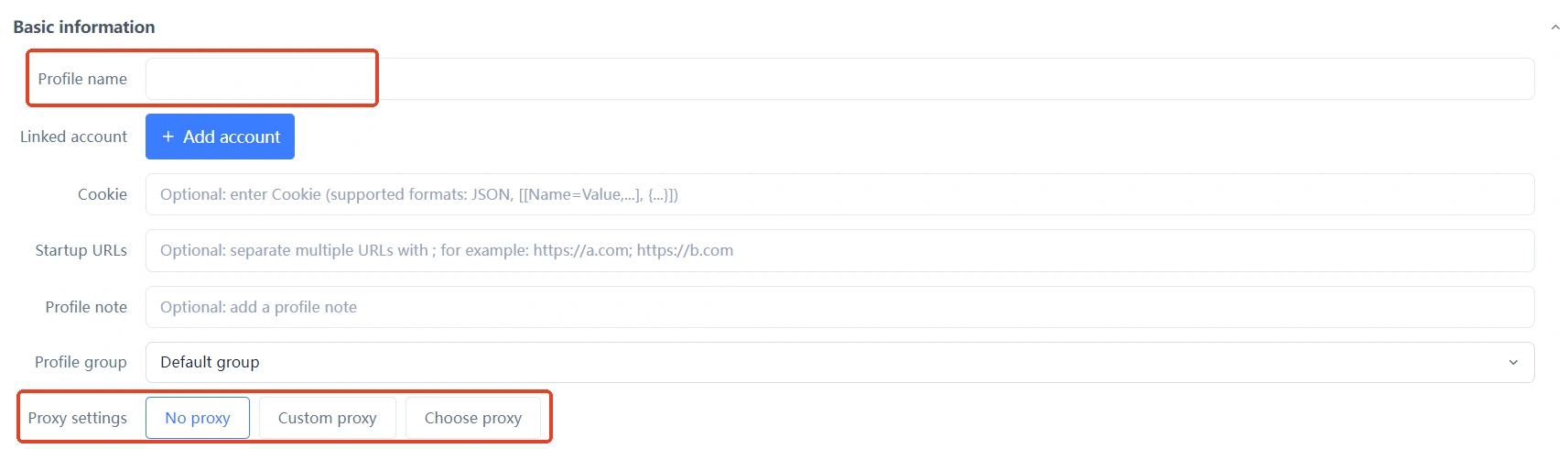 in fingerprint settings, set language, time zone, and geographic location to "Configure based on IP" and set WebRTC to "Disabled";
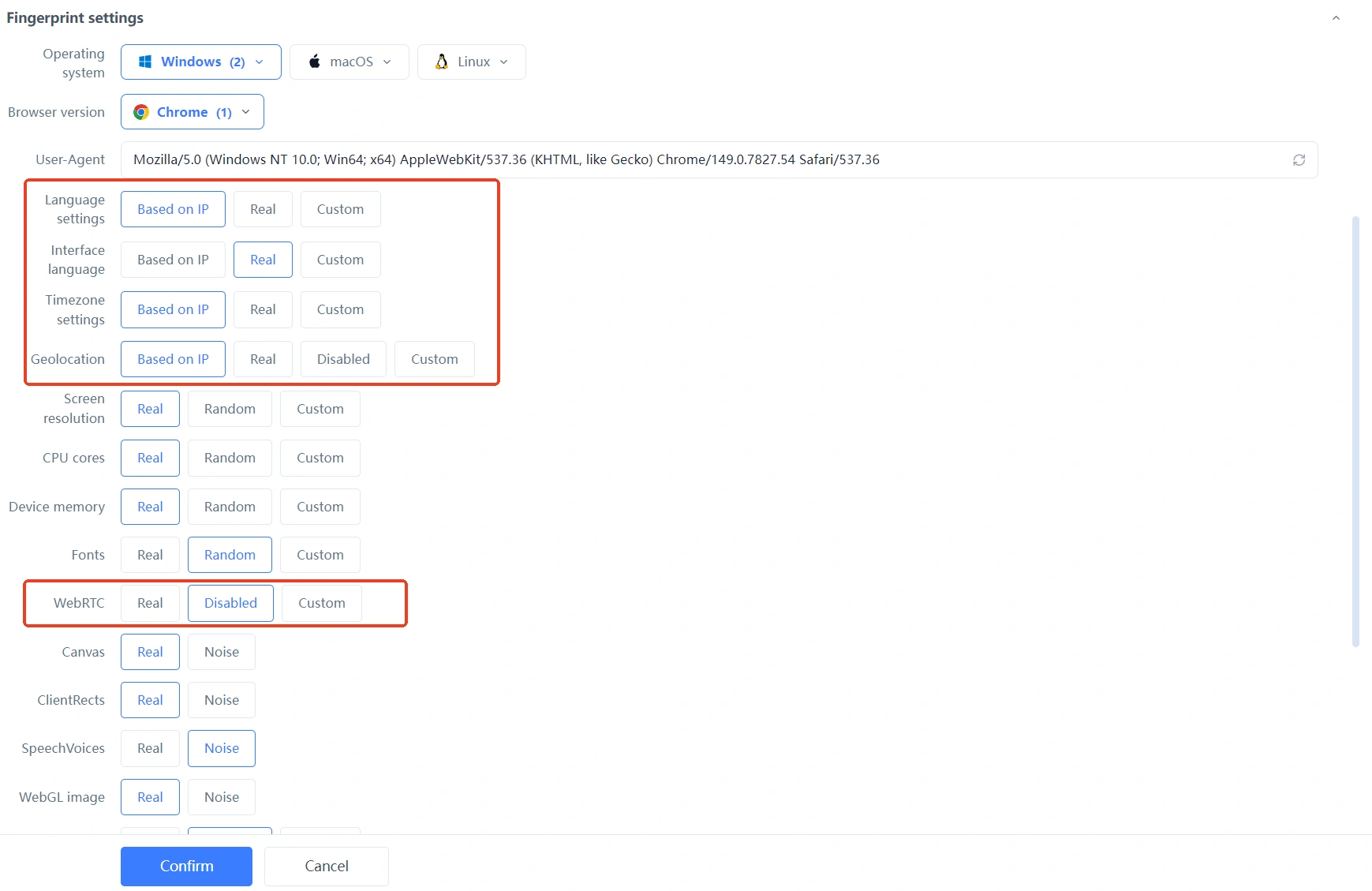 each site's Shopify backend only logs in within its own environment. For complete isolated environment and fingerprint configuration, see the MasBrowser multi-account security management page.

- Isolate domain management. Register domains with independent registration info (you can use privacy protection services to hide WHOIS), and do not let several domains share the same registration data.
Once this plan is running, every site has an independent set from registration, payout, domain, to login environment — the platform would struggle to link the whole site group from any single clue.
The 4 Pitfalls Sellers Fall Into Most Easily
- "Casually" sharing payouts: when the second site goes live, binding the first site's payout account out of convenience — the number one landmine of standalone-store association, highest priority.
- Similar email suffixes:
store1@gmail.com,store2@gmail.com— this kind of "same person" trace is easier to recognize than using completely different emails. - Opening multiple backends on the same computer: without environment isolation, switching between Shopify backends in a normal browser — the device fingerprint connects everything.
- Ad accounts dragged along: if the Facebook/Google ad accounts of multiple sites are also shared, when the site group is exposed the ad accounts suffer together, and the ad budget goes down the drain.
Remember: the priority of standalone-store anti-association is "payout > registration info > domain > login environment" — payout and registration info isolation is always the highest priority.
FAQ
Does Shopify allow one merchant to open multiple stores?
Shopify itself allows a merchant to register multiple stores — there is no hard "one person, one store" limit. But each store must operate independently and comply with the platform's terms of use; payout, domain, and login environment isolation is up to you.
Can multiple Shopify stores share a payout account?
Strongly not recommended. The payout account is one of the strongest association clues between multiple stores; sharing means "all sites' money goes into one pocket", and the platform understands at a glance. Every site must have independent payouts.
Can Chinese sellers use Shopify Payments?
Shopify Payments has regional support limits; regions outside the supported range (including mainland China) cannot use it and need third-party payouts like PayPal, Stripe, or 2Checkout. The specific supported range is subject to Shopify's latest official policy.
Does site-group operation definitely need a fingerprint browser?
For a single site, a normal browser is fine; but for multi-site site-group operations, environment isolation is a must — a fingerprint browser gives each site an independent login environment, avoiding the "same device fingerprint + same IP" linking the site group together.
Conclusion
The association risk of Shopify multi-site operations is not in "the platform not allowing multiple stores", but in clue crossover between sites: shared payouts, similar emails, identical domain info, same-environment backend logins — any single one can link the whole site group together.
The core of multi-site environment isolation comes down to one sentence: every site has a completely independent set from registration, payout, to login environment. The free plan already includes 2 environment quotas. Download MasBrowser, create two environments to run through the "one site, one environment" flow, then gradually expand to the whole site group.