How to Run Multiple X (Twitter) Accounts? Environment Isolation & Ban Prevention Guide
Anyone running an X (formerly Twitter) matrix has probably lived this scene: a fresh account is growing nicely, then one day posts start getting "silenced" — the post goes out, but nobody except you can see it, traffic like someone hit pause; or to build a matrix you switch between several accounts on the same device, and within a few days one of them asks you to re-verify the phone number, or even confirm your identity.
X is different from Facebook and Instagram: it has no Meta-style Accounts Center, and accounts don't get caught in each other's bans through "linking", but its risk control is extremely sensitive to devices, IPs and operation rates. This article is about environment isolation for X multi-account operations — how X's risk control differs from other platforms, how to lay out the matrix, and which red lines trigger "silencing" the moment you touch them.
Why Do X Multi-Accounts Get "Cascading Bans"? How X Risk Control Differs from Meta Platforms
First understand the essential difference between X association and FB/IG, so the direction is right:
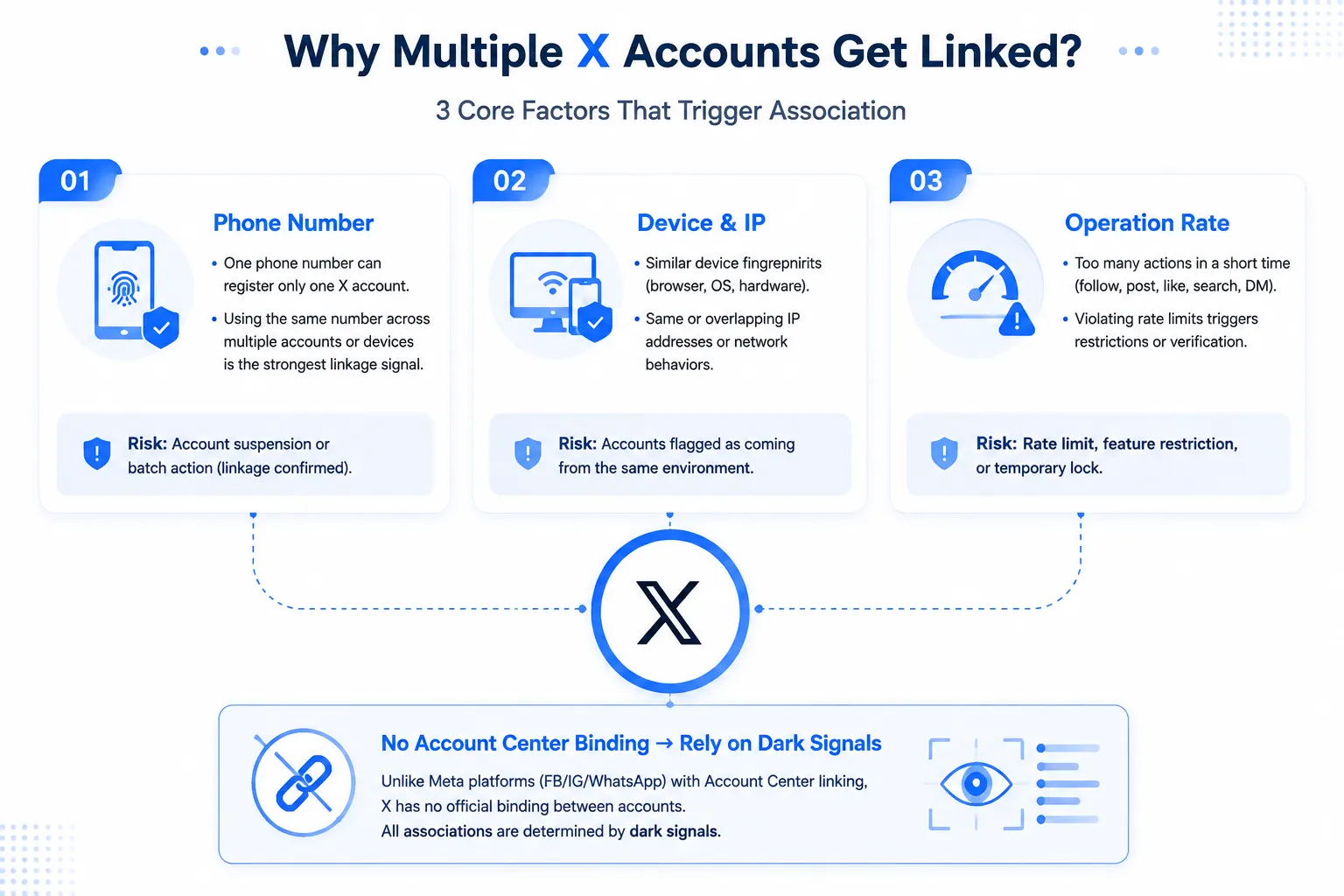
- No Accounts Center binding: FB/IG/WhatsApp share one Accounts Center — bound means associated; X is an independent system with no official binding channel between accounts — its association judgment relies entirely on "dark signals" like device fingerprints, IPs and behavior patterns.
- Phone numbers are a hard association: one phone number can only register one X account, and X's phone verification is strict. Multiple accounts verified with the same phone number, or one phone number logging in on multiple devices, is the most damning association evidence on X.
- Operation rate sensitivity: X has hard rate limits on "a lot of operations in a short time" — frequent following, frequent posting, frequent searching directly trigger throttling or verification. This is the most typical behavioral signal in X's risk control, triggered even before fingerprints.
So the anti-association approach for X is completely different from FB/IG: FB/IG requires breaking account bindings first; X requires managing phone numbers, devices and operation rhythm — especially the phone number. One phone number per account is the baseline; without that, everything else is pointless.
How to Lay Out the X Matrix: Position Differentiation + Trend Traffic
X is a real-time information platform, and matrix layout follows a similar logic to content platforms (TikTok/IG) — positions must be differentiated (see the TikTok matrix operation article for layout principles), but X has two signature plays:
- Position by "topic domain", not by persona: X content is driven by topics and trends, so matrix accounts should divide by domain — one account for industry news, one for opinion commentary, one for resource curation — accounts look like "bloggers in different fields", not "several clones of the same person".
- Trend traffic is the core: X traffic comes from real-time hot searches and trending topics, so matrix accounts can split trending topics (one tracks tech trends, one tracks finance trends), avoiding homogeneity; new accounts shouldn't jump straight into mega-traffic topics — that reads as a "marketing account", start from narrow vertical topics for stability.
- Profile personas must be independent too: avatar, bio and pinned posts shouldn't reference each other (same-series avatars, copy-pasted bios are association signals), and even posting tone should differ.
The essence of layout is still "make every account look like an independent real person" — on X that "real person" is more about topic circles: if account topics don't overlap at all, they look like people from two different circles.
X's Nurturing Red Lines: Follow Ratio, Posting Frequency and Rate Limits
X's nurturing rhythm is like Facebook — small steps, slow pace (see the Facebook account nurturing anti-ban article for the specific rhythm), but X has three signature red lines that cause "silencing" or verification when crossed:
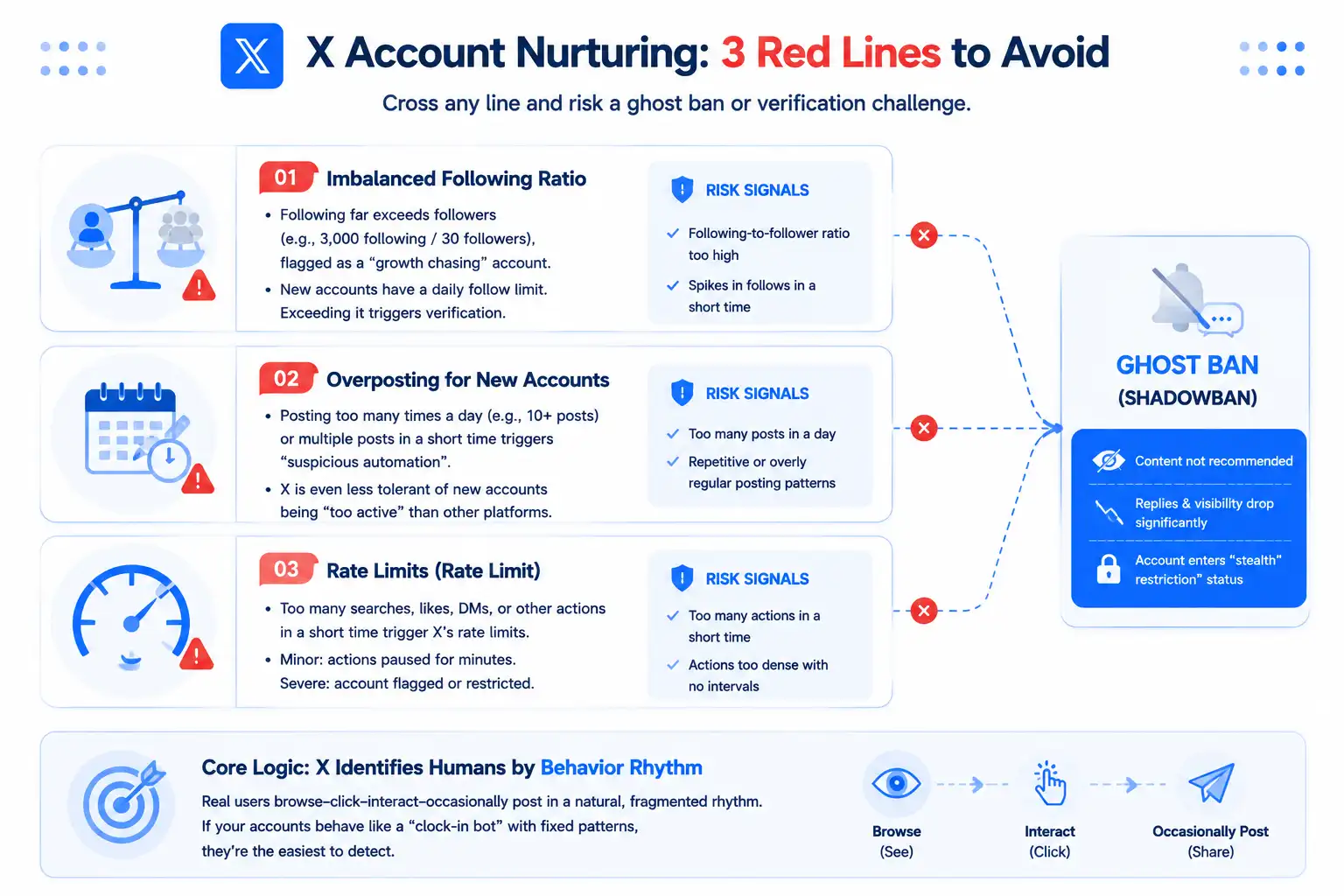
- Unbalanced follow ratio: X is very sensitive to "following far more than followers" (e.g. following 3,000 with 30 followers), flagging the account as a "follow-chasing account" and directly restricting the follow function; new accounts also have a hard daily follow cap — exceeding it triggers verification.
- New accounts posting too much: a new account posting a dozen posts a day, or several posts in quick succession, triggers "suspected automation" verification. X tolerates "overly eager new accounts" even less than FB — real new users don't start with high-frequency output, keep the pace slow.
- Rate limits: large amounts of searching, liking and DMing in a short time trigger X's rate limits — light cases pause operations for minutes, heavy cases mark the account. Matrix accounts doing engagement should cap per-account daily operations and leave intervals between operations.
All three red lines share one logic: X identifies real people by "behavior rhythm". Real users browse X in a fragmented "look-click-post occasionally" rhythm; if matrix accounts operate as regularly as "clocking in for work", they're actually the most recognizable.
How to Build X Multi-Account Environments: Independent Phone Numbers Come First
Environment setup follows the same anti-association principles (the full breakdown of environment isolation is in What Is a Fingerprint Browser), but the X scenario has three points that matter most:
- One phone number per account: X's phone verification is a hard gate; multiple accounts verified with the same number equals damning association. Prepare the corresponding number of phone numbers before building the matrix — this is the first gate.
- Independent 2FA setup: enable two-step verification (2FA) independently for every X account, and record authenticators/backup codes separately — this prevents account theft and avoids the association suspicion of "multiple accounts using the same verification method".
- Don't mix devices across platforms either: X and Meta systems are different systems, but the same device and same IP logging into multiple X accounts is still the core association signal; if you run FB/IG/X multi-platform matrices, keep X environments and Meta environments in separate sets that never cross.
In one sentence: the focus of X environments is not "preventing binding" (there is no binding channel) but "preventing same device, same IP, same phone number" — get all three "preventions" done and the association signals are cut.
Managing the X Matrix Environment with MasBrowser
With many X accounts, the biggest mess is "which environment goes with which phone number and which 2FA" — mix these up and troubleshooting association becomes a disaster. Taking MasBrowser as an example, here's how I manage an X matrix:
- Environment naming = domain-region-number: name environments "X-domain-region" (e.g.
x-tech-us-01,x-finance-eu-02), so the environment list shows at a glance which account runs in which domain and market.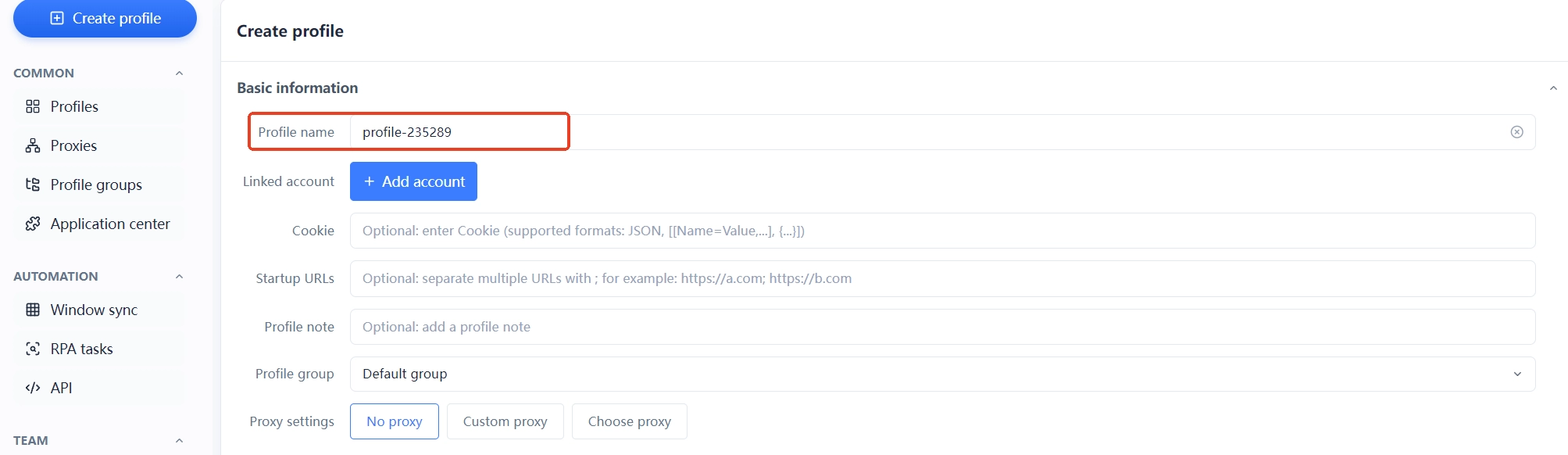
- One environment, one account, one proxy: every X account gets an independent environment and independent proxy (proxy region matches the target market), accounts invisible to each other — the same-device same-IP signal is cut at the tool level.
- Note phone numbers and 2FA in remarks: record "which phone number this account is bound to, which 2FA authenticator it belongs to" in environment remarks; check this table first when self-auditing association (team collaboration and sharing usage is documented on the environment management page).
- Separate environments by platform: when running FB/IG/X multi-platform matrices, name and manage environments per platform separately, avoiding "mixed use in one environment" at the tool level.
The moat of an X matrix is doing independent phone numbers + independent devices + restrained rhythm right at the same time. The free plan already includes 2 environment slots — build the first X account environment, get the flow working, then replicate step by step.
FAQ
What is X "ghost ban"? How do I know if I'm affected?
X "silencing" means your posts are only visible to followers and don't enter search or trends, so new users can't see them. How to check: log out and search the keywords you posted with from another account — if your posts don't show up, you're basically silenced. Usually triggered by unbalanced follow ratio or posting too often; stop the behavior and nurture at a lower frequency for a few days and it usually recovers.
How many people can an X account follow per day safely?
New accounts should start in single digits (within 5), gradually increasing with account age; also keep the follow ratio balanced (following shouldn't far exceed followers). X doesn't publish numbers — a "you're doing that too much" prompt or verification request is your reference line.
Can multiple X accounts use the same phone number?
No. One phone number can only register one X account; multiple accounts verified with the same phone number is damning association. Prepare the corresponding number of phone numbers for the matrix first — this is the most basic prerequisite.
Do X matrix accounts need 2FA?
It's recommended to enable 2FA independently on every account, with authenticators and backup codes recorded separately. Two benefits: lower risk of account theft; multiple accounts using the same verification method leaves association suspicion.
Do X web and app affect each other?
With an independent environment and independent IP, web and app are two separate entry points, each can log into its own account fine; but don't log into account A on web and account B on app on the same device — the device-level association signal is recorded either way.
Conclusion
The biggest difference in X multi-account operations is the risk-control logic: no account binding, but phone number, device and rate gates are all hard. Prepare independent phone numbers first, then isolate environments, finally manage follow ratio, posting frequency and operation rate — get all three right and the matrix can run long-term.
One reminder too: X rules change frequently, there is no "permanently safe" configuration — if you get silenced or verified, lower the frequency and self-audit the environment, don't push back hard. Keep doing independent phone numbers, independent devices and restrained rhythm right, and the matrix stays stable. Start from the first X account: confirm independent phone number and 2FA first, then give it an independent environment — the free plan's 2 environment slots are enough to start, download MasBrowser and build the first environment.