How to Avoid Walmart Multi-Store Association? Build Your US Market Play with MasBrowser
Anyone in US e-commerce has probably heard this: "Amazon is too competitive, go check out Walmart." Indeed, Walmart Marketplace is the second-largest e-commerce platform in the US — the seller base is an order of magnitude smaller than Amazon's, competition is lighter, and traffic is still growing. But for sellers, it has the same kind of threshold: multi-store association — get caught and stores get closed just the same.
Walmart's association risk control is very similar to Amazon's, but it also has its own traits: stricter onboarding review, harsher price-matching policy, and more rigid store performance metrics. This article is about Walmart multi-store anti-association — where the opportunity is in the new US market battleground, what's special about Walmart's association risks, and how to lay out multiple stores to stay stable.
Why Are Walmart Multi-Stores Worth Doing? First See the New US Battleground
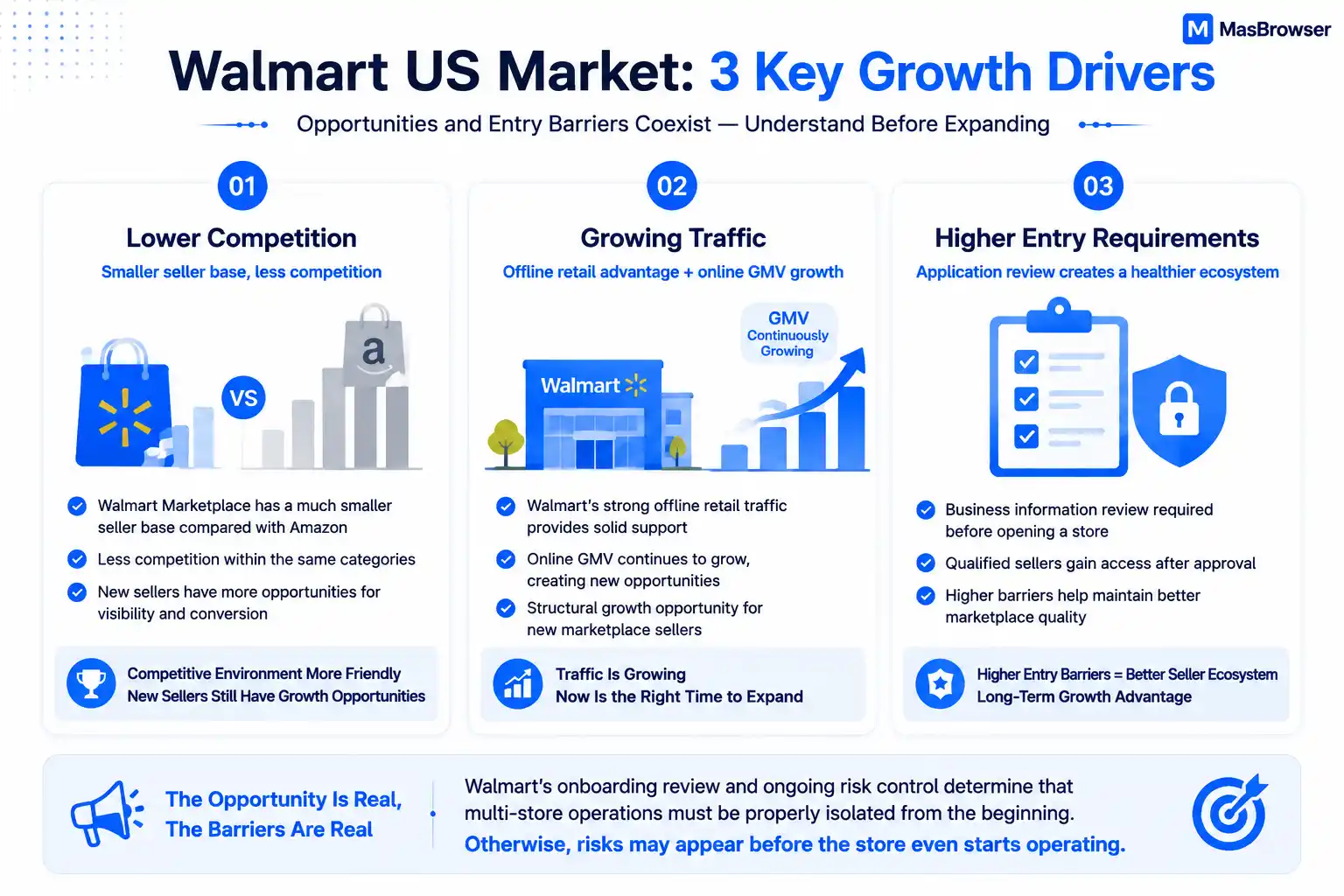
First clarify "why Walmart". Based on our team's review of Walmart Marketplace's public policies, its opportunities and thresholds are both clear:
- Less competition, growing traffic: Walmart Marketplace's seller base is far smaller than Amazon's, with lighter competition in the same categories; Walmart's offline retail traffic base, plus years of online GMV growth, is a structural dividend for new sellers.
- Onboarding has thresholds: Walmart isn't "register and start selling" — you submit company documents for review (US or Chinese companies both work; Chinese sellers usually go through the recruiting channel), and only after approval can you open stores — the threshold filters out a batch of people, leaving healthier competition.
- Complementary to Amazon: multi-platform layout itself is risk mitigation — when Amazon bans stores or policy fluctuates, a Walmart store is the second growth curve. This is why many sellers run an "Amazon + Walmart" dual-platform setup (the anti-association architecture for Amazon multi-stores is fully covered in the Amazon multi-store anti-association article; here we only discuss Walmart). Sellers running such multi-store matrices almost all use anti-detect browsers / fingerprint browsers like MasBrowser to manage multiple independent environments — the core of such tools is the reverse operation of browser fingerprinting, giving every store a different device profile.
The opportunity is real, but so is the threshold — Walmart's onboarding review and subsequent risk control mean multi-stores must get isolation right from day one, otherwise you plant mines before the store even opens.
Walmart Multi-Store Association Risks: Document Review Comes Before Devices
Walmart's association judgment, like Amazon's, is all-dimensional cross-checking: device fingerprints, IPs, payout accounts, registration info — any single duplication can trigger it (the full breakdown of four-factor isolation is in the MasBrowser fingerprint browser article). Of these, device fingerprints correspond to browser fingerprinting — the platform composes a "profile" of each device from parameters like Canvas, WebGL, UA, fonts and timezone; sellers only need to run a fingerprint test / fingerprint check once to see whether their current environment profile is being recognized as the same source across multiple accounts — this is exactly what fingerprint browsers like MasBrowser solve: changing each store environment's fingerprint into its own independent profile. But Walmart has two traits of its own:
- Onboarding review is the first association screening: Walmart reviews company documents before opening stores — legal representative, address, tax ID, payout account. Resubmitting the same documents gets flagged even at the review stage — more front-loaded than device association, and more fatal.
- Price-matching policy makes "same product, multiple stores" more dangerous: Walmart has an automatic price-matching mechanism; when the same SKU appears across multiple stores and prices compete with each other, the platform can tell at a glance "these are one seller's stores" — if the multi-store layout doesn't differentiate categories, you're actively exposing association at the business level.
So the focus of Walmart multi-store anti-association isn't "device prevention" but document isolation and business isolation: different stores use different company entities, different tax IDs, different payout accounts, and sell different categories — from identity to business everything is separate, and association has nothing to grab onto.
How to Lay Out Walmart Multi-Stores: Separate Categories + Isolated Entities
Walmart's multi-store layout adds one layer of "business isolation" on top of Amazon's requirements:
- Divide stores by category, not "same product, multiple stores": Walmart multi-stores should divide by category — store one does home, store two electronics, store three outdoor, with no SKU overlap. Listing the same product across multiple stores triggers price-matching association and is easily judged "one seller's clones".
- Isolate company entities: register multiple stores with different company entities (or use the officially allowed multi-account application path under one entity), with legal representative, address and tax ID not crossing — this is the core of document isolation.
- Isolate payout accounts: every store gets an independent payout account (bank account or sub-account of a payout service), don't "collect money for all stores in one payout" — at the capital level, Walmart catches this as reliably as Amazon.
With the layout right, multi-stores are "multiple cards"; with the layout wrong, multi-stores are just "putting all eggs in one basket".
Walmart Store Operation Red Lines: Performance Metrics and Price Matching
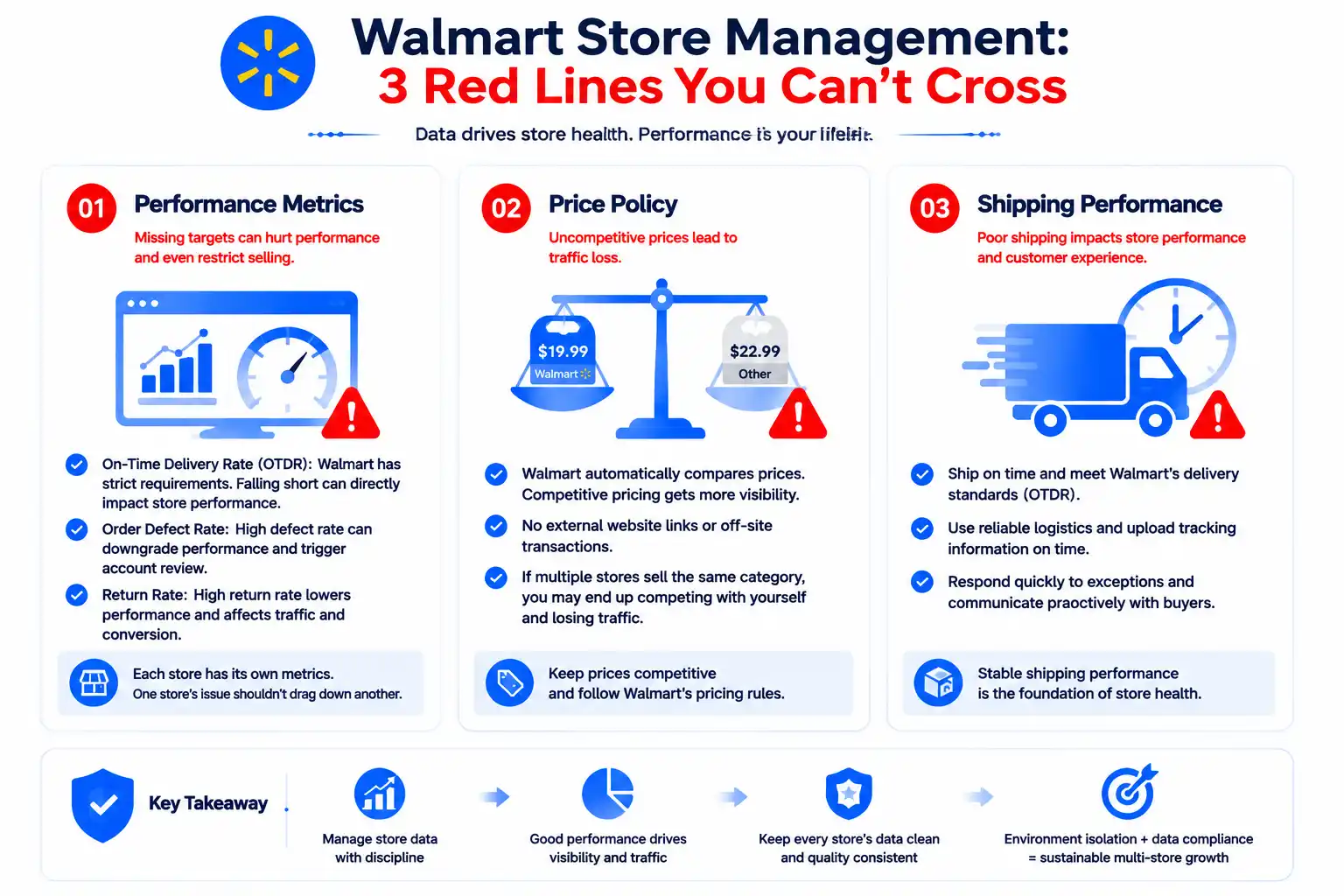
After stores open, the biggest difference from Amazon is the rigidity of performance metrics — Walmart's store health is measured directly by data, and several hard metrics need close watching:
- On-Time Delivery Rate (OTDR): Walmart is strict about shipping timeliness; failing OTDR directly hurts store performance and can even restrict sales. Multi-stores must each watch their own metrics — don't let "one store's problem drag down another".
- Order defect rate and return rate: order defects and high returns downgrade store performance, and can trigger account review in severe cases. Multi-store performance is independent, but operation quality must hold one standard.
- Price-matching policy: Walmart price-matches automatically; prices without competitiveness visibly cut traffic — if multi-stores overlap in categories, price matching becomes "fighting yourself".
All three red lines share one logic: Walmart manages stores by data, and performance is the lifeline. In multi-store operations, every store's data must be clean — like environment isolation, it's a "full-chain" matter; missing one link drags the whole.
Managing Walmart Multi-Store Environments with MasBrowser
Walmart's multi-store environment management follows the same one-store-one-environment-one-IP architecture as Amazon, with two Walmart-scenario notes. Taking MasBrowser as an example:
- Environment naming = store-category-site: name environments "WM-category-site" (e.g.
wm-home-us,wm-elect-us), so the environment list shows at a glance what category each store runs, displayed in a separate zone from Amazon stores (amz-xxx) — dual-platform stays unmixed.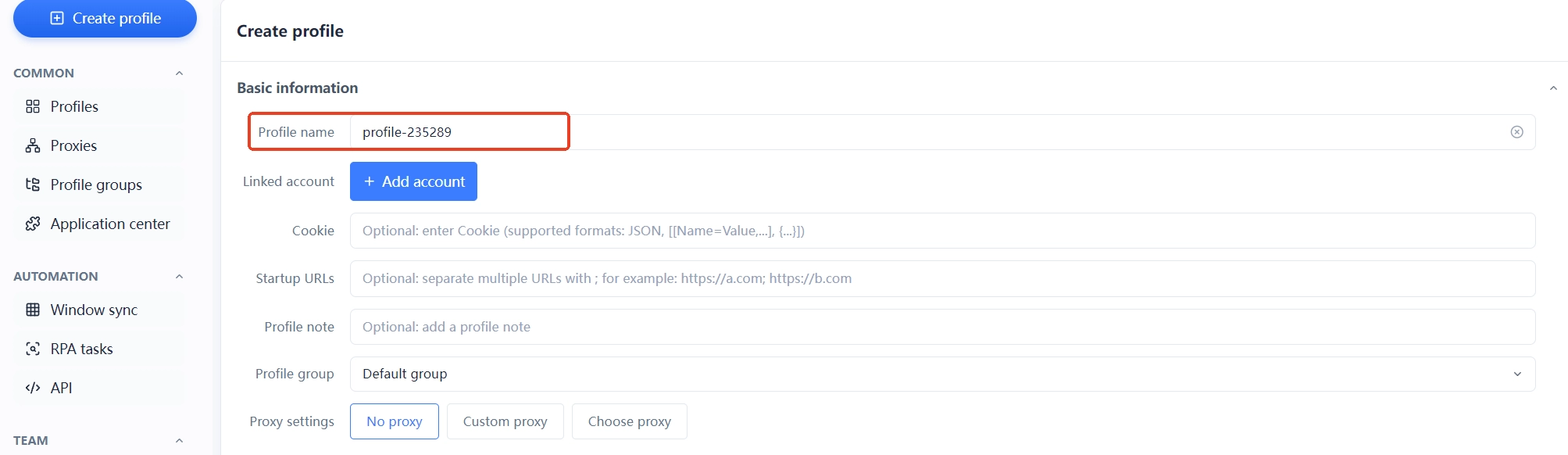
- One store, one environment, one proxy: every Walmart store gets an independent environment and independent proxy (US stores bind US IPs), stores invisible to each other — device and network association is cut at the tool level.
- Separate login states and performance data: each store's Seller Center login state is kept in its own environment, no need to re-login when restarting the environment; performance metrics and order data are checked per store, without interference (team collaboration and sharing usage is documented on the environment management page).
- Dual-platform environment zones: for those running an "Amazon + Walmart" dual-platform matrix, the two platforms' store environments are named and managed separately — when troubleshooting association, the platform dimension is checked separately too.
The moat of Walmart multi-stores is doing document isolation + category isolation + environment isolation right at the same time. The free plan already includes 2 environment slots — build the first Walmart store environment, get the flow working, then replicate step by step.
FAQ
Can Walmart stores be opened in multiples like Amazon?
Walmart is equally strict on multi-stores: multiple stores under the same entity are restricted in principle, and multiple accounts must follow official policy (different company entities, compliant application paths). Before building multi-stores, confirm the compliance of your own documents — don't register repeatedly with the same documents.
How long does Walmart onboarding review usually take?
Depends on document completeness: US company documents are usually faster; Chinese sellers go through the recruiting channel, and the review cycle ranges from weeks to one or two months. During review, don't "apply for multiple stores with one set of documents" — the chance of being flagged is high.
Can Walmart multi-stores use the same payout account?
Not recommended — you could even say "absolutely not". Collecting money for multiple stores in one payout account is among the most damning evidence in Walmart's association judgment. Every store gets an independent payout account — that's the baseline of document isolation.
What does Walmart's price-matching policy mean for multi-stores?
Walmart price-matches automatically; listing the same product across multiple stores makes them compete for traffic with each other and easily gets judged "one seller's stores". Dividing multi-stores by category with non-overlapping SKUs is the basic way to avoid price-matching association.
What happens if a Walmart store's performance fails?
Performance metrics (OTDR, order defect rate, return rate) are hard metrics of Walmart store health; failing them means traffic decline at best, sales restrictions or account review at worst. Multi-stores each watch their own metrics — don't let one store drag down the whole.
How do Walmart multi-stores self-check whether environments are associated?
A three-step self-check: step one, environment dimension — run a fingerprint check / browser fingerprint test for each store to see whether every "machine's" UA, Canvas, WebGL, timezone and IP are fully independent; step two, account dimension — check my browser fingerprint to confirm each store sits behind an independent browser profile; step three, business dimension — confirm company entity, tax ID, payout and category are all isolated as described above. All three pass, and association risk is basically under control. Third-party tools include Whoer, BrowserScan, ip-api, etc. (see the fingerprint detection tools roundup article for usage).
Conclusion
Walmart multi-stores are a solid opportunity in US e-commerce, but the threshold determines that document, category and environment isolation must be right from day one: separate company entities, non-overlapping categories, one store one environment one IP — get all three right and multi-stores are a growth engine, not a risk source.
One reminder too: Walmart's performance and price-matching policies are famously rigid — watch store data daily, don't wait until demotion to fix things. Keep document isolation, category isolation and environment isolation right consistently, and stores stay stable. Start from the first Walmart store: prepare independent company documents and payout account first, then give it an independent environment — the free plan's 2 environment slots are enough to start, download MasBrowser and build the first environment.