How to Do Web Scraping and Data Collection? Practical Ways to Bypass Anti-Bot with a Fingerprint Browser
Anyone doing data collection has probably hit this wall: the script is written, the proxies are bought, but running it hits obstacles everywhere — the same IP gets banned after dozens of requests, switching proxies still gets banned; pages open but data is empty, because the site detected "this isn't a real person browsing"; and the most frustrating part, the collection task ran for three days, and on day three you find out the first two days of data are all dirty.
Scraping itself isn't hard; the hard part is bypassing anti-bot. This article won't teach you how to write code — it covers the layer many collectors overlook: how fingerprint browsers work with scrapers to solve the environment problems in anti-bot blocking — plus the compliance boundaries of what data can be collected and what can't.
Why Do Scraping and Data Collection Keep Failing Against Anti-Bot?
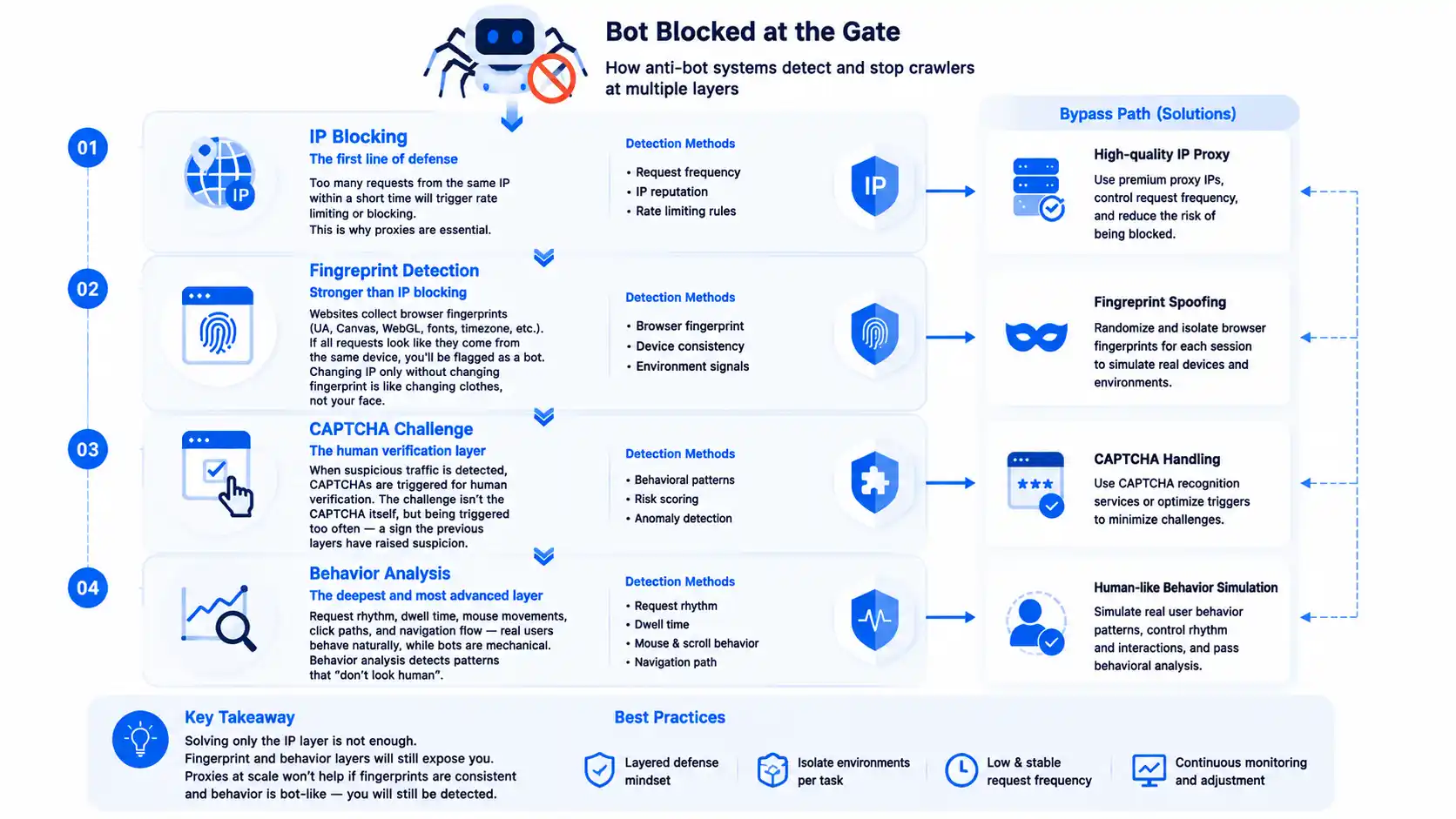
First understand how anti-bot works, otherwise you'll keep "banned, switch, banned, switch". Based on the author team's review of mainstream anti-bot solutions (Cloudflare, Akamai and major platforms' in-house risk control), website anti-bot usually has four layers, from shallow to deep:
- IP blocking: the most basic layer. Too many requests from the same IP in a short window — directly rate-limited or banned — that's why scrapers use proxies.
- Fingerprint detection: a harsher layer than IP. The site reads browser fingerprints (UA, Canvas, WebGL, fonts, timezone etc.) and, finding "all requests come from the same device", judges it as a machine. Only changing the IP without changing the fingerprint is like changing your coat but not your face — same fingerprint, still recognized.
- CAPTCHA: pops up when suspicious traffic is detected for human confirmation. The CAPTCHA itself isn't scary; frequent triggers are — it means the first two layers already raised suspicion.
- Behavior analysis: the most hidden layer. Request frequency, dwell time, mouse trajectory, browsing paths — real humans browse with natural rhythm, script requests are mechanical, and behavior analysis targets exactly this "not-human" pattern.
Understanding these four layers explains why traditional setups fail: proxies only solve the IP layer; the fingerprint layer and behavior layer are fully exposed. No matter how big the proxy pool, with identical fingerprints and mechanical behavior, you'll still be recognized.
How Does a Fingerprint Browser Bypass Anti-Bot? Three Core Tricks
A fingerprint browser solves the "environment problem" in anti-bot — making every collection request look like it comes from a real, independent device. Three tricks match three layers:
- Independent fingerprint environment: each collection task uses an independent environment with different UA, Canvas, WebGL, timezone parameters — the fingerprint detection layer is bypassed directly (the principle of environment isolation is detailed in What Is a Fingerprint Browser).
- Proxy rotation coordination: environments bind proxies, one environment one IP, switch to the next group when a task finishes — the IP blocking layer is handled by the proxy pool (how to choose residential vs datacenter IPs, see Residential IP vs Datacenter IP; in short: strict target-site risk control calls for residential IPs).
- Session consistency: the same environment keeps the same fingerprint and IP for continuous collection without frequent changes — the behavior analysis layer is handled with "stable + low frequency" to reduce suspicion.
Key insight: a fingerprint browser isn't meant to replace scraping frameworks (Scrapy, Playwright etc.), but to work with them — the scraper handles "fetching logic", the fingerprint browser provides the "human-like environment". The most common usage is treating the fingerprint browser as a stable browser environment, running the scraping framework inside it, sending every request from an independent environment — anti-bot sees "different real computers" accessing normally.
How to Set Up Data Collection Environments? Four Common Scenarios
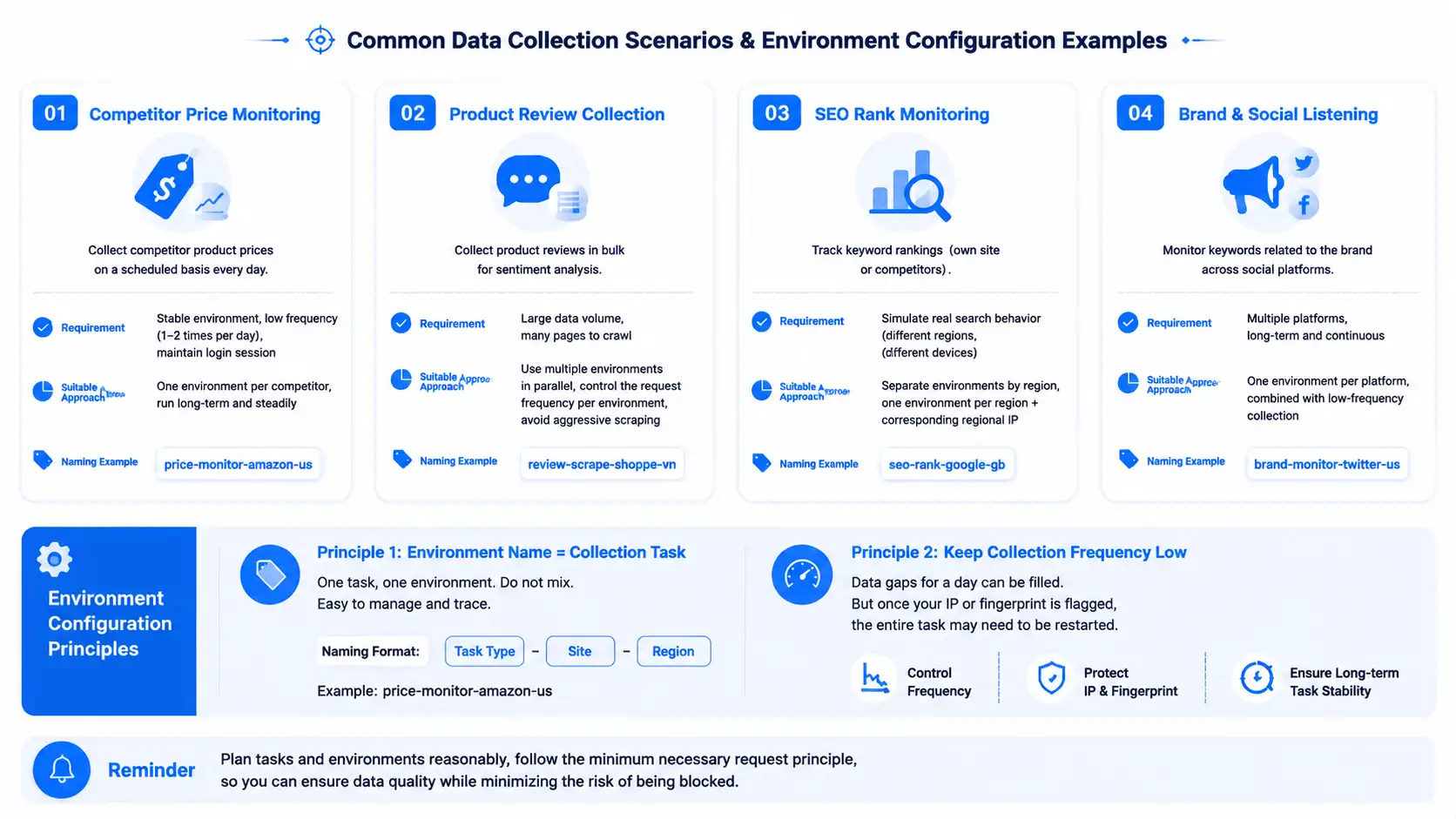
Theory done; look at real scenarios. The four collection scenarios below are the most common for cross-border e-commerce and marketing teams, each with different environment requirements:
- Competitor price monitoring: daily scheduled collection of competitor product prices. Requirements: stable environment, low frequency (1-2 times daily), persistent login — best with one environment per competitor, running long-term.
- Product review collection: bulk collection of reviews for reputation analysis. Requirements: large data volume, lots of pagination — best with parallel multi-environments, controlling per-environment request frequency; don't hammer from one environment.
- SEO ranking monitoring: checking keyword rankings for yourself/competitors. Requirements: simulate real search behavior (different regions, different devices) — best with one environment per region, each with a matching regional IP.
- Social listening: monitoring brand keywords on social media. Requirements: multiple platforms, long-term continuity — best with one environment per platform plus low-frequency collection.
Whatever the scenario, two configuration principles are universal: environment naming = collection task (e.g. price-monitor-amazon-us, review-scrape-shoppe-vn), one task one environment, never mix; frequency lower is better than higher — a day of missing data can be refilled, but once the IP and fingerprint are flagged, the whole task restarts (detailed proxy setup is in Fingerprint Browser Proxy Setup Guide).
Compliance Boundaries of Collection: What to Collect and What Not to
With the technical problem solved, compliance must be clarified — this is where many collectors get into trouble, not just with bans but legal risk. Three bottom-line rules to remember:
- Only collect publicly visible data: content behind login and paywalls is "non-public data"; collecting it carries clear legal risk — don't touch it.
- Respect the platform's robots protocol and terms of service: if the site explicitly forbids crawling (disallow in robots.txt), or the ToS clearly states "automated access prohibited", check before collecting. Many platform bans happen precisely because collection violated the ToS.
- Don't touch personal information and privacy data: users' phone numbers, emails, addresses, behavior traces — collecting and using personal data is strictly regulated (GDPR, personal information protection laws etc.); even if technically collectable, don't touch it.
Compliant collection isn't a "restriction" — it's actually the premise of sustainable collection: public data, rule-following, restrained frequency — only then can collection tasks run stably long-term.
Manage Collection Tasks with MasBrowser, Turn Data into Assets
When collection tasks multiply, the biggest headache isn't writing scripts, it's managing environments: a dozen collection tasks, dozens of environments, each with proxies from different regions — pure memory can't hold it. Take MasBrowser as an example, here's how collection tasks are managed:
- Environment naming = task code: name environments by "task-site-region" (e.g.
price-amazon-us,rank-google-de), and the environment management list shows at a glance what each environment is collecting — collection tasks are managed like accounts; environments stop being just browsers, they're the running unit of each collection task.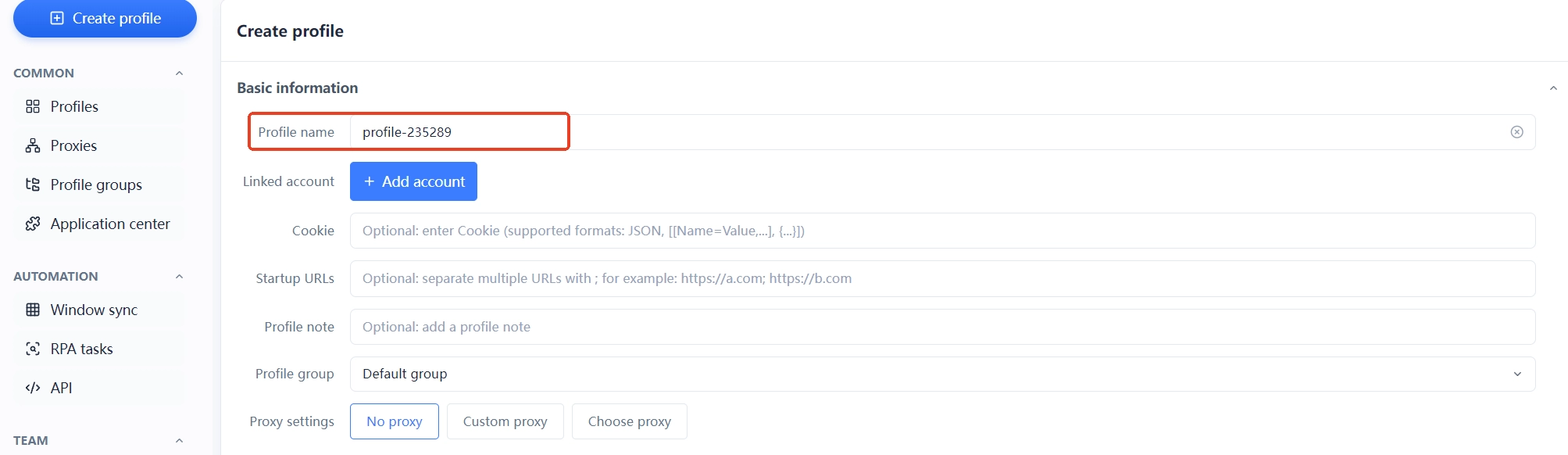
- Independent environment + proxy binding: each collection environment has independent fingerprints and independent proxies; tasks don't contaminate each other — if one task is flagged, others are unaffected, data doesn't cascade-fail.
- Persistent login state: for collection that needs login (like site backend data), the login state is saved in the environment; restarting the environment doesn't require re-login, and collection tasks keep running.
- Centralized multi-market proxy management: collection environments for the US, Europe and Southeast Asia — proxies configured centrally with unified connectivity tests; which IP is down is visible in the list directly, without affecting other tasks' progress.
The essence of collection is turning public data into your decision basis — data saved, environments archived, tasks traceable — every collection run becomes the foundation of the next analysis round. MasBrowser provides independent environment management, treating collection environments as "task units"; the free plan includes 2 environment slots: download MasBrowser, use environment management to set up your first collection task — get one site's monitoring running, then copy it to other tasks.
FAQ
What's the relationship between fingerprint browsers and Scrapy, Playwright?
A complementary relationship: scraping frameworks handle the code logic of fetching, parsing and storing; fingerprint browsers provide the "human-like browser environment". Usually you control the fingerprint browser environment with tools like Playwright, or switch environments for different requests in the collection flow — each handles its part.
How high a collection frequency is safe?
No universal number; the principle is "lower is better": same-IP request intervals of at least a few seconds; per-task daily request volume controlled in the hundreds to low thousands (depending on site strictness); when CAPTCHAs appear, lower the frequency immediately. Missing data can be refilled; a flagged IP means starting over.
Can one environment collect from multiple websites?
Not recommended. One environment per collection task is safer: different sites have different anti-bot strategies, and mixing environments can get one task flagged and implicate others; with independent environments, tasks don't affect each other.
What do I do when anti-bot bans my IP?
First lower the frequency (most likely a frequency problem), then switch IPs (possibly this IP is flagged), and if that fails, switch the fingerprint environment and retry. Order matters: check frequency first, then IP, then fingerprint — most bans are frequency-triggered, not fingerprint problems.
Must I use residential proxies for e-commerce data collection?
Depends on the target site's risk-control strictness: for lenient sites, datacenter IPs are sufficient and cheap; for strict ones (mainstream e-commerce, social media), residential IPs have far higher survival rates. With a limited budget, mix: low-frequency monitoring tasks use residential IPs; batch tasks trial with datacenter IPs.
Conclusion
There's no silver bullet for scraping, but the thinking is clear: the IP layer is handled by proxies, the fingerprint layer by environments, the behavior layer by frequency — when all three are right, anti-bot has no reason to block you; conversely, stacking proxies without fixing fingerprints and behavior just makes a ban a matter of time.
Compliance is the bottom line, stability is the premise: collect only public data, respect platform rules, keep frequency restrained — only then do collection tasks run long-term. Start with your first collection task: give it an independent environment, a matching regional proxy, and a restrained frequency — get one running, then copy to the next. The data is yours; environment management tools help you turn it into an asset.