How to Run a YouTube Multi-Channel Matrix? Environment Isolation for Creators
Creators running multiple YouTube channels have probably experienced this "cascade ban": you build up your main channel, plan to open two more niche channels to grow, then one channel gets a copyright strike and another channel's monetization gets restricted — because several channels share the same Google account, one move shakes everything. Worse, when there are many channels, remembering which account maps to which channel and which monetization account is bound takes more than memory.
YouTube's biggest difference from other social platforms is that it's part of the Google ecosystem: channels hang under Google accounts, and the association logic between accounts, devices and monetization accounts is completely different from other platforms. This article is about environment isolation for YouTube multi-channel matrices — how the Google account system affects association, how to lay out the matrix, and which red lines get channels terminated the moment they're touched.
Why Do YouTube Multi-Channels Get "Cascading Bans"? The Google Account System Is the Core
First understand YouTube's unique association behavior. Other platforms judge association by device fingerprints and IPs; YouTube adds a layer of Google account system association on top of those — this is the easiest pit to step into when building a multi-channel matrix:
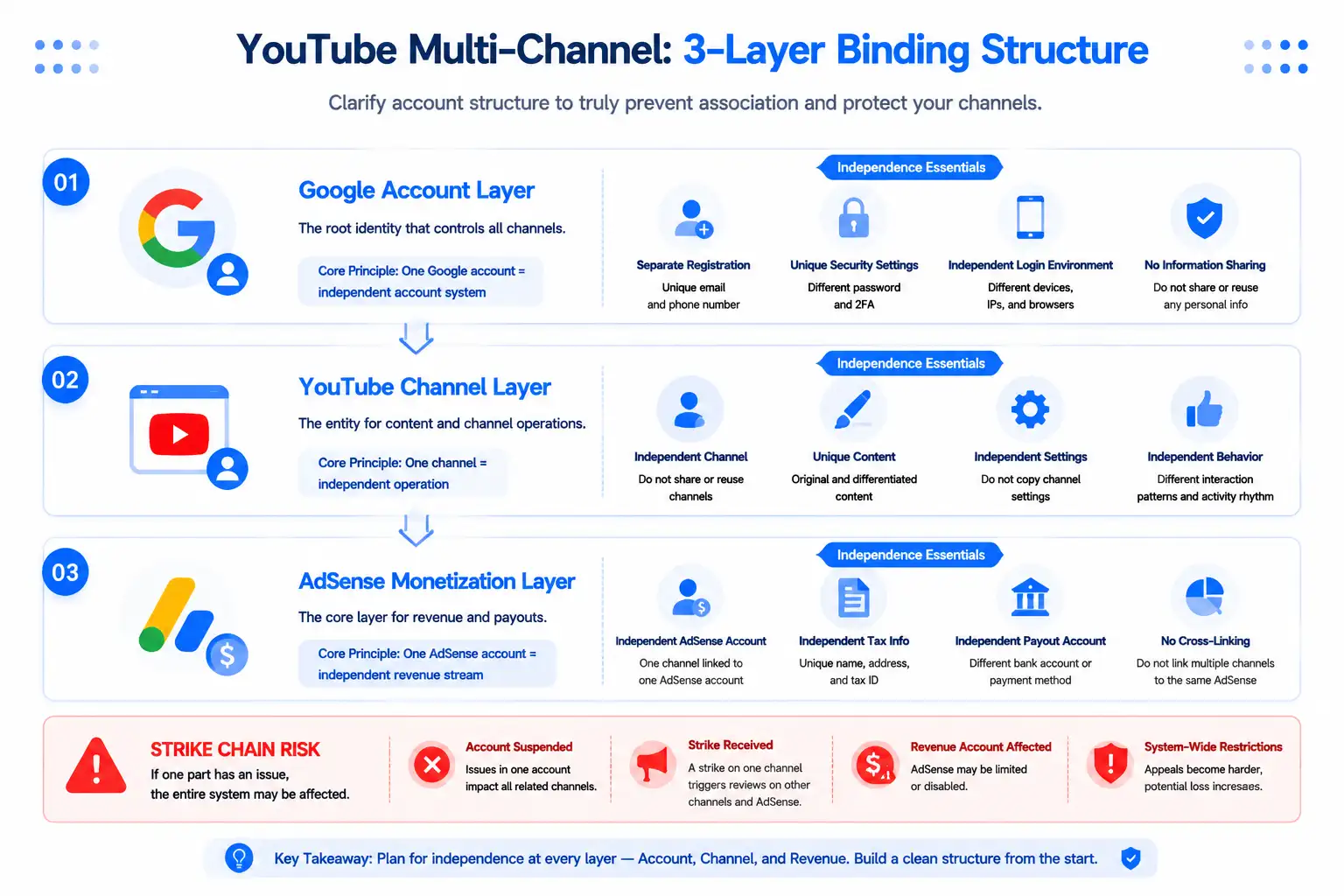
- One Google account can open multiple channels: YouTube allows multiple channels (brand accounts) under one Google account — this is an official feature. But "multiple channels under one account" means all account-level info (login device, phone number, 2FA) is shared — if one channel goes down, every channel under the same account is affected.
- Monetization accounts are official-level association: multiple channels bound to the same AdSense monetization account is clearly visible to Google — this is more damning than IP or fingerprints, and Google's policy means multiple channels under one monetization account carry joint risk.
- Copyright strikes cascade: YouTube's strike system is "three strikes and your channel is terminated"; once a channel is flagged, other channels under the same account and same monetization account get extra scrutiny — matrix channels reusing the same material triggers this most easily.
So the first step of YouTube multi-channel anti-association is not the environment, it's sorting out the account structure first: every channel gets an independent Google account and independent monetization account planning. Get this wrong and perfect environments are useless — this is similar to IG's logic of breaking Meta account bindings first, but YouTube's "account-channel-monetization" is a three-layer binding, more complex than IG.
How to Lay Out the YouTube Multi-Channel Matrix: Niche Division + Monetization Planning
After sorting out the account structure, look at the matrix itself. YouTube matrix layout follows the same position-differentiation logic as TikTok (see the TikTok matrix operation article for layout principles), but YouTube has three signature planning points:
- Divide by niche or language: channel positions must be differentiated — by niche (channel one does tutorials, channel two reviews, channel three vlogs) or by language (one channel each for Chinese, English, Japanese, Korean), avoiding overlapping content. Don't reuse material across channels either — duplicate content is a hotbed of spam judgments.
- Independent Google accounts vs brand accounts: matrix channels should use one independent Google account per channel, don't hang them all under one account for convenience; when multiple channels are needed (e.g. sub-channels in the same niche), use a "brand account" under an independent Google account so account boundaries stay clear.
- Plan monetization accounts ahead: think through each channel's monetization account (AdSense) in advance — multiple AdSense accounts under one person's name have their own limits; matrix channels either plan the ownership or accept that "monetization accounts are an association point" and make trade-offs early.
The essence of the layout is making every channel look like a channel made by an independent creator: independent account, independent niche, independent monetization — even the monetization logic doesn't entangle.
YouTube Operation Red Lines: Copyright, Duplicate Content and Interaction Frequency
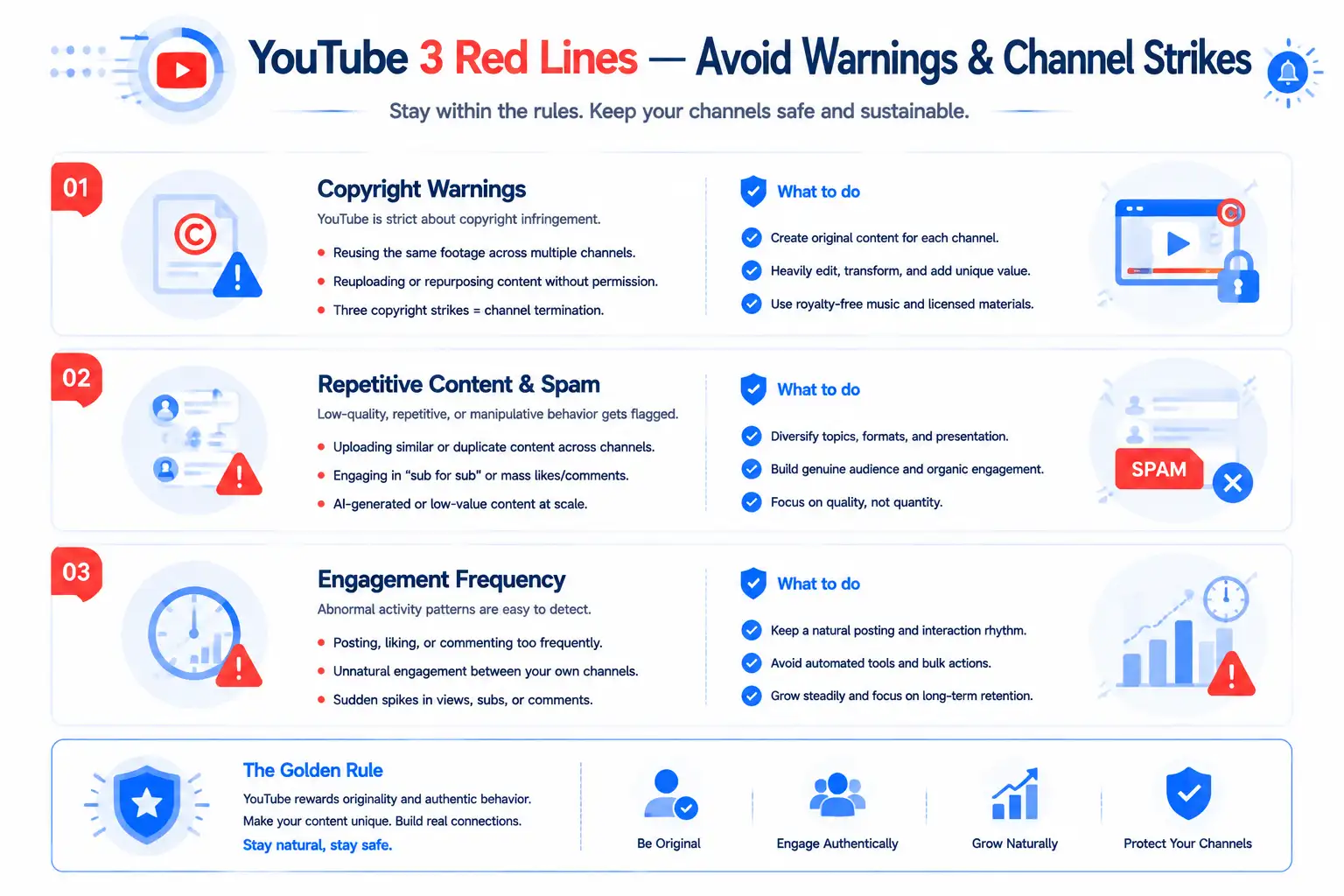
Once the matrix is up, daily operation has three YouTube-specific red lines — cross them and it's a warning or channel termination:
- Copyright and duplicate content: YouTube judges duplicate material strictly — re-uploading or reusing the same footage across channels means demotion at best, a copyright strike at worst (three strikes terminate the channel). Matrix channel material must be originally produced or deeply edited — don't "post one source video to three channels".
- Subscription and interaction judgment: YouTube recognizes "sub 4 sub" and batch likes/comments — subscribing to or commenting on the same channels in large volumes in a short time is judged spam. Interaction between matrix channels must be natural — don't let "channel one posts a video, channels two and three show up on time to comment".
- Phone number verification: enabling some features (livestreaming, uploading long videos, etc.) requires phone verification, and one phone number verifying multiple channels is an association signal; verification phone numbers must be as independent as accounts.
All three red lines share one logic: YouTube judges real people by "content originality + behavior naturalness". The more independent the matrix channels' content and the more natural the interaction, the less likely warnings are triggered.
How to Build YouTube Multi-Channel Environments: Independent Google Accounts Come First
Environment setup follows the same anti-association principles (the full breakdown of environment isolation is in What Is a Fingerprint Browser), but the YouTube scenario has three points that matter most:
- Independent Google account + independent environment: every channel gets its own Google account, its own browser environment and its own proxy — account, device and network are all separate at three layers, leaving Google's association judgment nowhere to bite.
- Independent 2FA and device trust: enable two-step verification independently on every Google account, don't use the same phone number to receive verification codes; prompts like "confirm it's you on this new device" mean Google thinks the login environment changed — give each channel its own verification setup.
- Don't mix devices across platforms either: if you run YouTube plus other social media matrices, keep YouTube environments and Meta-system or X environments in separate sets that never cross — the same device logging into Google accounts of multiple channels is the most basic association signal (for nurturing rhythms on other platforms, see the Facebook account nurturing anti-ban article).
In one sentence: the focus of YouTube environments is "account-environment-monetization" three-layer independence — independent Google accounts, independent login environments and clear monetization planning, and the association signals are cut clean.
Managing the YouTube Matrix Environment with MasBrowser
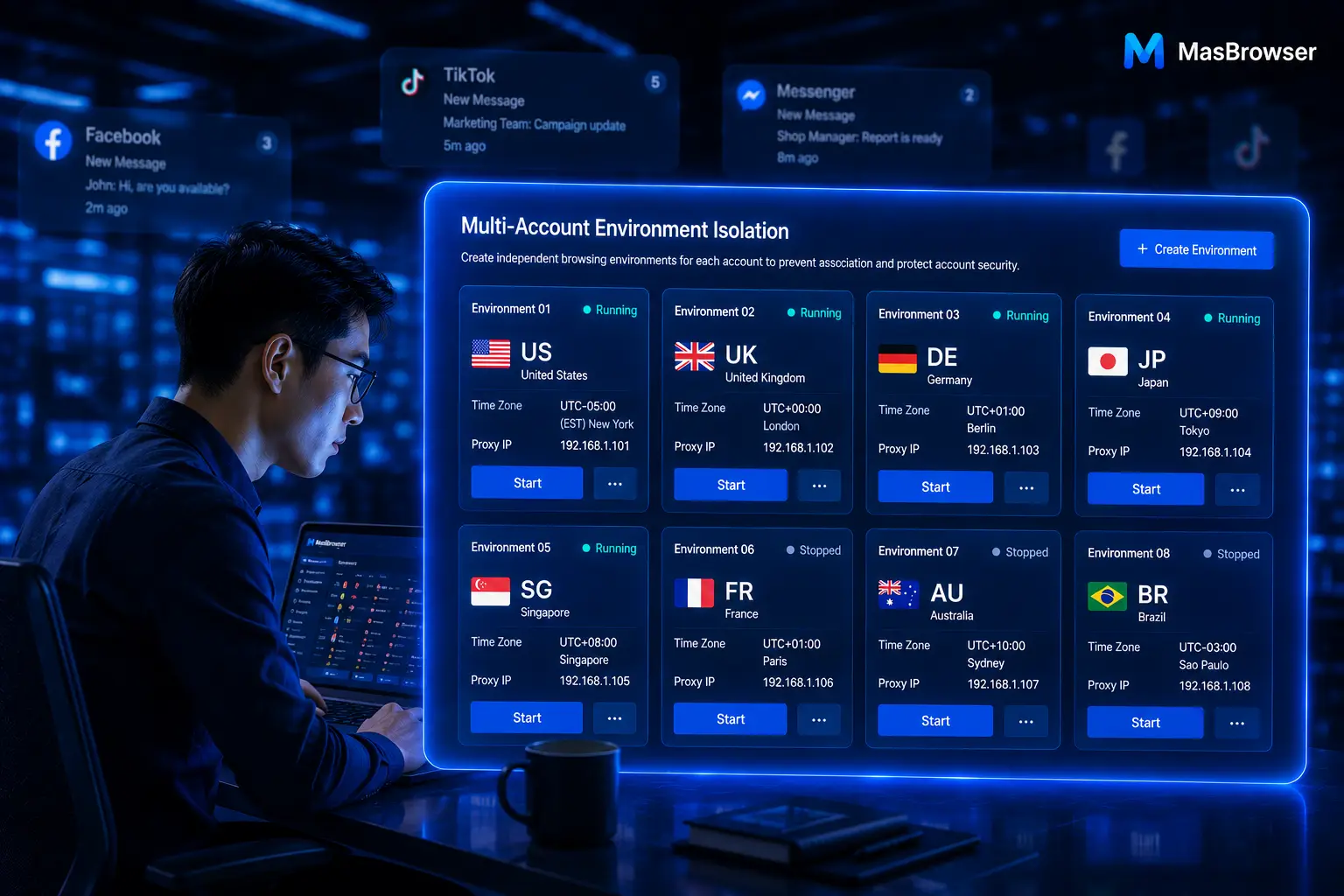
With many channels, the biggest mess is "which environment goes with which Google account and which monetization account" — mix these up and self-auditing association becomes a disaster. Taking MasBrowser as an example, here's how I manage a YouTube matrix:
- Environment naming = niche-language-number: name environments "YT-niche-language" (e.g.
yt-tutorial-zh-01,yt-review-en-02), so the environment list shows at a glance which channel produces what content in what language.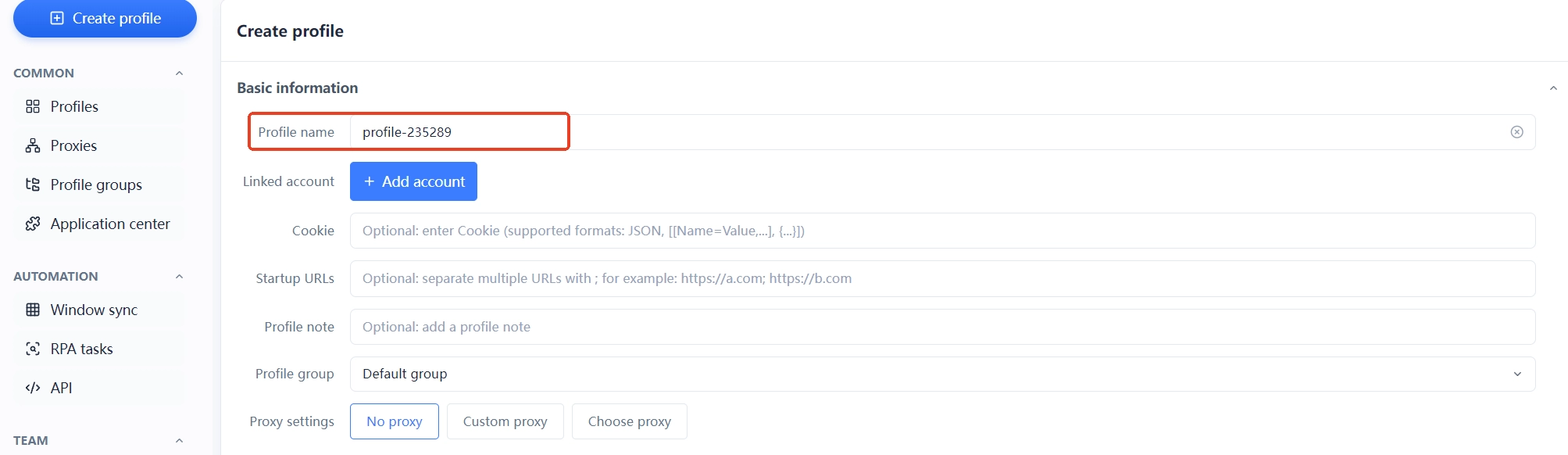
- One environment, one Google account, one proxy: every channel gets an independent environment and independent proxy (proxy region matches the target audience market), Google accounts never cross — accounts and devices are separated at the tool level.
- Note monetization and verification in remarks: record "which AdSense account this channel is bound to, which verification phone number" in environment remarks; check this table first when self-auditing association (team collaboration and sharing usage is documented on the environment management page).
- Separate environments by platform: when running YouTube plus social media matrices, name and manage environments per platform separately, avoiding "mixed use in one environment" at the tool level.
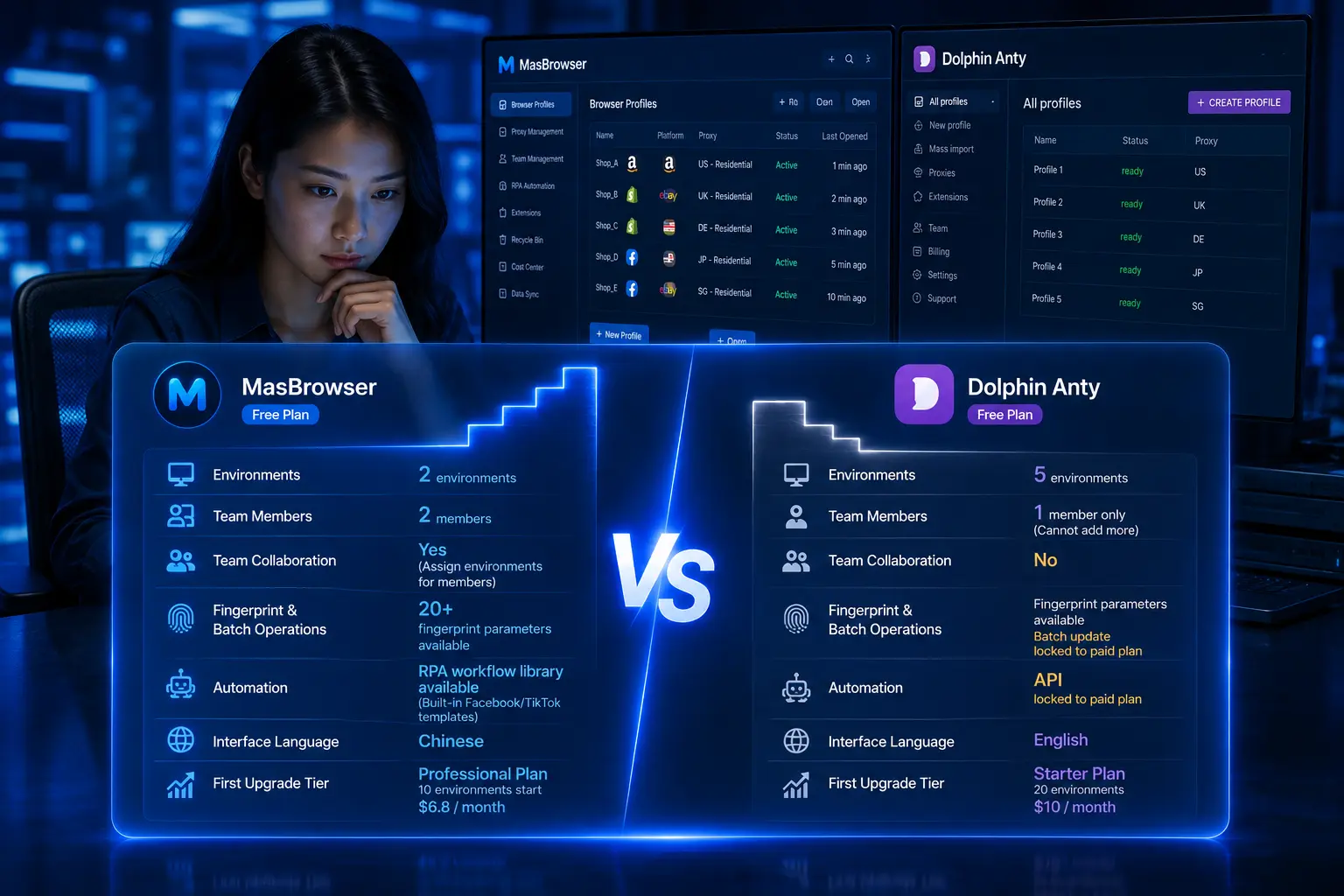
The moat of a YouTube matrix is doing account independence + environment independence + content independence right at the same time. The free plan already includes 2 environment slots — build the first channel's independent Google account environment, get the flow working, then replicate step by step.
FAQ
Can one Google account open multiple YouTube channels? Why is separate recommended?
Yes, YouTube allows multiple channels (brand accounts) under one account, but it's not recommended for matrices: channels under the same account share login info, and if one channel has a problem (copyright strike, account restriction), all others are affected. Matrix channels should each use their own independent Google account.
How many copyright strikes terminate a YouTube channel?
The strike system is "three strikes and termination": one strike restricts some features, three accumulated strikes terminate the channel. Strikes cascade to other channels under the same account and monetization account, so matrix channel material must be original — don't reuse across channels.
Can multiple channels bind the same AdSense monetization account?
Technically yes, but this is official-level association, and if one channel is terminated it affects other channels under the monetization account. Plan the ownership of matrix monetization accounts in advance, accept that "monetization accounts are an association point" and make trade-offs early.
Do YouTube channels need phone verification? Can they share one?
Some features (livestreaming, uploading long videos, etc.) require phone verification, and one phone number verifying multiple channels is an association signal. Verification phone numbers must be as independent as accounts — don't share one.
Can matrix channels comment and like each other?
Yes, but keep it natural: don't do "channel one posts a video, other channels show up on time to comment" type regular interaction, and don't mass-subscribe back and forth (sub 4 sub) in a short time. YouTube has spam judgments for batch interaction; keep channel-to-channel interaction at the level of real users.
Conclusion
The biggest difference in YouTube multi-channel matrices is the Google ecosystem: account, channel and monetization are bound in three layers — one move shakes everything. Sort out the account structure first (independent Google account per channel), then isolate environments, finally manage copyright, duplicate content and interaction rhythm — get all three right and the matrix can run long-term.
One reminder too: YouTube is famously strict on copyright and spam, and matrix channel content independence directly decides survival — the time saved by reusing material always comes back as channel terminations. Keep account independence, environment independence and content independence right consistently, and the matrix stays stable. Start from the first channel: register an independent Google account, then give it an independent environment — the free plan's 2 environment slots are enough to start, download MasBrowser and build the first environment.